

Mobile App for Medspas: Keep Patients Coming Back Between Treatments
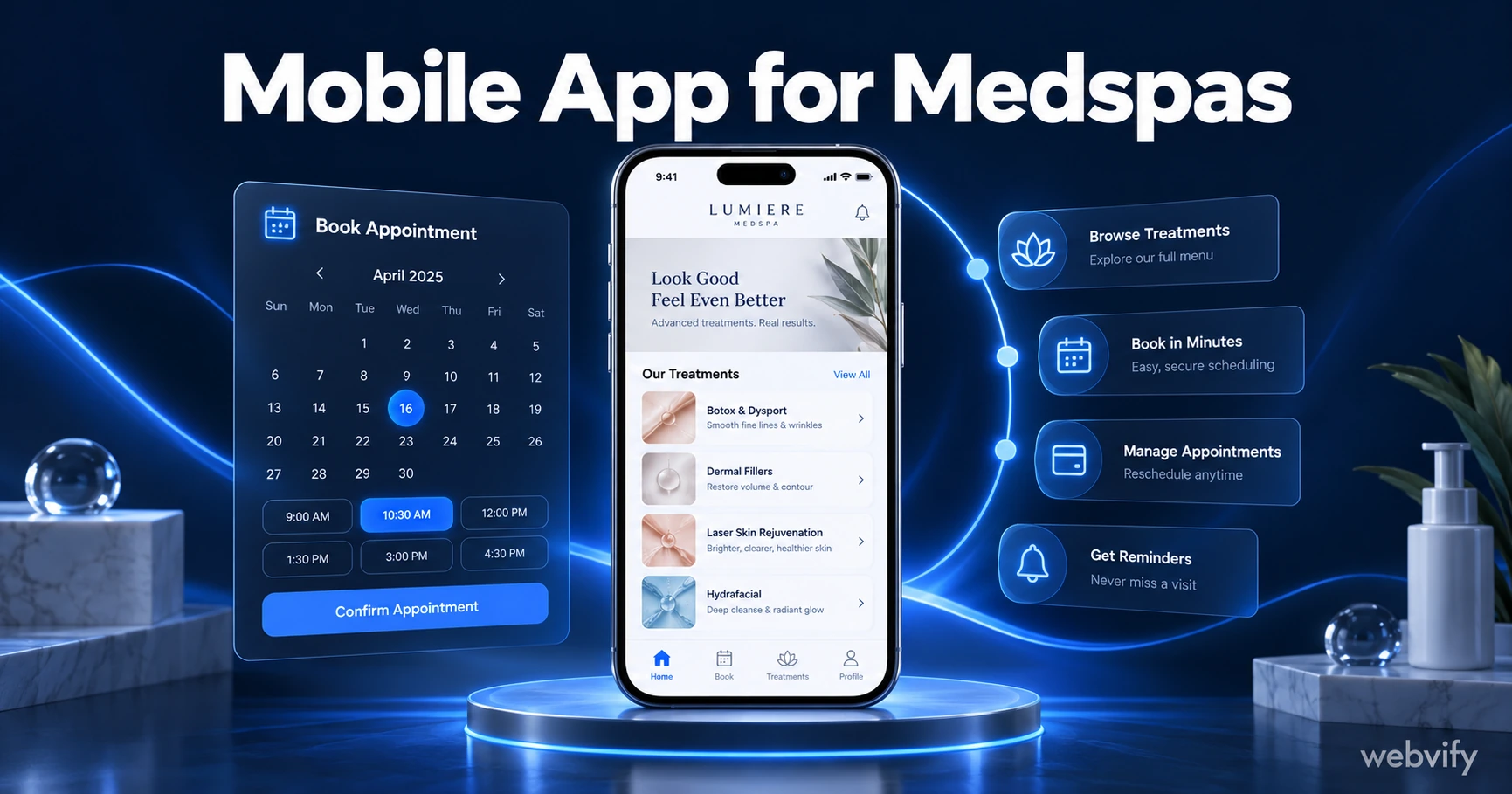
A mobile app for medspas keeps patients on their treatment schedule with push notifications. Here's what it costs and how to get one without a developer.
Inside this article
Botox wears off in 90 days. Dermal fillers last 6 to 12 months. Laser hair removal needs 6 to 8 sessions. Yet the average medspa loses 40–60% of first-time patients before they complete a treatment plan — not because the results were bad, but because nothing followed up.
A mobile app for your medspa fixes this at the root. When patients download your app, you can reach them directly on their lock screen with push notifications — at 60–90% open rates versus 22–28% for email. This guide covers the three campaigns that drive the most rebookings, what to look for when choosing an app, and how to get one live without hiring a developer.
Why Medspa Patients Disappear (And What Actually Stops It)
Medical aesthetics is a high-satisfaction, low-repurchase business by default. Patients leave happy after every treatment, but the 90-day gap before their next Botox appointment is a long time. Life gets busy. They forget to rebook. When they finally decide to top up, they Google "medspa near me" — and book with whoever appears first.
You did the hard work of acquiring the patient. You delivered results. But you lost them to silence.
The home screen solves this. When a patient installs your app, your medspa icon sits on their phone between their banking app and their grocery app — a passive brand reminder every time they pick up their device. And when you send a push notification, it arrives on their lock screen, not in an inbox.
The Three Push Notification Campaigns Every Medspa Needs
1. The 90-Day Botox Renewal Reminder
Send this on Day 75 — before the product fully wears off, while the patient is still happy with their results. Catching them at the right moment means you're competing with their intention, not fighting inertia.
"Time for your next Botox appointment? Book now before your slot fills up."
This single campaign recovers more patients than any loyalty discount, because it reaches them precisely when they're naturally thinking about rebooking.
2. The Seasonal Pre-Event Campaign
The two biggest medspa booking windows are the six weeks before summer and the six weeks before the holiday season. Most patients don't book proactively — they wait until they notice they need a treatment. A push notification in early April and early November moves them from passive to booked.
"Summer's coming — book your top-up before the rush."
Seasonal campaigns sent via push notification consistently outperform email for these predictable booking windows, because patients are already in the right mindset.
3. The New Treatment Alert
When you add a new service — a new laser technology, a new injectable, a new skin package — your existing patient base is your warmest audience. They've already trusted you with a treatment. A push notification announcing a new service to previous patients converts at significantly higher rates than advertising to cold audiences on social media.
Services like Webvify handle the medspa app build and App Store submission end-to-end, so you can have push notification campaigns running within days, not months.
What a Medspa Mobile App Does Beyond Push Notifications
Push notifications are the primary reason to get an app, but a medspa mobile app delivers additional value:
App Store credibility. Patients choosing between medspas from a Google search see your App Store listing alongside your website and reviews. A 4.8-star app signals permanence and professionalism in a way a basic website cannot.
Reduced no-shows. A push reminder 24 hours before an appointment, followed by one 2 hours before, measurably reduces no-shows — especially for longer laser sessions or combination treatment days booked weeks in advance.
Appointment-style communication for ongoing treatment plans. Patients undergoing a 6-session laser package need to stay on schedule for results. Push reminders keep them on track without requiring your front desk to make manual calls.
If you're running a beauty business alongside your medspa, the same retention approach works across the full service spectrum — from salon appointments to esthetician bookings. The rebooking gap mechanic is identical.
How to Get a Mobile App for Your Medspa
The technical barrier to getting an app on the App Store and Google Play used to be real. It required iOS and Android developers and six to nine months of build time. That's no longer the case for medspas that already have a website or web-based booking system.
A WebView app converts your existing website into a native mobile app. When patients open the app, they see your site — your booking system, your treatment menu, your before-and-after gallery — wrapped in a native app shell that lives on the App Store and Google Play.
What you get:
- Push notification capability — the core patient retention tool
- App Store and Google Play listing under your medspa's own brand
- Native app icon on patients' home screens
- No need to rebuild your booking system or website
Look for a service that handles App Store submission end-to-end. The submission process — setting up Apple Developer and Google Play accounts, preparing screenshots, writing App Store copy, navigating Apple's review requirements — takes most business owners two to three weeks the first time. A managed service does this for you.
What to Look For in a Medspa Mobile App
When comparing app options, prioritize these four things:
Push notifications with no coding required. You need to send a campaign from a dashboard, not by calling a developer. Test this before committing.
App Store submission handled for you. The review process includes privacy policy requirements and data safety declarations. Navigating this alone is time-consuming; a managed service removes the bottleneck.
Works with your existing booking software. Whether you use Jane, Mindbody, Timely, or a custom website, the app wraps what you already have. You shouldn't need to migrate your system.
Listed under your brand. Your app should appear as "[Your Medspa Name]" on the App Store, not inside a platform's shared app. Patients need to find it by searching for your business.
FAQ
How much does a mobile app for a medspa cost?
A WebView app through a managed service typically costs between $1,500 and $3,500 for setup, with a monthly retainer covering updates and App Store maintenance. This compares to $50,000–$150,000 for a custom native app with six to twelve months of development time.
Will my booking system work inside the app?
If your booking system has a web interface — Jane, Mindbody, Timely, or a custom website — it works inside a WebView app. The app loads your site in a native wrapper, and patients log in and book as they normally would.
Do I need both an iOS app and an Android app?
Yes, most medspas should launch on both platforms. Apple accounts for roughly 55–57% of US smartphone users; Android covers the rest. Most app services submit to both simultaneously at no extra cost.
Your medspa gets patients in the door. A mobile app keeps them coming back.