

Mobile App for Estheticians: Keep Clients Booked and Coming Back
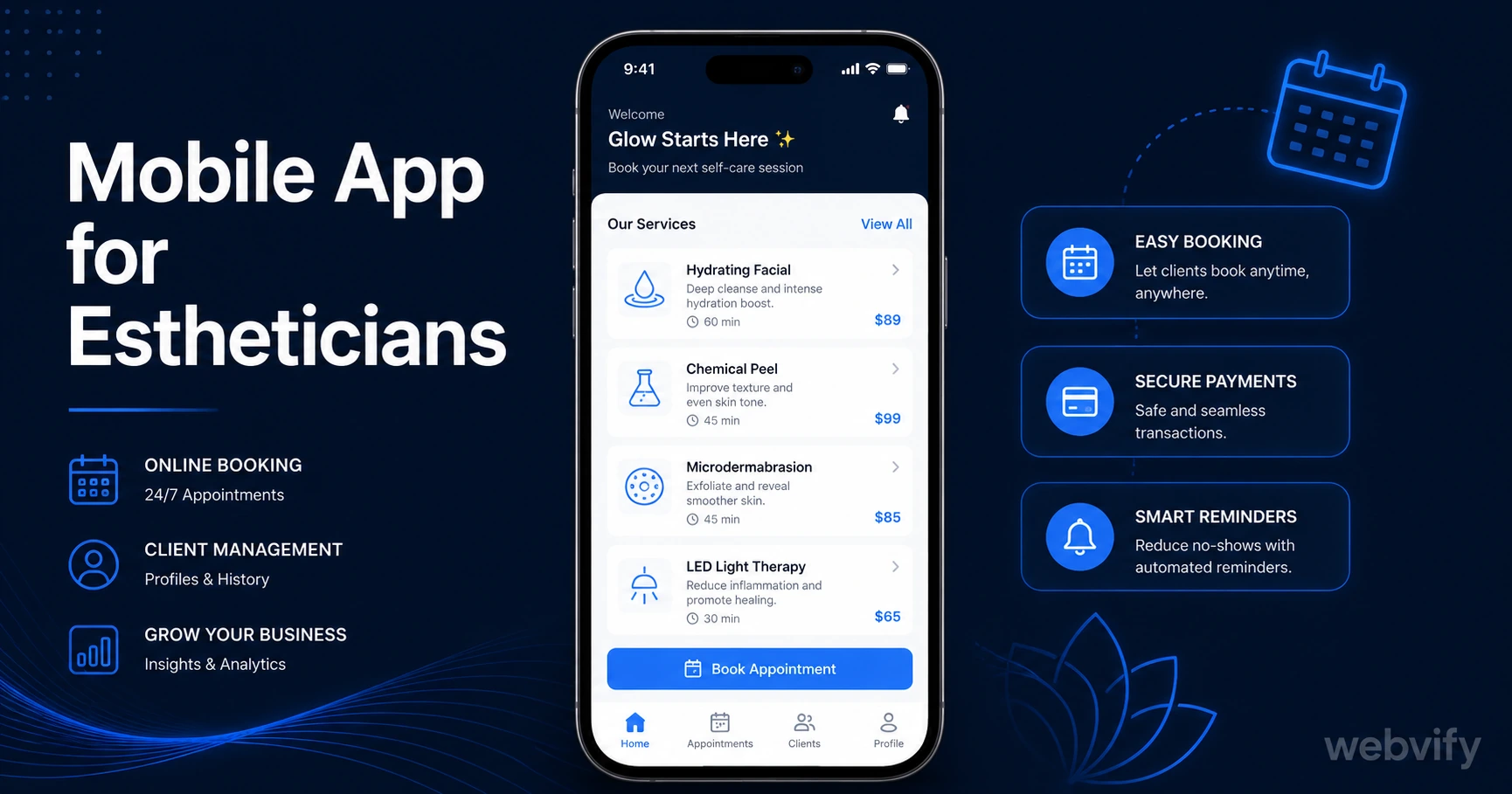
Esthetician clients book once, then disappear for months. A mobile app with push notifications keeps them coming back. Here's how it works and what it costs.
Inside this article
- Mobile App for Estheticians: Keep Clients Booked and Coming Back
- Why Estheticians Lose Repeat Clients (And What the Data Says)
- What a Mobile App for Estheticians Actually Does
- Three Push Notification Campaigns That Fill Your Books
- Getting Your Esthetics App on the App Store
- What It Costs Compared to What You Lose
- FAQ
Mobile App for Estheticians: Keep Clients Booked and Coming Back
Esthetician clients leave every facial glowing — and then go quiet for four to six months. Not because the service was bad. Because nothing reminded them to come back before someone else did.
A mobile app changes that dynamic. With your brand on their home screen and push notifications going directly to their lock screen, you stop relying on clients to remember you unprompted.
Why Estheticians Lose Repeat Clients (And What the Data Says)
The average esthetician client should book every four to six weeks for ongoing skin health. In practice, the gap stretches to three to five months — sometimes longer. The reason is simple: out of sight, out of mind.
Email open rates in the beauty industry average 20–25%. Push notifications sent through a mobile app reach 60–90% open rates. That's the gap between "hoping clients remember" and "actually keeping them on your books."
Booking platforms like Vagaro, Square, or Fresha send appointment confirmations — but they aren't sending personalized rebooking nudges 30 days after the last visit. That job falls to you. A mobile app makes it automated.
What a Mobile App for Estheticians Actually Does
A mobile app for your esthetics practice wraps your existing website — your booking page, menu of services, gallery, and contact info — into a native app published on the App Store and Google Play. Clients download it once. It sits on their home screen with your brand.
The core tools you get:
Push notifications. Send messages directly to the lock screen. No algorithm, no spam folder. A "your skin is due for a refresh" message on Day 30 post-appointment gets read. A "book before summer slots fill" seasonal alert gets clicked.
Home screen presence. When a client thinks about their skin or searches for their esthetician's number, your app icon is right there — not buried in a browser tab or an inbox.
App Store credibility. A published app signals legitimacy in a crowded market. When a new client is choosing between two estheticians, the one with a branded app looks more established — even if the service quality is identical.
If you're looking for the full process of getting your booking site packaged as an app, this guide on converting your website to a mobile app covers the steps in detail.
Three Push Notification Campaigns That Fill Your Books
The value of a mobile app for estheticians isn't the app itself — it's what you send after clients download it.
Campaign 1: Day-30 Rebooking Nudge Send this 30 days after a client's last appointment. Keep it simple: "Hey [Name], your skin is about due for its next session — grab a slot before the week fills up." This one campaign alone recovers clients who would otherwise drift for another two months.
Campaign 2: Seasonal Skin Alert Skin needs change with the seasons. A "spring skin reset" or "pre-holiday glow prep" notification in early March, September, and November gives clients a reason to book that feels timely rather than promotional. Seasonal campaigns consistently outperform generic discount offers.
Campaign 3: Dormant Client Reactivation For clients who haven't booked in 90 days: send a short "we miss you" message with a specific offer — a complimentary upgrade on their next facial or a priority booking slot. Done right, this reactivates 20–30% of dormant clients who assumed you were fully booked or had forgotten about them.
Services like Webvify handle the end-to-end process of building and submitting your app — so you're not navigating Xcode or Apple developer portals on your own. You get the push notification tools without the technical setup.
Getting Your Esthetics App on the App Store
The main barrier most estheticians assume is technical: "I'd need a developer." In reality, the process has two parts:
Building the app. Your booking site is already functional on mobile. A WebView app packages it into a native container — same features, App Store compliant. No rebuild needed.
Submitting the app. Apple and Google have review processes. For service businesses with physical bookings (no digital goods sold inside the app), approval is straightforward. The common rejection trigger — Apple's Guideline 3.1.1 on in-app purchases — doesn't apply when all transactions happen through your external booking system.
The full App Store submission process for first-timers is covered in this step-by-step guide.
Apple's review typically takes 24–48 hours. Google Play can be as fast as a few hours for straightforward service apps.
What It Costs Compared to What You Lose
Custom mobile app development runs $30,000–$100,000+. That's not the relevant comparison for an esthetics practice.
The relevant comparison is what you lose from client churn. If the average client spends $120 per visit and books every 4–6 weeks, each client who drifts for an extra three months costs $240–$360 in deferred revenue. Multiply that by 10 drifting clients and you're looking at $2,400–$3,600 in lost revenue — per quarter — from clients who actually liked your work.
A no-code app service that wraps your existing site costs a fraction of that. The push notification campaigns pay for themselves if they recover even two or three clients per month.
FAQ
How much does a mobile app for an esthetician cost?
No-code app services that convert your existing website into an App Store-published app typically range from $500 to $2,500 as a one-time fee, with lower monthly maintenance costs compared to custom development. This covers App Store and Google Play submission, the push notification system, and an admin panel to manage your app. Custom-built apps cost significantly more but aren't necessary for most independent estheticians or small skin care studios.
Do I need a developer to get my esthetics business on the App Store?
No. WebView app services handle the packaging and submission process for you. As long as your existing booking website is mobile-responsive and uses an external payment or booking system (Vagaro, Square, Fresha, Mindbody), the app qualifies for App Store approval without any code changes or developer involvement.
What push notification campaigns work best for estheticians?
The three highest-performing campaigns are: a Day-30 rebooking nudge after each appointment, a seasonal skin alert timed to spring and pre-holiday periods, and a 90-day dormant client reactivation message. These three campaigns, running automatically, consistently outperform email for rebooking rates because push notifications land on the lock screen rather than in an inbox.
Your clients leave happy. The problem is the silence between appointments. A mobile app with the right push campaigns closes that gap — so the next booking happens before the client forgets to book at all.
Ready to get your esthetics business on the App Store? Start with Webvify →