

Mobile App for Martial Arts Studios: Keep Students Training and Coming Back
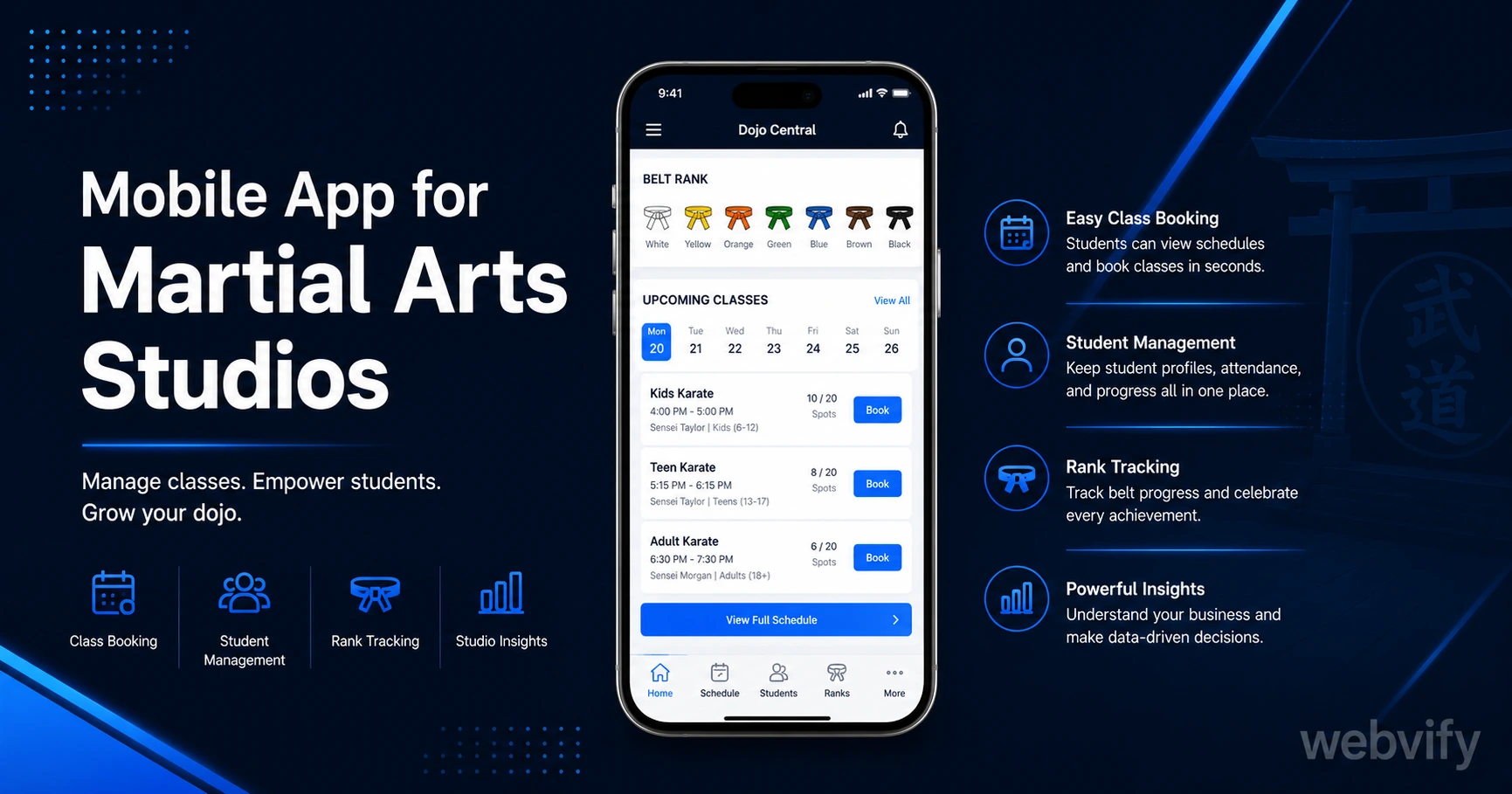
A mobile app helps martial arts studios reduce dropout, fill class slots, and keep students engaged between sessions. Here's what it does and how to get one.
Inside this article
- Mobile App for Martial Arts Studios: Keep Students Training and Coming Back
- Why Martial Arts Studios Need a Dedicated Mobile App
- The Three Biggest Retention Problems a Mobile App Solves
- What Features Matter Most in a Martial Arts Studio App
- How to Get a Mobile App for Your Martial Arts Studio Without a Developer
- FAQ
Mobile App for Martial Arts Studios: Keep Students Training and Coming Back
Martial arts studios lose students not at the door — they lose them in the silence between classes. A student misses one week, then two, and by week three they've mentally quit without ever telling you. A mobile app changes that dynamic entirely.
Why Martial Arts Studios Need a Dedicated Mobile App
A dojo's real competition isn't another school across town. It's the couch, the busy schedule, and the short memory of a student who hasn't felt the community pull in a few weeks.
Email open rates in fitness and wellness hover around 20–25%. Push notifications from a mobile app hit the lock screen directly and average 60–90% open rates. That's the difference between a reminder that gets buried in an inbox and one that actually moves a student back onto the mat.
Beyond retention, a mobile app for your martial arts studio creates something even more valuable: home screen presence. Every time a student picks up their phone, your school's icon is right there — a constant, silent reminder that they're part of something.
The Three Biggest Retention Problems a Mobile App Solves
1. The Attendance Drop-Off
Students who skip two consecutive classes are far more likely to quit than those who miss only one. The problem is timing: most studios don't reach out until it's already too late.
With a mobile app, you can set up an automated push notification sequence. A student doesn't check in on Tuesday? They get a "We missed you" nudge on Thursday. Still no-show by the following week? A "Your next belt test is coming up — don't lose momentum" message goes out automatically.
These aren't spam messages — they're the kind of thing a good instructor would say in person. The app just makes it scalable.
2. The Belt Test Window
Belt promotions are the punctuation marks of a martial arts student's journey. The weeks before a test are high-motivation; the weeks after (especially if a student didn't pass) are high-dropout risk.
A mobile app lets you send targeted notifications based on rank or upcoming milestone dates. Students preparing for their next test can receive a "Two weeks out — here's your checklist" message. Students who tested recently can receive a "Your next stripe opportunity is in 30 days" follow-up.
This level of timing is impossible with email and a spreadsheet. With a push notification tool built into your app, it becomes a standard part of your studio's routine.
3. Class Slot Gaps and Last-Minute Availability
Most studios have classes that fill to 60–70% capacity on average, with unused slots they can never seem to fill consistently. A mobile app solves this with a simple slot-filler campaign.
When a Monday evening class has open spots, you send a push notification Sunday afternoon: "3 spots open in tomorrow's beginner class — claim yours." The message goes only to students enrolled in the appropriate track, not the whole school. Relevant, timely, and low-friction.
Services like Webvify convert your existing school website into a fully branded iOS and Android app — without rebuilding your scheduling system or class pages from scratch. If you already have a class schedule and sign-up form on your website, the app wraps that directly. Students see the same interface they're used to, but now they're accessing it from a branded icon on their home screen with push notifications enabled.
What Features Matter Most in a Martial Arts Studio App
Not every feature a general app builder promotes will matter for a dojo. Here's what actually drives retention and revenue:
Push notifications — the single highest-ROI feature. Attendance reminders, test prep milestones, schedule changes, new class announcements, and promotional offers all work better through push than through email or text.
Class schedule access — students need to check when classes are and whether they can make a session. If this is already on your website, an app that wraps your site delivers this immediately.
Membership and billing portal — if you handle billing online, the app surfaces that in a low-friction way. Students can check their renewal date, update payment info, or upgrade their membership tier without calling the studio.
Event announcements — belt ceremonies, sparring tournaments, seminars, and community events are exactly the kind of content that gets lost in email but stands out as a push notification.
Loyalty or points system — optional, but effective. If you have or want a simple rewards program (e.g., points for consistent attendance or referrals), an app is the natural home for tracking it.
For a deeper look at how no-code app builders compare for small businesses, the no-code app builder vs. custom development guide breaks down what to expect in terms of cost and timeline.
How to Get a Mobile App for Your Martial Arts Studio Without a Developer
The barrier most studio owners imagine is a six-figure development project and a year-long wait. The reality is different.
A WebView-based mobile app wraps your existing school website into a native iOS and Android app. Your schedule page, class descriptions, contact form, and member portal are all already there — they just get packaged into an app that lives on the App Store and Google Play under your school's name.
The practical steps:
- Make sure your website works well on mobile. If students can use it on a phone browser, it will work inside the app.
- Choose a service that handles App Store and Google Play submission for you. Apple and Google each have their own developer account requirements, review guidelines, and technical compliance rules. Having this handled end-to-end saves weeks.
- Enable push notifications. This is the feature that makes the app worth having — without it, you're just putting your website in an app wrapper with no engagement mechanism.
- Set up your first three notification campaigns before launch: an attendance reminder sequence, a belt test countdown, and a slot-filler template.
If you already have a website for your studio, you can have a live app on the App Store in a matter of days — not months. You can also check out how other appointment-based businesses approach this in the appointment booking mobile app guide.
FAQ
How much does a mobile app for a martial arts studio cost?
A WebView-based app that wraps your existing website typically costs a fraction of custom development. Custom native apps start at $25,000–$100,000+. No-code platforms that build apps from your existing website run anywhere from a few hundred dollars as a one-time build to a monthly fee, depending on the service. Most studio owners who go the no-code route spend between $500 and $2,000 total to get fully live on both stores.
Can students book classes or pay through the app?
Yes — if your current website has an online booking system or payment portal, those features work inside the app automatically. The app is built around your existing website, so anything that functions in a mobile browser will function in the app. You don't need to rebuild or migrate your scheduling software.
Will my app be approved by Apple and Google?
WebView apps are approved by both stores every day. The key requirements are that your app provides genuine utility (a class schedule, booking, and push notifications easily qualify), that your website works responsively on mobile screens, and that any in-app purchases for digital content follow Apple's payment guidelines. Services that handle App Store submission end-to-end — like Webvify — manage compliance so you don't have to learn the review guidelines yourself.
Martial arts is built on consistency — showing up, even when it's hard. A mobile app for your studio makes it easier for students to stay consistent, and easier for you to keep them engaged when life gets in the way.
Get your martial arts studio app live on the App Store and Google Play →