

Mobile App for HVAC Companies: Win More Repeat Service Calls
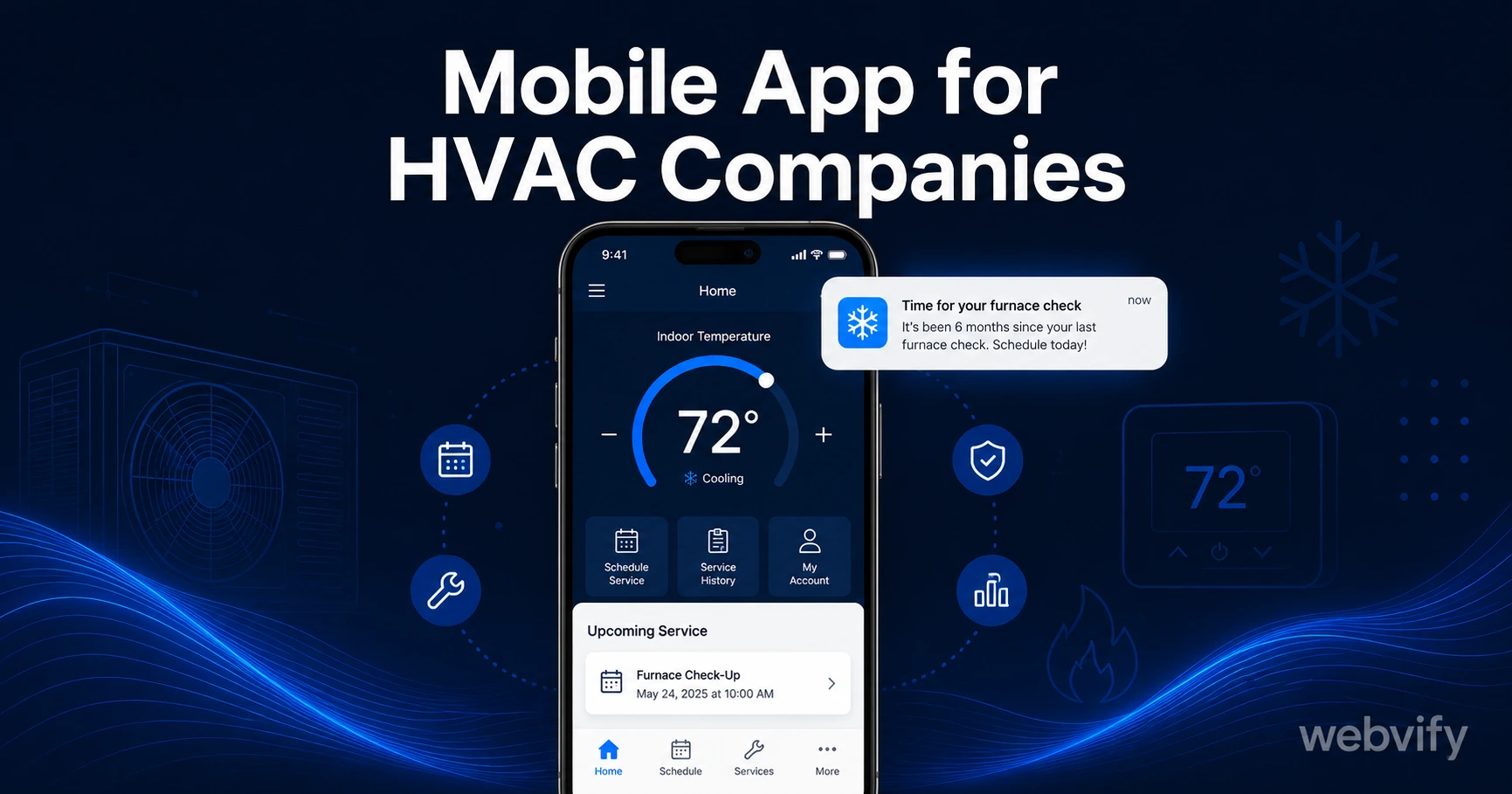
HVAC businesses lose repeat customers between service calls. Here's how a mobile app with push notifications turns seasonal jobs into year-round revenue.
Inside this article
Most HVAC customers call you once, get great service, and then call someone else the next time — not because you did anything wrong, but because you disappeared.
Between a spring AC tune-up and an autumn furnace check, months pass with zero contact. By the time they need service again, your competitor's van has already shown up in their neighborhood. A branded mobile app with push notifications is the simplest fix to this problem — and it doesn't require hiring a developer or rebuilding your website.
Why HVAC Businesses Lose Repeat Customers (Even Great Ones)
HVAC work is inherently seasonal. Spring and autumn are peak booking windows, but customers rarely think about their HVAC provider in the quiet months. Email newsletters go unread — HVAC service emails average a 20–25% open rate at best. Fridge magnets fall off. Business cards get lost.
The customer didn't go looking for a new HVAC company. They just forgot you existed.
A branded mobile app sitting on a customer's home screen solves the visibility gap without any action from the customer. Push notifications reach the lock screen directly — no inbox, no algorithm, no spam folder. Studies consistently show push notification open rates between 60–90%, versus 20–25% for email. For seasonal service reminders, that difference is the gap between a fully booked spring schedule and an empty one.
What a Mobile App for Your HVAC Business Actually Does
A dedicated HVAC mobile app doesn't need to be complex. The core job is maintaining the relationship between service calls. Here's what that looks like in practice:
Service reminders that land. A push notification sent in late March — "Time to schedule your spring AC tune-up before the heat hits" — gets seen. The same message as an email often doesn't. Customers who get the reminder book before peak season fills your calendar. Customers who don't get the reminder call you in July when you're overbooked.
Seasonal campaign windows. HVAC has two natural push windows per year: spring (AC prep) and autumn (furnace/boiler check). A mobile app lets you send targeted campaigns to your entire customer base in minutes — no printing, no postage, no ad spend.
Dormant customer reactivation. If a customer hasn't booked in 14 months, a well-timed push notification — "We haven't seen you since last winter. Ready for an autumn furnace check?" — costs nothing to send and can recover accounts that would otherwise be lost to a competitor.
Booking and quote requests from the app. If your website already has an online booking or contact form, your app carries that functionality automatically. Customers can request a quote, schedule a maintenance visit, or report an emergency without calling — which matters more than ever as younger homeowners prefer messaging over phone calls.
The App Store Credibility Angle (Especially for HVAC)
Trust matters more in HVAC than in almost any other service trade. Customers are handing over access to their home and making decisions that affect their family's comfort and safety. An app on the App Store signals legitimacy in a way that a Facebook page simply doesn't.
When a customer searches for your business and finds an app in the App Store alongside your website, that combination acts as a trust signal — it says you're an established operation, not a fly-by-night contractor. For HVAC companies competing against new entrants and national chains alike, App Store presence is an underused differentiator.
Services like Webvify handle the entire process end-to-end — converting your existing HVAC website into a branded app and submitting it to both the App Store and Google Play. You don't touch Xcode or Android Studio. Once the app is live, you manage push notifications from a simple admin panel.
Three Push Notification Campaigns That Fill HVAC Schedules
Here are three specific campaigns HVAC businesses use immediately after launching an app:
Campaign 1 — The Spring Tune-Up Window (late March) Send a push notification in the last week of March: "Spring is here — get your AC serviced before the heat hits. Book your tune-up now." Target everyone who hasn't booked in the past 6 months. This one campaign can fill April and May.
Campaign 2 — The Autumn Furnace Check (mid-September) "Cold nights are coming. Schedule your furnace or boiler check before heating season starts." Customers who book early lock in appointment slots before your calendar fills. You get predictable revenue before demand spikes.
Campaign 3 — The Emergency Call Reminder (year-round) Pin your contact number and emergency service option in the app's home screen. When a homeowner's heating fails at 11pm in January, the first number they reach for is the one on their phone. If your app is on their home screen, that's you.
If you want to learn more about how push notifications compare to email for service businesses, the push notifications for small business guide covers the mechanics in detail.
How to Get a Mobile App for Your HVAC Business Without a Developer
The most common objection from HVAC business owners is that building an app requires a developer, months of work, and a budget in the tens of thousands. That was true for native apps built from scratch. It's not true for apps built from your existing website.
A WebView-based approach takes your working HVAC website — your booking form, your service pages, your contact details — and packages it as a native mobile app. The app submits to the App Store and Google Play under your business name. Customers download it, see your branding, and interact with the same content as your website — but now with push notification capability and a home screen icon.
The entire process, from submission to live app, typically takes a few days rather than months. You don't need to maintain separate content. When you update your website, the app reflects those changes automatically.
For HVAC businesses that already have a working website, this is the practical path to an App Store presence — without the overhead of a full mobile development project.
You can also learn about how to submit your app to the App Store if you want to understand what the submission process actually involves.
FAQ
How much does a mobile app for an HVAC business cost?
A WebView app built from an existing HVAC website typically costs far less than custom development. Custom native HVAC apps can run $30,000–$150,000 and take 6–12 months. Managed WebView services like Webvify charge a flat fee that covers building the app, submitting it to the App Store and Google Play, and providing an admin panel — typically a fraction of custom development cost. There are no per-booking fees or ongoing commission structures.
Do I need a developer to get my HVAC business on the App Store?
No. If you already have a website, a WebView-based approach packages it as a native app without any coding. The App Store submission process — which involves Apple's developer accounts, compliance guidelines, and binary uploads — is handled by the service provider. You receive a live app on the App Store under your business name without needing to touch any technical tools.
What's the best push notification to send as an HVAC company?
Seasonal reminders tied to natural service windows have the highest conversion for HVAC. "Spring AC tune-up" in late March and "Autumn furnace check" in mid-September are the two highest-ROI campaigns. A short, specific message with a direct booking link — sent to your full customer list — consistently outperforms email equivalents at 3–4x the open rate.
Ready to stop losing repeat service calls between seasons? Webvify converts your existing HVAC website into a branded mobile app on the App Store and Google Play — push notifications included, no developer required.