

Mobile App for Football Clubs: Keep Players Coming Back All Season
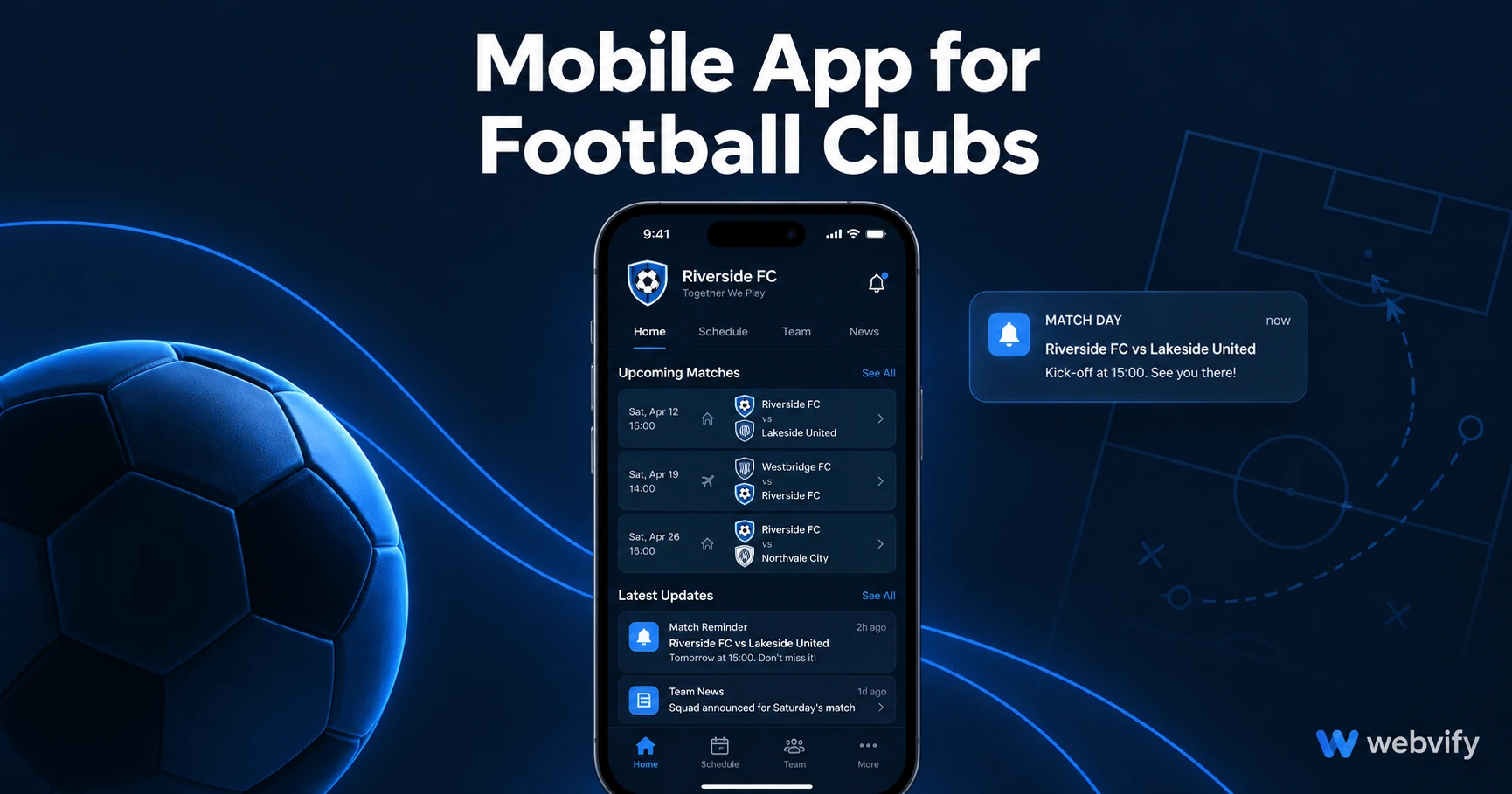
Football clubs lose 30–40% of players each off-season. A branded mobile app with push notifications keeps players engaged and brings them back every season.
Inside this article
- Why Football Clubs Lose Players Between Seasons
- How a Mobile App for Your Football Club Fixes the Retention Gap
- Three Push Notification Campaigns Every Football Club Should Run
- App Store Credibility: Why Players and Parents Trust Clubs With Their Own App
- What to Look for in a Mobile App Solution for Football Clubs
- How to Get Your Football Club App Live Without a Developer
- FAQ
The average amateur football club loses 30–40% of its registered players every off-season. Not because the coaching was poor or the facilities let them down — but because the club went completely silent the moment the final whistle blew in May.
A mobile app changes that.
Why Football Clubs Lose Players Between Seasons
Most football clubs rely on WhatsApp groups, email newsletters, and social media posts to stay connected with players and members. The problem: those channels are noisy, easy to ignore, and entirely at the mercy of an algorithm.
WhatsApp groups go quiet between seasons. Emails get buried in inboxes. Facebook posts reach only 2–5% of your page followers organically. By the time August pre-season arrives, players have already signed up with a rival club or quietly moved on from the sport.
The real retention gap isn't during the season — it's the months of off-season silence that makes players forget the club exists. When re-enrollment time comes, they don't see a message from you. They see one from a competitor.
How a Mobile App for Your Football Club Fixes the Retention Gap
A branded mobile app for your football club puts your name on every player's home screen. That single change is more powerful than any social media strategy.
With a club app, you can send push notifications directly to players' lock screens. Push notifications open at 60–90% compared to 20–30% for email — meaning your pre-season announcement actually reaches people, instead of landing in a folder nobody checks.
Beyond push notifications, a club app creates a central space for team news, training schedules, match results, and membership renewals. Everything your members need is in one place, under your club's name, rather than scattered across three different platforms.
Services like Webvify turn your existing club website into a fully branded app for both the App Store and Google Play — no developer or technical knowledge required. The app goes live under your club's own developer accounts, which means you own it outright.
Three Push Notification Campaigns Every Football Club Should Run
The value of a mobile app is only as good as how you use it. These three campaigns deliver the highest return for most clubs.
Pre-Season Re-Enrollment Nudge (Send: 6–8 Weeks Before Pre-Season Starts)
Six weeks before training returns, send a push notification to every player who was active last season. Keep it simple: "Pre-season starts in 6 weeks. Registration is now open — don't miss out." This campaign alone recovers players who would otherwise drift to a rival club simply because nobody reached out first.
Match-Day Announcement (Send: 48 Hours Before Every Game)
Push match details — venue, kick-off time, kit colour, meeting point — directly to every player's lock screen 48 hours before the game. This eliminates the "I didn't know we had a game this weekend" dropout that costs clubs points and creates unnecessary stress for managers.
The 90-Day Dormant Player Reactivation (Send: Mid-December)
Mid-December is when clubs start planning the spring season. Push a short message to players who haven't re-registered or engaged in 90 days: "Spring season registrations are open. We'd love to have you back." This fills the roster gap that clubs typically patch with expensive last-minute recruitment drives.
App Store Credibility: Why Players and Parents Trust Clubs With Their Own App
An app on the App Store signals something to potential members: this club is professional and organised.
When a family is choosing between two youth football clubs, the one with a branded app — rather than a Facebook page and a WhatsApp group — stands out. Parents feel more confident registering their child with a club that has invested in its communication infrastructure. The same applies to adult players evaluating their options at the start of a new season.
This is especially true for junior sections, where parents often make the final decision. An App Store listing functions as a trust signal in the same way a professional website does — it communicates that the club is serious and here to stay.
For clubs that already have a website, this credibility is close at hand. A web-to-app service like Webvify converts the existing site into a native-feeling app without requiring a rebuild from scratch. The club gets App Store presence without the cost or time of custom development. You can read more about how this works for sports clubs and community organisations.
What to Look for in a Mobile App Solution for Football Clubs
Not every app platform suits a sports club's needs. Here is what to confirm before committing to any service.
Push notification support. This is the core value driver. Without push, an app is just a mobile website. Confirm push is included and that it works on both iOS and Android before signing up.
App Store and Google Play publishing. The app needs to be discoverable on both stores. Some platforms give you a builder but leave the submission process entirely to you — which means navigating Apple's developer portal and Google Play Console on your own. Look for a service that handles submission end-to-end.
Your own developer accounts. You want the app published under your club's name, not a third-party platform's account. If the platform shuts down or you cancel, you should keep access to the app. Confirm this upfront.
No technical requirement for ongoing management. Club managers and committee volunteers are not developers. The right service handles building, submitting, and updating the app — so your team can focus on running the club, not managing software.
How to Get Your Football Club App Live Without a Developer
Custom-built apps for football clubs typically cost £10,000–£50,000 and take 6–12 months to build. That is not realistic for most amateur and semi-professional clubs operating on tight budgets.
The faster path is a web-to-app conversion service. If your club already has a website — even a basic one — a service like Webvify can wrap it into a fully branded mobile app and manage the App Store and Google Play submission process from start to finish.
Most clubs go live within two to three weeks. The cost is a fraction of custom development, with no ongoing dependency on a developer for updates or changes.
FAQ
How much does a mobile app for a football club cost?
Custom-built apps for football clubs typically cost £10,000–£50,000 depending on features. Web-to-app conversion services that wrap an existing club website are significantly cheaper — usually a one-time setup fee plus a monthly service fee. Always confirm that push notifications, App Store submission, and Google Play submission are included in the price before committing.
Do I need a developer to get a mobile app for a sports club?
No. Web-to-app conversion services handle the entire technical process — building the app, configuring push notifications, and submitting to both stores. Club staff and committee members do not need any technical knowledge. The service manages everything from setup to approval.
Can a WebView app be approved on the App Store and Google Play for a football club?
Yes. Apple and Google approve WebView-based apps for sports clubs regularly, provided the app meets their minimum functionality guidelines. Push notifications, team schedules, training updates, match results, and membership information all count toward the functionality threshold Apple requires (Guideline 4.2). A managed service handles compliance as part of the submission process.
Player dropout is expensive — every season you lose experienced members, you spend time and resources recruiting replacements. A branded mobile app gives your football club a direct line to every player's lock screen, year-round.