

Push Notifications vs Email: The Real Comparison for Small Businesses in 2026
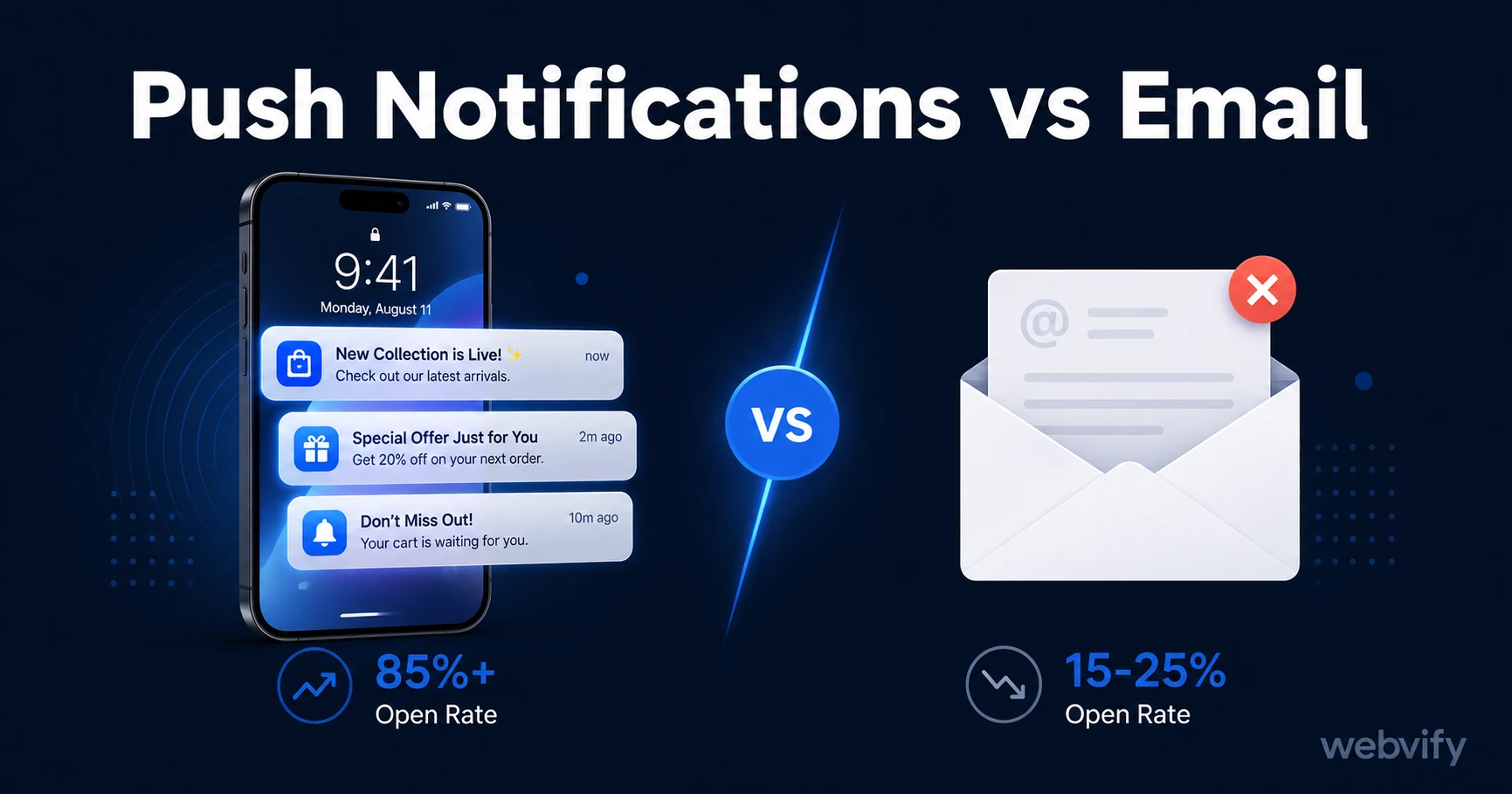
Push notifications open at 60–90%. Email averages 20–30%. Here's when each channel wins—and which one small businesses should prioritize in 2026.
Inside this article
- Push Notifications vs Email: The Real Comparison for Small Businesses in 2026
- Push Notifications vs Email: What the Open Rate Numbers Actually Mean
- Where Email Still Wins
- Where Push Notifications Win
- How Push Notifications Work for Small Businesses
- Which Channel Should You Prioritize?
- Frequently Asked Questions
Push Notifications vs Email: The Real Comparison for Small Businesses in 2026
Your last email campaign went to 1,000 subscribers and 200 of them opened it. That's a solid 20%—but 800 people never saw what you had to say.
Push notifications sent through a mobile app typically reach 60–90% of recipients. The same message, a fraction of the silence.
This comparison breaks down when each channel wins, where the numbers actually come from, and what small businesses should do when they can't master both at once.
Push Notifications vs Email: What the Open Rate Numbers Actually Mean
The headline figures are well-documented:
- Email open rates average 20–30% for small business sectors
- Push notification open rates average 60–90% depending on industry and message relevance
But the gap understates the real difference. When you send an email, it arrives in an inbox competing with hundreds of other messages. When you send a push notification, it appears directly on the lock screen—the same place text messages land.
The delivery context is fundamentally different. Email is asynchronous and easily buried. Push is immediate and impossible to miss when the phone lights up.
That said, open rate alone doesn't tell the full story. The right channel depends on what you're trying to accomplish.
Where Email Still Wins
Email isn't going away. For several use cases, it remains the stronger channel.
Long-form content. Email handles depth well. If you're sending a newsletter, product updates with multiple sections, or detailed instructions, email gives you the space. Push notifications are limited to a headline and a short body—they're built for urgency, not depth.
Transactional messages. Order confirmations, booking details, receipts, and account security alerts belong in email. Customers expect to find these in their inbox and refer back to them. A push notification disappears once dismissed.
Reaching people without your app. If someone hasn't downloaded your app, you can't reach them with push. Email reaches anyone with an address. For customer acquisition and re-engaging lapsed customers who never installed your app, email is the default channel.
Documented communication. In healthcare, legal, and financial services, email creates an audit trail. If your business needs records of what was sent and when, email wins.
For a broader look at how digital channels fit together in a mobile-first strategy, see 7 Benefits of Converting Your Website to a Mobile App.
Where Push Notifications Win
Push notifications beat email in three specific scenarios.
Time-sensitive offers. If you have empty appointment slots tomorrow or a flash sale ending in 24 hours, push reaches customers while the window is open. By the time an email gets opened—if it gets opened—the moment may have passed.
Rebooking sequences. For service businesses, the core retention problem is the gap between visits. A push notification sent 21 days after an appointment reaches the customer when they're likely due for another one. Personalized rebooking nudges via push consistently outperform the same message in email.
Habit-building touchpoints. Push is the mechanism behind daily habit apps. If your business benefits from regular customer engagement—fitness studios, coffee shops, tutoring centers—push keeps you visible without requiring customers to open an inbox.
The data in Mobile App Statistics 2026 confirms it: app-based push notifications deliver the highest engagement rate of any digital channel available to small businesses without a paid ad budget.
How Push Notifications Work for Small Businesses
Push notifications require a mobile app. You cannot send them reliably from a website—browser push does not work on iOS, and opt-in rates are far lower than app-based push.
The fastest path for a small business with an existing website is a web-to-app conversion. Your current website becomes a native mobile app published on the App Store and Google Play. Once it's live, you send push notifications from an admin panel without writing code or involving a developer.
Services like Webvify handle this end-to-end—building the app, managing App Store submission, and setting up the admin panel—so you don't need to learn Xcode or navigate Apple's developer portal. The ongoing sending is simple enough to run yourself.
For Shopify store owners, the push notification opportunity is especially clear. Email averages 20–30% open rates for e-commerce, while a dedicated app delivers notifications directly to the lock screen. Here's how Shopify push notifications work with a mobile app →
Which Channel Should You Prioritize?
The real question isn't push or email—it's where is your retention gap?
If your customers visit or buy regularly (weekly or monthly): Push notifications are the higher-leverage channel. Gyms, salons, coffee shops, and restaurants have frequent natural rebooking windows. Push converts those windows into revenue without waiting for someone to check an inbox.
If your customers buy infrequently (quarterly or annually): Both channels matter, but email is easier to start with because the timing is less critical. Accountants, HVAC companies, and annual service businesses can run effective seasonal campaigns via email without an app.
If you're currently doing nothing: Start with what you can execute. Email requires no app, no App Store review, and minimal setup. Push notifications require a mobile app, but once the audience opts in, the engagement rates justify the setup.
The strongest small businesses in 2026 use both channels for different jobs: email handles depth and transactions, push handles urgency and retention. But if you can only add one new channel this year and your customers carry smartphones—push is worth the investment.
Frequently Asked Questions
Is the push notification open rate really that much higher than email?
Yes. Data consistently shows push notifications reach 60–90% of recipients compared to 20–30% for email. The gap exists because push appears on the lock screen rather than in a crowded inbox. Relevance still matters—irrelevant push notifications get dismissed quickly and lead to app uninstalls.
Do I need a developer to send push notifications to customers?
No. If your business has a website, a web-to-app service converts it into a mobile app without code. Once the app is live on the App Store and Google Play, you send push notifications from an admin panel with no technical skills required. The step that requires expert help is App Store submission—not the ongoing sending.
Can I send push notifications without a mobile app?
Browser push notifications are possible from a website, but they have hard limits: they don't work on iOS, they don't appear on the lock screen, and opt-in rates are much lower than app-based push. For meaningful open rates, a native mobile app is the correct foundation for push notifications.
Your email list is valuable—keep building it. But if you want to reach customers at the moment that matters—when a slot is open, a rebooking window is closing, or a time-sensitive offer is live—push notifications are the faster channel.
See how Webvify turns your existing website into a push-enabled mobile app →