

Google Play Keyword Research: How Small Businesses Get Found in 2026
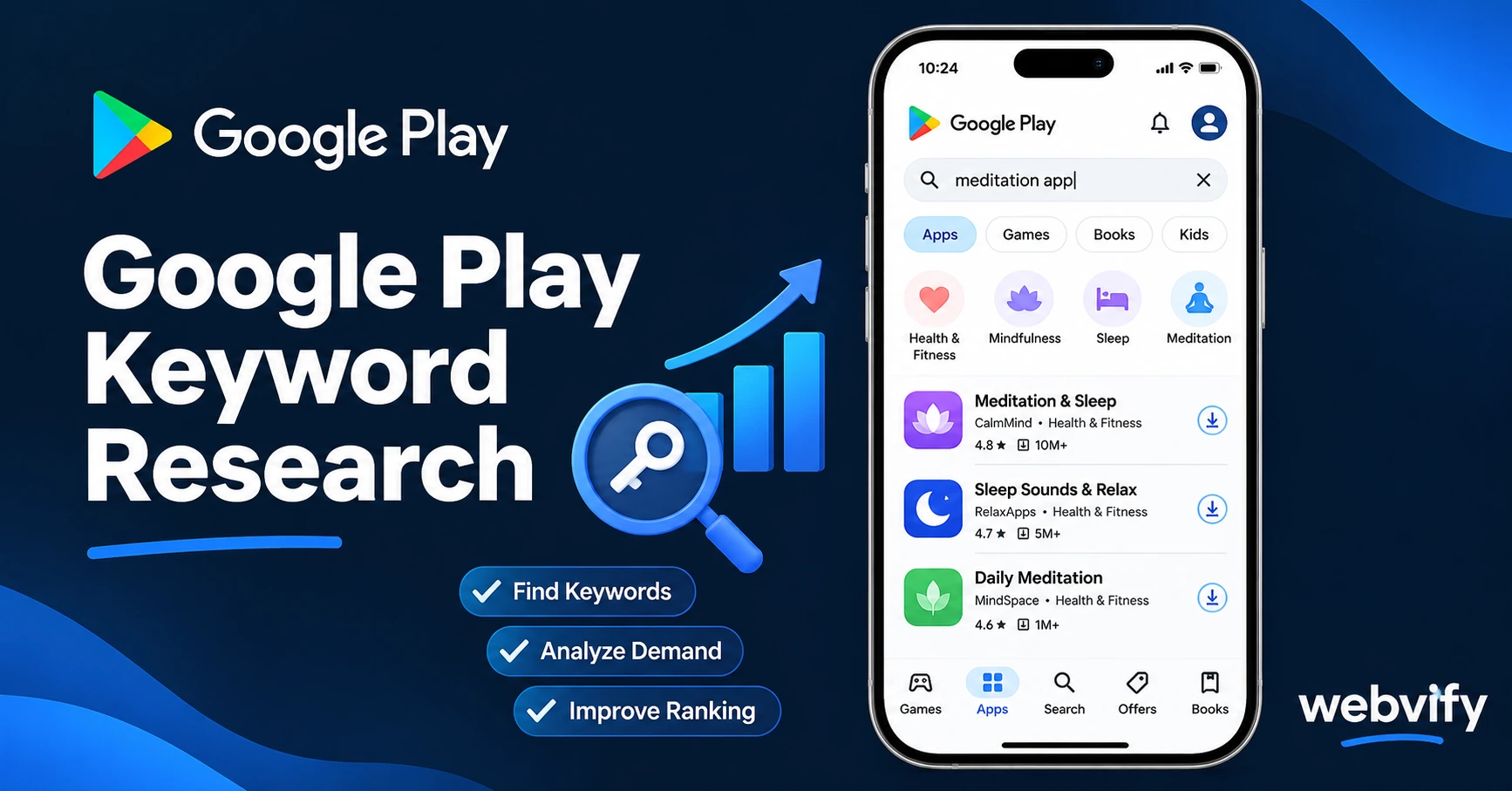
Learn how to do Google Play keyword research and get more app downloads. A practical guide for small business owners — no developer or SEO background needed.
Inside this article
- How Google Play Keyword Research Works (and Why It Matters)
- How to Find the Right Keywords for Your Google Play Listing
- Where to Use Keywords in Your Google Play Store Listing
- How to Track Your Keyword Rankings on Google Play
- Common Google Play Keyword Research Mistakes Small Businesses Make
- Frequently Asked Questions
Most small business apps collect fewer than 50 downloads in their first three months — not because the app is bad, but because nobody can find it. Google Play keyword research is the free, overlooked lever that separates apps that grow on autopilot from ones that sit at zero.
How Google Play Keyword Research Works (and Why It Matters)
Google Play is a search engine with its own algorithm. When someone opens the Play Store and types "yoga studio app" or "loyalty card for restaurants," the store shows them apps ranked by relevance, download history, ratings, and listing completeness.
The difference from Google Search: Play Store is far less competitive. A local coffee shop can rank for "coffee shop loyalty app Chicago" in a few weeks — a task that would take years on Google.com. For small business apps, this is the fastest organic channel available.
Google Play keyword research means finding the specific words your customers type when they're looking for an app like yours, then placing those words in the right fields of your Play Store listing.
How to Find the Right Keywords for Your Google Play Listing
Start with what your customers type, not what you think they type. Open the Play Store on a phone. Type the problem your app solves — "book appointment," "loyalty card," "food ordering." Watch the autocomplete. Those suggestions are real searches from real users.
Three keyword types to target:
| Type | Example | Competition |
|---|---|---|
| Brand + category | "coffee shop loyalty app" | Low |
| Function-based | "appointment booking app" | Medium |
| Local + category | "salon app Chicago" | Very low |
Start with brand + category and local combinations. They convert better because the user knows exactly what they want.
Free tools worth using:
- Google Play autocomplete — the fastest and most accurate source. Type a broad term and read the full suggestion list.
- AppFollow (free tier) — enter a competitor's app and see which keywords it ranks for.
- AppTweak (free tier) — similar to AppFollow; good for checking keyword difficulty.
- Google Keyword Planner — not Play-specific, but the web search volume gives a signal for how much demand exists.
For a small business app, 5–10 focused keyword phrases outperform a list of 50 scattered terms. Narrow down, then expand once you're ranking.
If you've already optimized your App Store listing, the approach here is similar but the mechanics differ — here's the App Store keyword research guide →.
Where to Use Keywords in Your Google Play Store Listing
Google Play indexes text from four places, each with different weight:
| Field | Character Limit | Keyword Weight |
|---|---|---|
| App Title | 30 characters | Highest |
| Short Description | 80 characters | High |
| Long Description | 4,000 characters | Medium |
| Developer Name | — | Low |
App Title (30 characters, most important): Include your primary keyword here if the name allows. "Brewed — Coffee Shop Loyalty App" outranks "Brewed" for every loyalty and coffee-related search. Keep it readable — keyword stuffing ("Coffee App Loyalty Rewards Booking") gets flagged.
Short Description (80 characters): This text appears in search results before anyone clicks. "Appointment booking and loyalty for small salons" is more findable than "The best app for your salon."
Long Description (4,000 characters): Use your primary keyword 3–5 times naturally throughout. Use secondary keywords once or twice each. This is your biggest keyword opportunity — most app owners either skip it or write one generic paragraph and leave 3,900 characters empty.
What to avoid: Repeating your app title verbatim in every sentence. Keyword stuffing. Vague descriptions like "a great experience for everyone." Google Play's algorithm and human reviewers both penalize it.
Services like Webvify include an optimized Play Store listing as part of the app submission process — you don't have to research and write everything from scratch.
How to Track Your Keyword Rankings on Google Play
Once your app is live, ranking data appears in Google Play Console under Acquire users → Store listing acquisition. For a full walkthrough of Google Play Console, see the Google Play Console guide for small business owners →.
The three metrics to watch:
- Organic installs — people who found your app by searching (not ads or external links)
- Store listing conversion rate — the percentage of visitors who actually download after seeing your listing
- Search terms report — which keywords brought installs
If organic installs are low but impressions are high, the problem is usually the title or icon, not the keywords. If impressions are very low, your keywords aren't matching real searches yet.
Check these numbers every 2–4 weeks. Play Store rankings shift gradually — don't judge a keyword change in the first week.
Common Google Play Keyword Research Mistakes Small Businesses Make
Using brand jargon nobody searches for. "The engagement platform for forward-thinking businesses" describes nothing a customer types at 7pm looking for a loyalty card.
Skipping location modifiers. A local salon app that ranks for "salon booking app Austin" will convert far better than one trying to rank for "salon app" globally. Location keywords are almost always lower competition and higher intent.
Ignoring seasonal updates. A yoga studio should refresh keywords in January ("New Year yoga app") and September ("back to routine yoga"). Fresh listing changes signal to Google Play that the app is maintained — a lightweight ranking signal that most SMBs miss.
Setting the listing once and never touching it. Google Play rewards apps that show signs of active maintenance. Two or three listing updates per year — adding a new screenshot, tweaking the description — keep the listing competitive.
Frequently Asked Questions
Does Google Play keyword research work differently from App Store keyword research?
Yes. Google Play indexes your full long description and uses keyword density as a ranking factor. The App Store uses a separate hidden keyword field (100 characters) that the description doesn't affect. For Google Play, your best keywords should appear naturally in the description 3–5 times. For the App Store, the keyword field and title carry the most weight. The underlying research process — finding what your customers search — is the same on both platforms.
How long does it take to rank on Google Play after updating a listing?
For a new app targeting a narrow niche (e.g., "yoga studio app Portland"), rankings typically appear within 2–4 weeks of a well-optimized listing going live. Broader, competitive terms like "booking app" or "loyalty app" can take 3–6 months and require more downloads and reviews to break through. Start with specific, local, or category-combined phrases and expand as your base grows.
How many downloads do I need to rank on Google Play?
Download velocity matters more than total count. Twenty consistent installs per week from search outperforms a launch spike that stops cold. Google Play also weighs your retention rate (how many people keep the app after 7 days) and ratings. A small business app with 50 downloads, a 4.5-star rating, and a fully completed listing will often outrank one with 500 downloads and no description.
Getting found on Google Play starts with the right words in the right fields — and it compounds over time. Webvify handles your app build, Play Store submission, and listing setup so your app shows up where customers are already searching.