

Community App vs Facebook Group: Which One Actually Builds Loyalty?
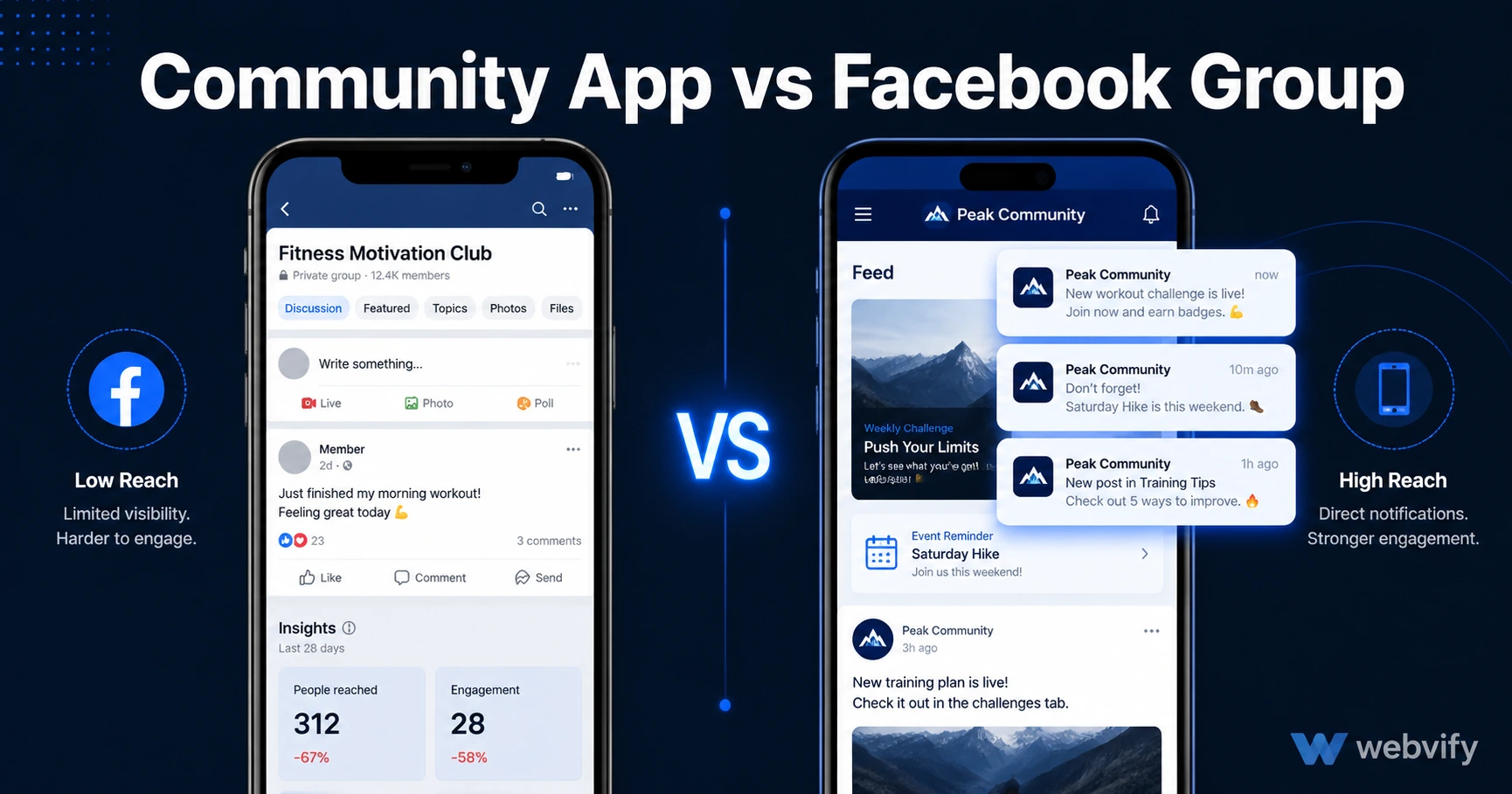
Facebook Groups are free — but you don't own the audience. Here's when a community app beats a Facebook Group for small business retention.
Inside this article
Facebook organic reach for business posts has dropped to 2–5%. Even your most engaged Facebook Group members might never see what you post — and that makes the community app vs Facebook Group question one of the most important retention decisions a small business owner can make right now.
Building your customer community inside Facebook feels free. But every member you gain is a member Facebook controls. When the algorithm changes or the platform restricts group notifications, you lose access. A branded community app gives you the same community features with one critical difference: direct push notification access and a home screen icon your customers actively chose to install.
This guide breaks down exactly where Facebook Groups win, where they fall short, and when a dedicated community app is the smarter investment for long-term customer retention.
Where Facebook Groups Work Well
Facebook Groups are genuinely useful in the right situation. They're free to create, require no technical setup, and tap into a platform where billions of people already spend time.
For businesses testing a new audience — or building community around a short-term event or campaign — a Facebook Group makes sense. You get discussion threads, event features, polling, and file sharing without building anything from scratch. The barrier to entry is zero.
The problem isn't what Facebook Groups can do. It's what they can't guarantee as your retention strategy scales.
Why Facebook Groups Break Down for Long-Term Customer Retention
There are three structural problems with Facebook Groups as a primary retention channel.
The first is reach. When you post in a Facebook Group, not every member sees it. Facebook's algorithm decides which posts appear in members' feeds. For business-related groups, organic reach has declined steadily for several years. Your 500-member group might only deliver your post to 30–50 people on any given day — less if your post doesn't get early engagement.
The second is notification control. Members adjust or turn off group notifications entirely after the initial join excitement. Once they do, your messages are invisible. You have no way to reach them directly without paying for Facebook ads.
The third is platform dependency. Your entire community lives inside Facebook's product. If Facebook changes its algorithm, terms of service, or group features — your retention strategy changes with it. You don't own the customer relationship. Facebook does.
If long-term customer lifetime value and repeat bookings are what you're managing, these three issues compound over time into measurable revenue loss.
What a Branded Community App Gives You
A branded community app is a mobile app published under your business name on the App Store and Google Play. Customers install it directly onto their phones, where it lives on the home screen alongside Netflix and their banking app.
The critical difference from a Facebook Group is direct access — push notifications.
Push notifications sent from a mobile app reach the lock screen immediately. They don't pass through an algorithm. They don't depend on whether the customer opens Facebook. And they arrive with an open rate of 60–90%, compared to under 5% organic reach in a Facebook Group. That's not a marginal improvement — it's a fundamentally different channel.
Here's what a branded community app gives you that a Facebook Group cannot:
- Lock screen access — push notifications that bypass the algorithm entirely
- Home screen real estate — your icon sits permanently on the phone, not inside someone else's app
- App Store credibility — a published app signals professional legitimacy that a Facebook Group never can
- Owned audience — your members opted into your app, not into Facebook
Services like Webvify convert your existing website into a fully branded mobile app and handle App Store and Google Play submission end-to-end — without code or a mobile developer.
According to mobile app statistics for 2026, 90% of mobile time is spent inside native apps, not mobile browsers. Your customers are already living in apps. The question is whether your business is one of them.
The Push Notification Advantage: A Concrete Example
Here's what the numbers look like in practice.
Say you run a yoga studio with 300 active clients. You have a Facebook Group with 280 of them as members. On a slow Tuesday, you need to fill a 6pm class.
You post in the Facebook Group. The algorithm might surface it to 30–40 members. Of those, maybe 5–8 are actually looking at Facebook in the next hour when you need a decision.
With a branded app and push notifications, you send a "2 spots left — Tuesday 6pm class" alert to all 300 installed app users. It lands on their lock screen within seconds. At a 70–80% open rate, 210–240 people see it in real time.
The 7 benefits of converting your website to a mobile app covers this retention mechanic in detail — push notifications are the primary driver, not a secondary feature.
When a Facebook Group Is Enough
Facebook Groups are the right choice when:
- You're building community around a one-time event or campaign with no long-term retention goal
- Your audience is primarily on Facebook and unlikely to install a dedicated app
- You're early-stage and want to validate community demand before investing in an owned channel
- Your community purpose is peer-to-peer discussion rather than direct business communication
The cost-benefit of a community app shifts decisively once customer lifetime value and repeat purchase rates matter to your revenue model. For most service businesses, retail, hospitality, and fitness businesses — that threshold is crossed quickly.
Frequently Asked Questions
Can I run both a Facebook Group and a community app at the same time?
Yes, and many businesses do. Facebook Groups work well for peer discovery and social proof — new customers search for your brand on Facebook and find the community. The mobile app becomes the primary retention channel for existing customers who've already opted into a direct relationship with your business. Both can coexist.
How much does a community app cost compared to a Facebook Group?
A Facebook Group costs nothing to create, but the cost is indirect — you're building equity inside Facebook's platform, not your own. A branded mobile app via a WebView-based service costs significantly less than custom development, which typically runs $50,000–$300,000 and up. App Store and Google Play submission is included in the Webvify service. Most businesses recover the investment within a few rebooking cycles from customers who would otherwise have drifted away silently.
Do I need a website to get a branded community app?
Yes — WebView-based apps convert your existing website into a mobile app. If you already have a website with booking, loyalty, or communication features, those translate directly into the app experience. You don't rebuild anything from scratch.
Your customers are on their phones. A branded community app puts your business on the home screen — not buried inside Facebook. Webvify handles everything from build to App Store submission so you can get there in days, not months.