

7 Benefits of Converting Your Website to a Mobile App
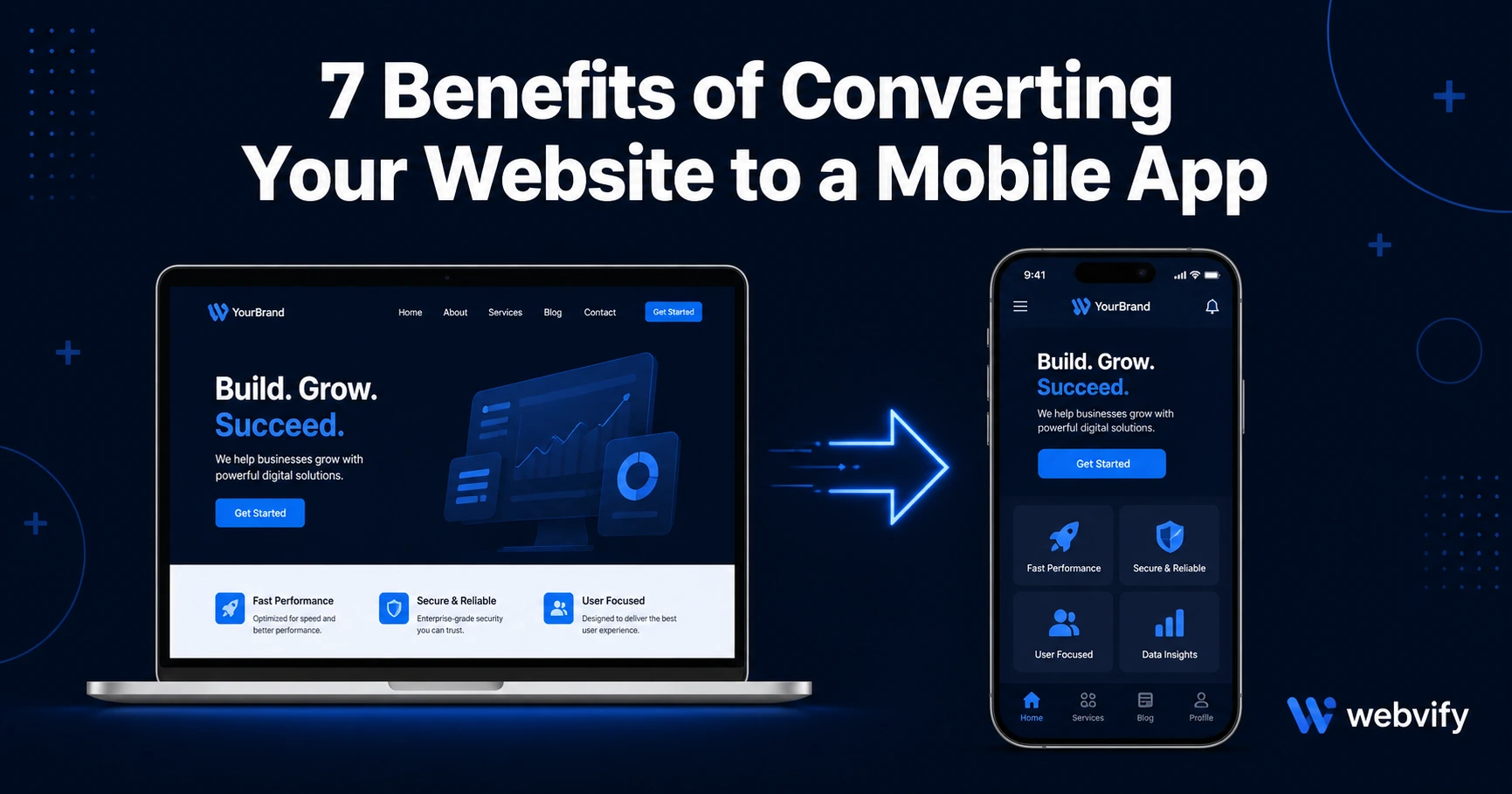
Discover 7 concrete benefits of converting your website to a mobile app — from push notifications to App Store discovery — and how to do it without a developer.
Inside this article
- 7 Benefits of Converting Your Website to a Mobile App
- Benefit 1: Push Notifications Bring Customers Back Without Ads
- Benefit 2: Home Screen Presence Changes How Customers Think of You
- Benefit 3: App Store Discovery Puts You in Front of New Customers
- Benefit 4: Mobile Conversions Improve When You Remove Friction
- Benefit 5: Offline Access Builds Loyalty in Low-Connectivity Moments
- Benefit 6: You Get First-Party Data You Don't Have to Ask For
- Benefit 7: You Don't Need to Rebuild — You Can Convert What Already Works
- FAQ
7 Benefits of Converting Your Website to a Mobile App
Your website works. Your mobile traffic is growing. But your conversion rate on mobile is half what it is on desktop — and you can't figure out why.
The answer is usually the same: mobile browsers are designed for browsing, not for coming back. A mobile app changes the relationship entirely.
Here are seven concrete benefits of converting your website to a mobile app, and why it matters more in 2026 than it ever has.
Benefit 1: Push Notifications Bring Customers Back Without Ads
Email open rates average 25–30%. Push notifications from mobile apps land directly on the lock screen and get opened at 60–90% rates.
That difference is not incremental — it's the gap between a customer who forgets you exist and one who sees your message the moment it matters. A flash sale, a new appointment slot, a loyalty reward: these land when you send them, not when someone decides to check their inbox.
This is the single most underrated benefit of converting your website to a mobile app. You gain a direct channel to your customers that no algorithm can throttle.
Benefit 2: Home Screen Presence Changes How Customers Think of You
When your app is on someone's home screen, you are not competing with fifty browser tabs. You are one tap away.
This is not a soft brand benefit — it has measurable effects. Studies consistently show that branded apps on home screens increase purchase frequency and average order value compared to mobile web. The reason is simple: you are present, you are easy, and you are trusted in a way that a browser bookmark never is.
For restaurants, salons, gyms, coaches, and retailers, home screen presence is the modern equivalent of being the first number on the fridge.
Benefit 3: App Store Discovery Puts You in Front of New Customers
Google indexes websites. Apple and Google index apps.
When someone searches "yoga studio app" or "meal delivery near me" in the App Store or Google Play, the results are entirely separate from web search. A business with a published app is discoverable in that second ecosystem. A business without one is invisible.
Converting your website to a mobile app effectively doubles the number of places a new customer can find you — without any additional SEO work, because the App Store and Google Play have their own search algorithms.
Benefit 4: Mobile Conversions Improve When You Remove Friction
Mobile web checkout requires users to navigate browser menus, deal with autofill quirks, and re-enter payment details. Mobile apps — even WebView apps wrapping your existing website — store sessions, enable Face ID or Touch ID authentication, and remember preferences.
That reduction in friction has a direct impact on conversion rates. E-commerce stores that move customers from mobile web to a dedicated app typically see conversion rate improvements of 20–40%, according to data from Criteo and similar sources.
If your store already runs on Shopify or WooCommerce, the app is not replacing your checkout — it's removing the obstacles that make mobile browsers frustrating. You can read more about this in the guide to adding push notifications to your Shopify store with a mobile app.
Benefit 5: Offline Access Builds Loyalty in Low-Connectivity Moments
A mobile web experience disappears the moment the connection drops. A mobile app can cache key content — menus, product catalogs, class schedules, booking forms — so that customers can browse and queue actions even without a signal.
This is especially valuable for businesses with customers in areas with variable connectivity, or industries like restaurants and service businesses where the app is used in the physical location itself.
The offline experience is a small feature that creates a disproportionate amount of trust. When your app works when competitors' sites don't, customers notice.
Benefit 6: You Get First-Party Data You Don't Have to Ask For
Every time a customer uses your app, you know what they looked at, what they clicked, how long they stayed, and what they ignored. This behavioral data belongs to you — not to Google, not to Meta.
In an environment where third-party cookies are disappearing and ad targeting is becoming less reliable, first-party data is the competitive advantage that compounds over time. The businesses that own their customer data make better decisions: better timing for promotions, better personalization, better product development.
Converting your website to a mobile app is one of the fastest ways to start building that data layer without building a custom analytics infrastructure.
Benefit 7: You Don't Need to Rebuild — You Can Convert What Already Works
The most common objection to getting a mobile app is cost and complexity. Building a native app from scratch can run $50,000–$300,000 and take 12 months or more — that's the reality for a fully custom build. You can see the full breakdown in the mobile app development cost guide for 2026.
But converting your existing website is a different category entirely. A WebView-based app packages your existing website into a native app container and submits it to the App Store and Google Play under your own accounts. Your website stays the same. Your content stays the same. You just gain all the benefits above without the cost of a rebuild.
Services like Webvify handle the entire process end-to-end — building the app, preparing the store listings, and submitting on your behalf — so you don't need to touch Xcode, the App Store Connect portal, or any developer tooling.
FAQ
How long does it take to convert a website to a mobile app?
With a WebView-based approach, the app itself can be built in a few days. App Store review typically takes 24–48 hours, and Google Play review takes a similar amount of time for first-time submissions. Most businesses are live on both stores within a week of starting the process.
Will my existing website content work in a mobile app?
Yes — a WebView app wraps your existing website in a native container, so your content, checkout, bookings, and login flows work exactly as they do in a browser. The main things to check are responsiveness on smaller screens and any payment flows that might need adjustment for Apple's in-app purchase rules if you sell digital goods.
Is converting a website to a mobile app worth it for a small business?
For any business that depends on repeat customers — restaurants, salons, gyms, coaches, retailers — the push notification channel alone typically delivers measurable ROI within the first few months. The combination of home screen presence, App Store discoverability, and improved mobile conversion makes it one of the highest-leverage marketing investments available to small businesses in 2026.
Ready to get your website on the App Store and Google Play? Webvify converts any website into a fully branded mobile app and handles the entire submission process end-to-end — no developer required.