

Mobile App Statistics 2026: Key Numbers Small Businesses Need
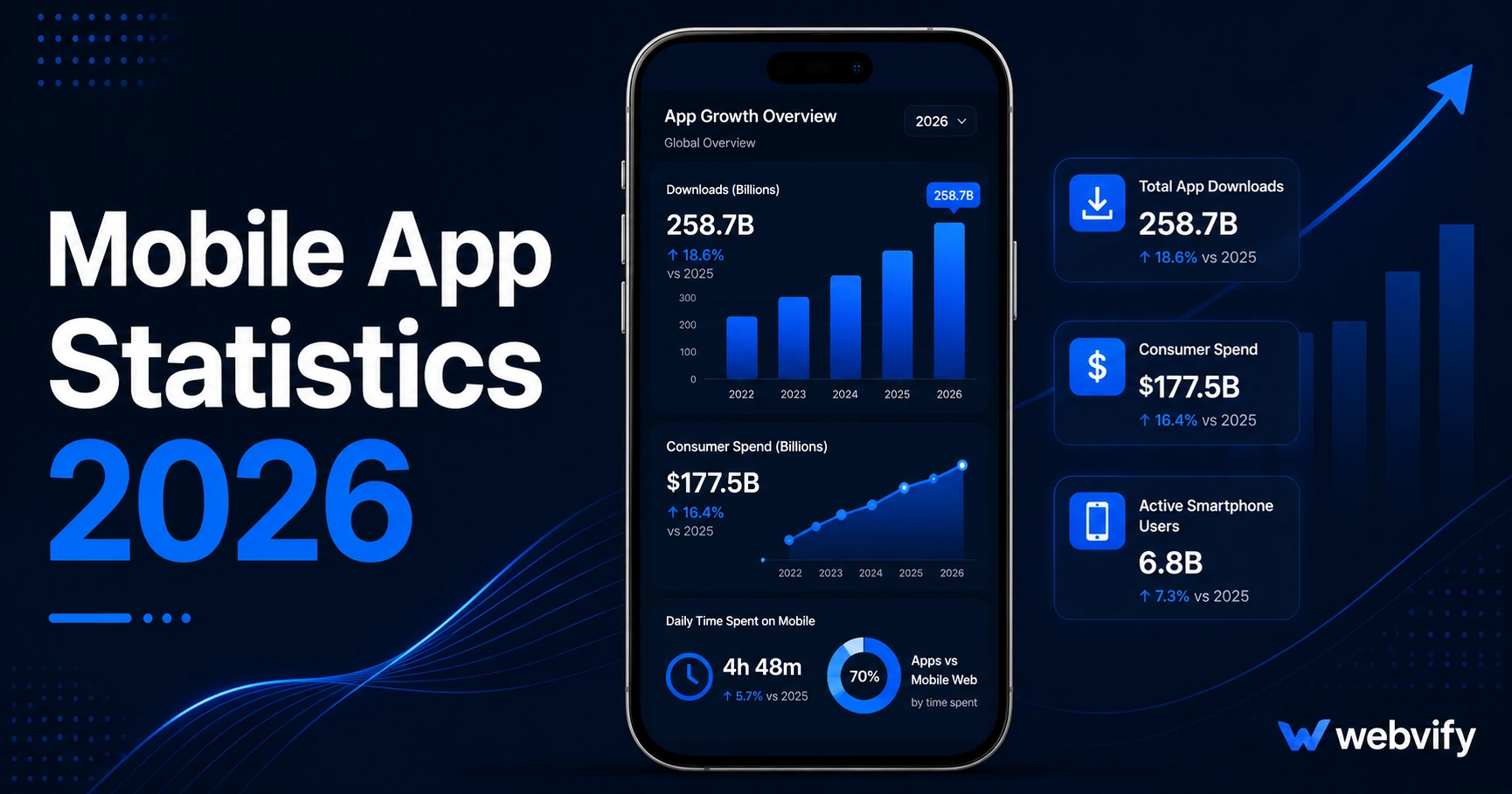
Mobile app statistics 2026 every small business needs to know — usage trends, mobile commerce revenue, push notification open rates, and how to act on the data.
Inside this article
- What Mobile App Statistics in 2026 Actually Tell You
- Mobile App Statistics 2026: Usage Has Already Crossed the Tipping Point
- Mobile Commerce Statistics: The Revenue Gap You're Missing
- Push Notification Open Rates vs. Every Other Channel
- App Store Statistics: An Organic Discovery Channel Most Businesses Skip
- What These Statistics Mean for a Business Without an App Yet
- FAQ
Mobile now drives more than 60% of all internet traffic globally — but most small businesses still have no mobile app. That gap is where competitors are quietly gaining ground.
What Mobile App Statistics in 2026 Actually Tell You
Raw download counts and global revenue figures make headlines, but they don't help a business owner make a decision. The statistics that matter are the ones that show where your customers spend time, how they shop, and what gives one business a repeatable advantage over the next.
This post breaks down the mobile app statistics 2026 that are directly relevant to small and medium businesses with an existing website — and explains what each one means in practice.
Mobile App Statistics 2026: Usage Has Already Crossed the Tipping Point
More than 60% of all internet traffic now comes from mobile devices. But that number understates the actual shift in behavior.
The more important figure: approximately 90% of mobile time is spent inside apps, not in a browser. When your customer picks up their phone, the default behavior is to open an app — not to search for your business in Safari or Chrome.
The average smartphone user has around 80 apps installed and uses 9–10 of them daily. Those daily-used apps belong to brands in the user's regular routine: their bank, their coffee shop, their fitness studio, their go-to online store. Businesses without an app are invisible at this layer — no matter how good their website is.
Mobile Commerce Statistics: The Revenue Gap You're Missing
Mobile commerce (m-commerce) now accounts for more than 70% of global e-commerce transactions. Global m-commerce revenue in 2026 is projected to exceed $2.5 trillion.
The number small businesses need to pay attention to is not the total market size — it's the conversion rate gap.
Mobile web conversion rates average 1–2%. Mobile app conversion rates consistently reach 3–5% or higher for brands with optimized checkout and push notifications enabled. That's roughly double the conversion rate for the same traffic.
The reason is friction. A mobile browser experience requires typing or searching for the site, waiting for the page to load, navigating cookie banners, and re-entering session information. An app opens in one tap from the home screen, remembers the user's cart and login, and can send a re-engagement notification before the customer forgets you exist.
For a business doing $25,000/month in mobile web revenue, closing that conversion gap with a dedicated app isn't a vanity metric — it's a direct revenue lever. Our guide on the benefits of converting your website to a mobile app breaks down the full ROI case in detail.
Push Notification Open Rates vs. Every Other Channel
Push notifications are consistently the most underrated figure in 2026 mobile app statistics.
Email averages 25–30% open rates across industries. SMS sits at 35–45%. Push notification open rates average 60–90% — because they land on the lock screen without competing with a full inbox.
For any business that depends on repeat customers — restaurants, salons, gyms, coaching businesses, e-commerce stores — push notifications are the most direct retention tool available. You choose the message, pick the timing, and reach customers who have already opted in by installing your app.
The key difference between push and the alternatives: when a customer installs your app, they've made an active choice to stay connected. A push notification is a direct line to that relationship — not a borrowed audience you're renting from a platform.
Services like Webvify handle the end-to-end process — building your app from your existing website, submitting it to the App Store and Google Play, and giving you an admin panel to send push notifications without touching code or hiring a developer.
App Store Statistics: An Organic Discovery Channel Most Businesses Skip
The App Store and Google Play together receive more than 4 billion searches per month. For small businesses, that's an organic discovery channel most never consider.
When your app is live and keyword-optimized in the App Store, customers searching for your service or business type can find you before they open a browser. App Store search behaves similarly to Google for local and category queries — and the competition is far thinner than on Google, especially at the local level.
App Store Optimization (ASO) for small businesses follows a straightforward framework: a keyword-rich title, a descriptive subtitle, strong screenshot visuals, and ongoing review generation. Most small businesses can execute this without an agency. Our App Store Optimization guide for small businesses covers the full process step by step.
What These Statistics Mean for a Business Without an App Yet
The most common objection to getting an app is: "I know I should have one — I just don't have the budget or a developer to build one."
That framing was outdated by 2024. The assumption is that building an app means hiring engineers and starting from scratch. For businesses that already have a website, that's not the relevant path.
A WebView wrapper converts your existing website into a native-feeling mobile app — same content, same functionality, published under your own business name in the App Store and Google Play. The process doesn't require any code changes to your website. It doesn't require an iOS or Android developer. And it doesn't require rebuilding anything you've already built.
The 2026 mobile app statistics aren't an argument for custom development. They're an argument for closing the gap between where your customers are spending time and where your business is visible.
FAQ
How much of internet traffic comes from mobile devices in 2026?
More than 60% of global internet traffic now comes from mobile devices. Of that mobile time, approximately 90% is spent inside apps rather than browsers — meaning customers are primarily reached through installed apps, not search or browsing.
What is the average mobile app conversion rate compared to mobile web?
Mobile apps convert at 3–5% on average, compared to 1–2% for mobile web. The gap is caused by reduced friction: apps load faster, remember sessions, and allow one-tap access. For e-commerce businesses, this difference compounds significantly over monthly revenue volumes.
Can a small business afford a mobile app in 2026?
Yes — for businesses that already have a website, the cost is a fraction of custom development. WebView-based app services convert an existing website into a published App Store app without rebuilding from scratch. Services like Webvify handle the full process end-to-end, including App Store and Google Play submission, for a flat rate that's accessible for small businesses.
Ready to put your business on the App Store and Google Play — without hiring a developer? Webvify converts your existing website into a mobile app and handles everything, including submission and admin panel setup. Start at webvify.app →