

Web Agency Mobile App Services: A Practical ROI Guide
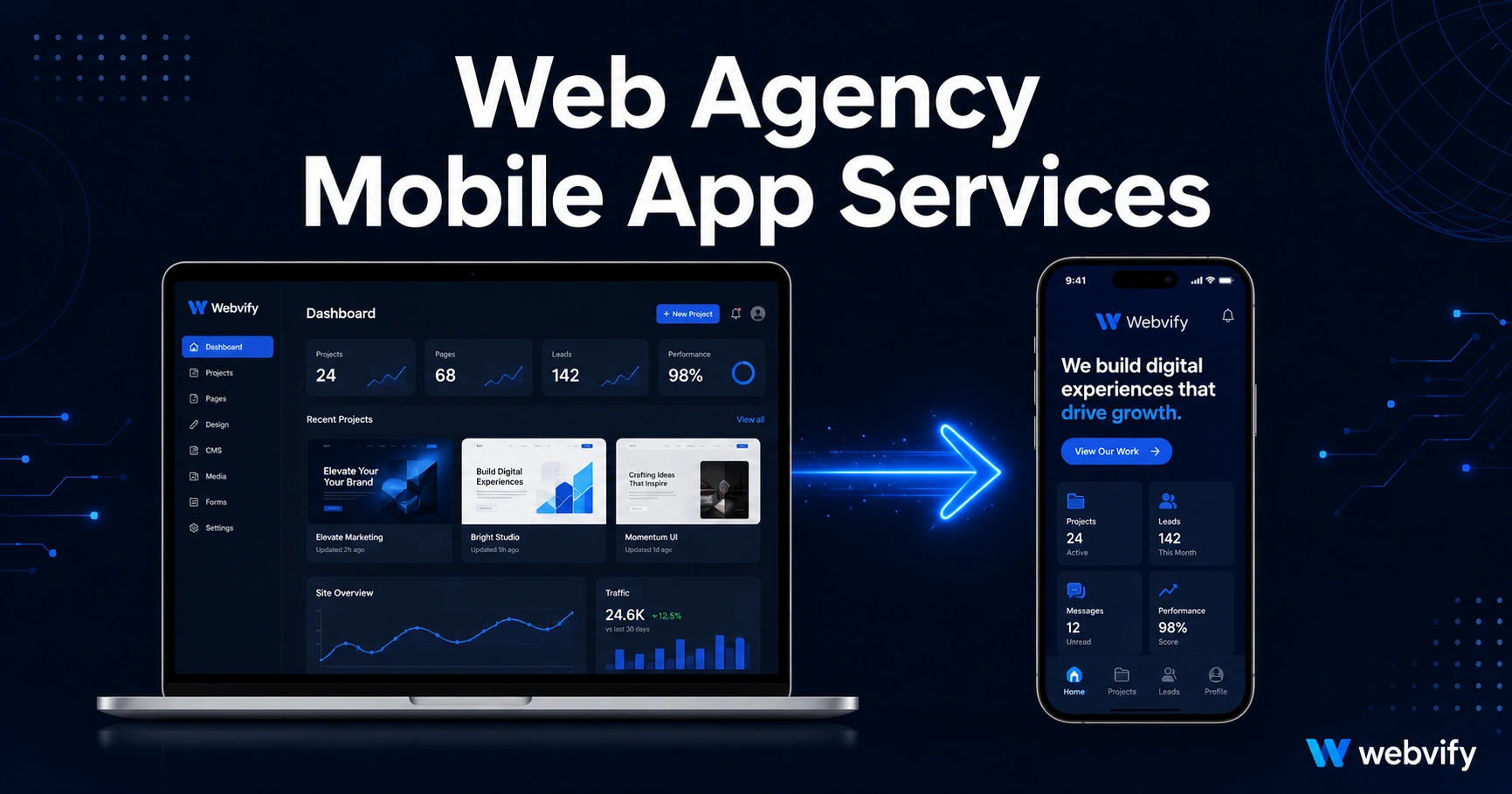
Web agencies that add mobile app services earn $3K–$8K more per client. Here's the exact ROI breakdown and how to offer apps without learning mobile dev.
Inside this article
- Why Web Agency Mobile App Services Are the Easiest Upsell You're Not Doing
- What the Revenue Math Actually Looks Like
- The Technical Barrier Is Gone — That's the Real News
- How to Price Mobile App Services as an Agency
- What the Upsell Conversation Actually Sounds Like
- What to Watch Out For
- FAQ
- Add Mobile App Services to Your Agency — Without the Learning Curve
Most web agencies close a project, hand over the files, and move on. The average client relationship ends at launch — and the revenue walks out with them.
Adding a mobile app to your service offering changes that equation entirely.
Why Web Agency Mobile App Services Are the Easiest Upsell You're Not Doing
Your clients already have a problem they haven't solved: they're sending mobile visitors to a browser-based site that doesn't convert as well as an app, and they have no way to reach customers between visits.
You already have the relationship to solve it.
The clients who hire web agencies are exactly the people who need mobile apps — small business owners, e-commerce operators, service businesses — but most have never been offered one. Not because they wouldn't buy it, but because no one asked.
The question isn't whether your clients want apps. It's whether you're positioned to offer them.
What the Revenue Math Actually Looks Like
Here's a simplified version of the revenue impact for a web agency that adds mobile apps as a service.
A typical web design project runs $2,000–$5,000 for a small business site. It's transactional: deliver the site, collect payment, done.
A mobile app service, sold as an add-on or standalone project, typically runs $1,500–$3,500 for a done-for-you WebView app covering the build and App Store submission. On top of that, ongoing support or admin panel access can generate $50–$150/month in recurring revenue.
Across just five clients per quarter, that's an additional $7,500–$17,500 in project revenue, plus recurring. That's not a projection — it's the math for agencies that have already built this into their model.
If you'd like a broader look at what mobile apps cost in 2026 across different service levels, this breakdown covers the full range.
The Technical Barrier Is Gone — That's the Real News
The most common objection from agencies: "I don't know how to build a mobile app."
That barrier doesn't exist the same way it did five years ago.
WebView-based apps convert a client's existing website — the site you already built — into a fully packaged iOS and Android app. There's no native code to write. The client's WordPress site, Shopify store, or custom web app becomes the app content. A service like Webvify handles the full end-to-end process: building the WebView wrapper, preparing the App Store submission, and managing the review process — all under the client's own developer accounts.
For an agency, this means you can offer a mobile app service without adding a mobile developer to your team. The technical execution is handled. Your job is the client relationship and the upsell conversation.
This is the same model covered in more detail in How to Offer Mobile Apps to Your Web Design Clients — if you're looking for the full positioning playbook.
How to Price Mobile App Services as an Agency
Pricing depends on whether you're reselling a managed service or marking up a platform fee.
Option 1: Done-for-you resale. You sell a mobile app package at $2,500–$4,000. The underlying service costs you $800–$1,500. Your margin is $1,500–$2,500 per project, with no technical work required from your team. This is the most common model for web agencies entering the mobile space.
Option 2: Retainer add-on. After the initial app build, offer a monthly support retainer ($99–$199/month) covering updates, App Store account management, and push notification strategy. Across 10 clients, that's $1,000–$2,000/month in predictable recurring revenue — without adding headcount.
Option 3: Annual maintenance package. Some agencies bundle app maintenance into an annual package alongside hosting and site maintenance. This increases average client contract value and reduces churn by tying the client's app stability to the agency relationship.
The key is deciding which model fits your current client mix. If you're primarily project-based, start with done-for-you resale. If you already have retainer clients, the monthly add-on model is the lowest-friction entry point.
What the Upsell Conversation Actually Sounds Like
You don't need a formal sales pitch. The conversation is short.
"We can take the site we built and package it as a native iOS and Android app. It goes live on the App Store and Google Play under your brand. You'd be able to send push notifications to your customers — open rates around 60–90%, compared to 25–30% for email. The process takes about two to three weeks and we handle everything."
That's it. The client either has a use case — they want to send offers, they want to be on the home screen, they're losing mobile conversions — or they don't. If they do, the conversation is already 80% closed.
The friction isn't the sale. It's having the conversation. Agencies that add mobile apps to their offering report that the most surprising part was how few clients pushed back on price once they understood what they were getting.
What to Watch Out For
A few things that trip up agencies adding mobile app services for the first time.
App Store submission takes longer than expected. Apple's review process is 24–48 hours for most apps, but first-time submissions often require corrections. Build a one-to-two week buffer into your timeline, especially for apps with login flows or digital goods.
The client needs their own developer accounts. Apple charges $99/year; Google charges a one-time $25 fee. This isn't your cost, but it's a client expectation to set upfront. Developer account setup should be scoped into your onboarding process.
Push notifications require configuration. WebView-based apps can integrate third-party push services without native code, but it's a setup step. If the client wants push notifications — and they usually do — confirm it's included in your scope or priced separately.
FAQ
How much should a web agency charge for mobile app services?
Most web agencies price done-for-you mobile app packages between $2,500 and $4,000 for a WebView-based iOS and Android app including App Store submission. Monthly support retainers typically run $99–$199/month. A 50–70% gross margin on the project fee is achievable with a managed service model where the technical build is handled by a third party.
Do I need to know mobile development to offer mobile apps as a web agency?
No. WebView-based app services convert a client's existing website into a packaged iOS and Android app without native code. Services like Webvify handle the technical build and App Store submission end-to-end, so you can offer mobile apps as a managed service without hiring a mobile developer.
How long does it take to get a client's app on the App Store?
From kickoff to a live app, expect two to four weeks. The build itself typically takes a few days. Apple's review adds 24–72 hours, but first-time submissions often need one or two rounds of corrections. Google Play is faster, usually 24 hours. Setting client expectations at three weeks is a safe default.
Add Mobile App Services to Your Agency — Without the Learning Curve
Web agencies that add mobile app services don't need to become mobile development shops. The technical path is already solved.
What it takes is deciding to offer it, pricing it into your service menu, and having the five-minute conversation with clients who are already asking why their competitors have an app.
Webvify handles the build, App Store submission, and post-launch admin panel — so your agency keeps the client relationship and the margin, without the technical overhead.