

White-Label App Builder Comparison 2026: The Agency Guide
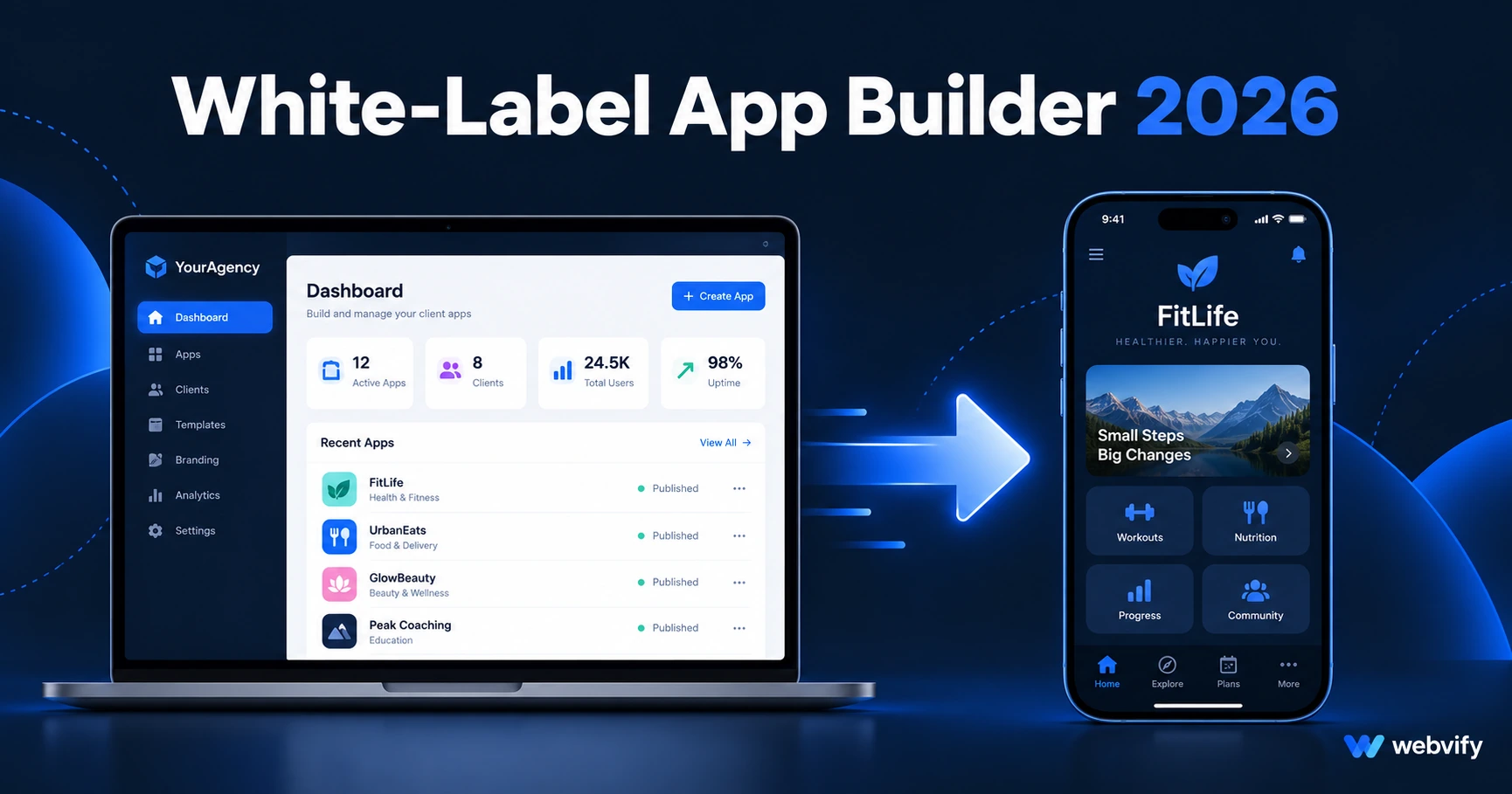
Not all white-label app builders handle App Store submission. Here's how agencies compare platforms in 2026 — and what most reviews miss.
Inside this article
- What "White-Label" Actually Means in the App World
- The 5 Questions That Actually Matter When Evaluating a White-Label App Builder
- The Main Categories of White-Label App Builders in 2026
- What to Look for in a White-Label Partnership for Agencies
- How to Pick the Right Platform for Your Client Base
- What Agencies Get Wrong When Adding App Services
- FAQ
Most white-label app builder comparisons stop at features and pricing. The part they skip — who actually handles App Store and Google Play submission — is the difference between a platform your agency can resell and one that turns your team into a mobile dev shop.
What "White-Label" Actually Means in the App World
The term gets used loosely. When an agency asks for a white-label app builder, they usually want one of two things:
Option 1: A build tool. A platform where they create apps for clients themselves, branded under their agency or the client's name. The agency does the work.
Option 2: A reseller program. A service that builds and submits the app on the agency's behalf, under the client's developer accounts, with the agency as the point of contact. The provider does the work.
Most comparisons mix these two categories. They are fundamentally different products with different cost structures, time investments, and margins.
This guide focuses on agencies that already build websites and want to offer mobile apps as an add-on service — without hiring mobile developers.
The 5 Questions That Actually Matter When Evaluating a White-Label App Builder
Before comparing any platform, answer these five questions:
1. Does it wrap your client's existing website, or does content need to be rebuilt? If the platform requires recreating all website content inside a proprietary editor — which Appy Pie, BuildFire, and GoodBarber all do — you've just created a second system for the client to maintain alongside their website. That is a support burden you inherit.
2. Who handles App Store and Google Play submission? Apple charges $99/year per account. Google charges $25 once. But the real cost is the 20–40 hours spent navigating app review, compliance requirements, and rejection handling if something goes wrong. A white-label app builder that leaves submission to you or your client is not resellable — it is another technical service you have to deliver.
3. Whose developer accounts does the app live on? Apps published under a third-party's developer account are locked to that provider. If the client wants to leave, the app does not come with them. Apps published under the client's own Apple and Google accounts are portable.
4. What happens when the client's website changes? A WebView-based app pulls content live from the existing website. When the client updates their site, the app updates instantly. A rebuild-based platform requires manual updates in two places — the website and the app backend.
5. What does the pricing actually include? Many platforms advertise a low monthly fee, then charge separately for App Store submission, hosting, push notifications, and custom domains. Factor in the full cost before quoting a client.
The Main Categories of White-Label App Builders in 2026
Website wrapper services (managed, done-for-you)
These services take a client's existing URL and convert it into a native-shell app, then handle App Store and Google Play submission end-to-end. The app updates automatically when the website changes. Best for agencies that want to resell app delivery without learning mobile development.
Examples: Webvify, GoNative, Natively, Median.co, Twinr.
Self-serve app builders (DIY)
These platforms provide an editor where you build an app from scratch, export it, and handle submission yourself. Best for agencies with in-house mobile development capacity.
Examples: BuildFire, GoodBarber, Appy Pie, Shoutem.
Shopify-specific app builders
These tools convert Shopify stores into branded mobile apps with native shopping features. Best for agencies specializing in e-commerce clients.
Examples: Tapcart, Shopney, Vajro, Appbrew.
Which category fits your agency depends on your client profile, not on feature lists.
What to Look for in a White-Label Partnership for Agencies
If you are evaluating a website wrapper service as a white-label reseller:
End-to-end delivery matters more than the feature list. An app that gets submitted successfully under your client's developer accounts, with push notifications working from day one, delivers more agency value than a feature-heavy platform that takes months to go live.
Client-owned accounts protect long-term relationships. Apps published under your client's Apple and Google accounts mean the client keeps the asset even if they change agencies. This builds trust and reduces client anxiety.
Admin panel self-service reduces your support load. After launch, clients want to send push notifications, update their splash screen, and check analytics. A clean admin panel means they do not call you for every change.
Clear reseller pricing protects your margin. Know exactly what you are paying per app per month, what the setup cost is, and what is included before you quote your first client. Services like Webvify offer agency-specific pricing that makes this straightforward.
For a practical breakdown of the revenue math for agencies, the mobile app reseller program guide for agencies covers the step-by-step setup — including how to price app delivery as a service with real margin numbers.
How to Pick the Right Platform for Your Client Base
Your clients have websites → use a website wrapper service. If your clients run WordPress, Shopify, Webflow, Wix, or custom sites, the fastest path to a delivered app is a wrapper service that converts the existing URL. There is no content rebuild, no dual system, and the app goes live in days rather than months.
Your clients need custom native features → use a rebuild platform. If your clients need hardware integrations, custom offline functionality, or features that cannot be delivered through a WebView, a rebuild platform gives you more control — but expect a significantly higher time and cost investment per project.
Your clients are Shopify stores → use a Shopify-specific builder. For pure Shopify clients, native shopping features (cart sync, product filters, checkout optimization) justify a specialized tool over a general wrapper.
For most web agencies working with SMBs, the website wrapper category delivers the best ratio of speed to quality. How to offer mobile apps to web design clients walks through how agencies package this service to maximize client uptake and build a recurring revenue stream.
What Agencies Get Wrong When Adding App Services
Underpricing the submission process. App Store review takes 24–48 hours on average, but rejections can take weeks to resolve. If you handle submission yourself, price that time into your quote.
Choosing a platform based on features instead of workflow fit. The platform that wins every feature comparison is rarely the one that fits neatly into an agency's delivery process. Evaluate platforms on how much post-launch support they require from you.
Not testing the admin panel before pitching clients. The admin panel is what your client touches every week after launch. If it is complicated or limited, it becomes your support burden. Request a demo account from any provider before committing.
FAQ
What is the best white-label app builder for web design agencies?
For web agencies that build client websites and want to offer apps without hiring mobile developers, managed website wrapper services are the best fit. These services convert the client's existing website URL into an iOS and Android app, handle App Store and Google Play submission, and include an admin panel for post-launch management — all without rebuilding any content.
Do white-label app builders handle App Store submission?
It depends on the platform. Self-serve app builders like BuildFire, GoodBarber, and Appy Pie provide the app file but leave submission to you or your client. Managed wrapper services like Webvify handle submission end-to-end as part of their service. For agencies, submission-included services protect your time and make the offering resellable.
How do agencies price mobile app services to clients?
Most agencies charge a one-time setup fee ($1,500–$3,500) and a monthly retainer ($99–$299/month) that covers the app platform, hosting, and account management. The setup fee covers the initial build, branding, and App Store submission. The monthly fee covers platform costs, ongoing support, and push notification management. Detailed pricing models are covered in the best mobile app reseller programs comparison.
Ready to offer mobile apps to your web clients without hiring a mobile developer? Webvify converts any existing website into a fully branded iOS and Android app, handles end-to-end App Store and Google Play submission, and gives your clients an admin panel to manage it all.