

Webvify vs MobiLoud: Pricing, Features & Who Wins in 2026
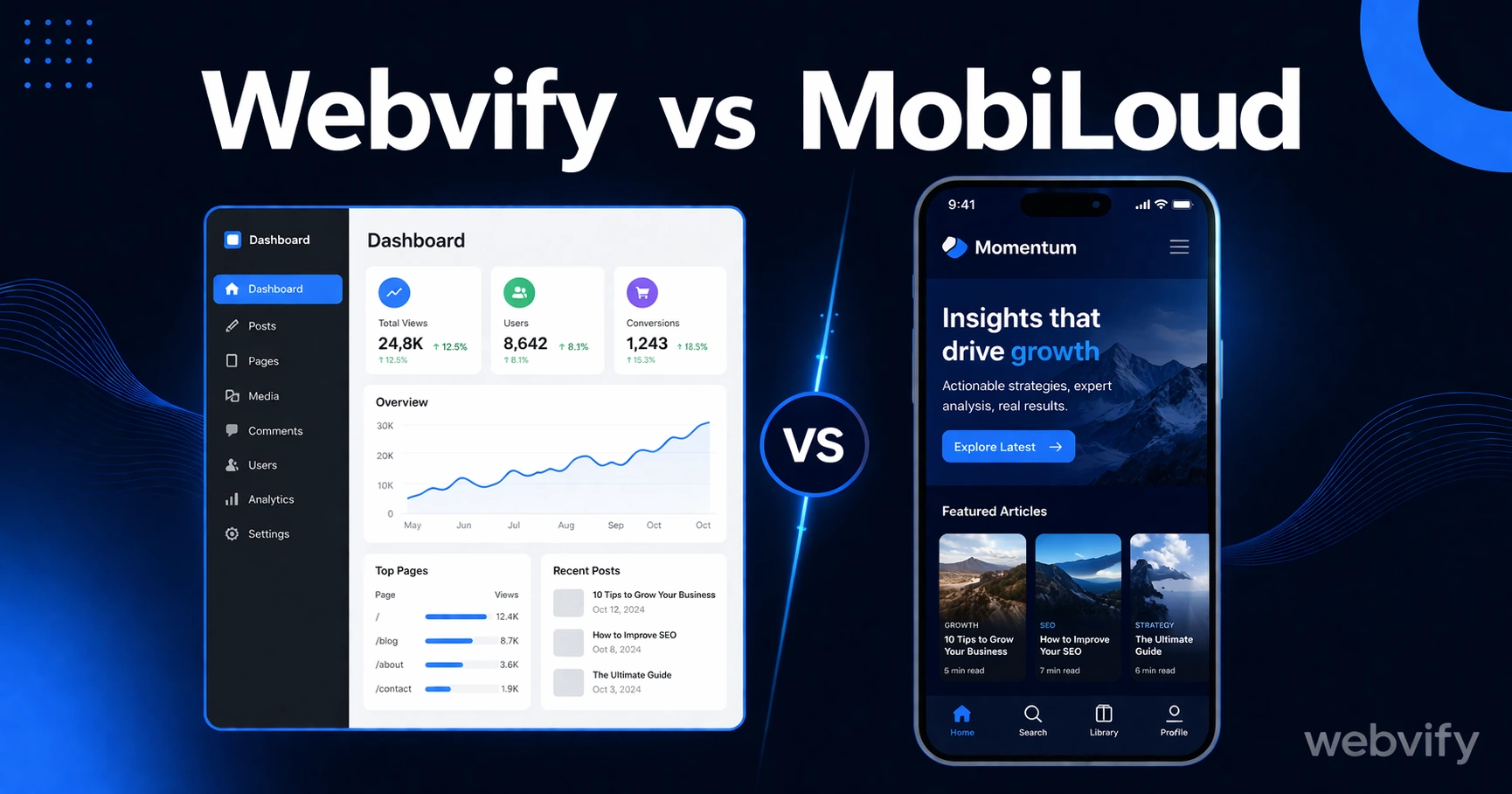
MobiLoud starts at $399/mo + $850 setup. Webvify is a flat one-time fee. Here's the full pricing and feature breakdown so you can decide fast.
Inside this article
MobiLoud charges $399 per month plus an $850 one-time setup fee. Before you've seen a single screen of your app. For a small business owner or freelancer exploring mobile apps for the first time, that's not a small number — and it raises a fair question: what does that price actually get you, and is there a better fit for your situation?
This comparison breaks down how Webvify and MobiLoud actually differ, who each one is built for, and how to decide which makes more sense for your business.
What Webvify and MobiLoud Both Do
Both Webvify and MobiLoud take your existing website and package it into a mobile app that runs on iOS and Android. The core technology behind both is similar: a WebView container that loads your site inside a native app shell, giving it the look and feel of a real mobile app without rebuilding your website from scratch.
This approach works because your website already has all the content, products, and functionality your customers need. The app is essentially a branded, App Store-published wrapper that loads your site with native features layered on top — like push notifications, offline splash screens, and app icons.
Where Webvify and MobiLoud diverge is not in what they build. It's in who does the building, what the service model looks like, and how much it costs to get from "I want an app" to "my app is live on the App Store."
MobiLoud: Built for E-Commerce Teams With Budgets to Match
MobiLoud has established a strong position in the mid-market e-commerce space. Their content and product are built around Shopify, WooCommerce, and Magento stores with established customer bases and internal teams to manage the integration.
Their pitch is ROI-driven: case studies showing "53x ROI" and "3x higher lifetime value from app users" are front-and-center on their site. Those numbers are compelling if you already have a large customer base to re-engage. If you're running a Shopify store doing serious volume and you need deep cart and checkout sync, MobiLoud has the track record to back it up.
But the pricing reflects that target market. The base plan at $399/month is self-serve — meaning your team handles configuration, integrations, and ongoing updates. App Store submission, the part that most small businesses find most confusing, is only included at the managed service tier, which starts at $7,200 per app.
For an established e-commerce brand with a marketing team, those costs can make sense. For a restaurant owner, a local service business, or a freelancer building a first app, they rarely do.
Webvify: Done-For-You Without the Enterprise Price Tag
Webvify's model is structurally different. Rather than giving you a platform to manage yourself, Webvify handles the entire process from start to finish — building the app, submitting it to the App Store and Google Play, and delivering an admin panel so you can manage push notifications and content updates yourself after launch.
You don't need to navigate Apple's review guidelines, set up provisioning profiles, or coordinate a developer. The technical work is done for you. You approve the result.
This matters most for three types of customers:
Local and service business owners who have a working website but no developer on staff. They want an app that looks professional and actually gets approved — without spending months learning mobile development.
Web developers and freelancers who want to add mobile apps to their client services without learning a new skill set. With a done-for-you service, they can resell the delivery without managing it themselves. If you're in this position, this guide walks through exactly how freelancers are packaging mobile apps as a client service.
Small e-commerce and content site owners who want a real mobile presence but can't justify $400+/month in ongoing platform fees for a self-managed tool.
Services like Webvify exist precisely for the gap between "I want an app" and "I have the resources to build and manage one." The done-for-you model removes the dependency on internal technical capacity.
The Key Differences Between Webvify and MobiLoud
The most important difference is the service model. MobiLoud is a self-serve platform with optional managed tiers at additional cost. Webvify is a fully managed service where the technical execution is handled for you by default.
On pricing, MobiLoud starts at $399/month plus setup, with a $7,200+ managed tier for App Store submission. Webvify operates on a project-based model — you pay for the work done, not a recurring platform access fee.
On App Store submission, MobiLoud includes it at their managed tier only. Webvify includes submission as part of the standard service — there's no upsell to reach the feature most customers actually need.
On target customer, MobiLoud is optimized for e-commerce businesses at scale. Webvify is built for SMB owners, freelancers, and service businesses that want a professional result without running the process themselves.
If you've already looked at other tools in this space, the Webvify vs. Median comparison covers how Webvify stacks up against the other major web-to-app platform — including the enterprise-focused tier that Median.co targets.
Which One Is Right for You?
Three questions make this decision fairly clear:
Do you have a technical team? If yes, MobiLoud gives you more granular control over the integration. If no, Webvify's done-for-you model removes the need to learn a new platform.
Are you running a large e-commerce operation? MobiLoud was designed around high-volume Shopify and WooCommerce stores that need tight checkout sync. For most small businesses, a WebView app that mirrors your existing site delivers everything your customers need without the complexity.
What's your budget ceiling? At $399/month, MobiLoud runs to approximately $4,800 per year before setup fees and App Store submission costs. For a business that wants a one-time investment rather than an ongoing platform bill, the math rarely works out in MobiLoud's favor.
Neither tool is universally better. MobiLoud earns its place for well-resourced e-commerce operations. Webvify is the stronger fit when the goal is getting a professional, fully published app live without managing the technical process internally.
Frequently Asked Questions
Is MobiLoud better than Webvify?
It depends on your specific situation. MobiLoud is well-suited for established e-commerce businesses with internal teams and budgets above $400/month. Webvify is the stronger fit for small business owners, freelancers, and service businesses that want a fully managed process — from app build to App Store submission — without ongoing platform fees or technical overhead.
Does MobiLoud include App Store submission?
App Store submission in MobiLoud is part of their managed service tier, which starts at $7,200 per app. With Webvify, App Store and Google Play submission is included in the standard service by default — there's no additional tier required to get your app published.
Can I switch from MobiLoud to Webvify?
Yes, and the process is relatively straightforward. Since both services wrap your existing website, the migration involves rebuilding your app from your current website URL and resubmitting to the App Store and Google Play. Your existing app users won't be disrupted, and after launch you manage everything through Webvify's admin panel.
Getting your app onto the App Store shouldn't require an enterprise budget or a technical team to manage it.
Webvify handles everything — building your WebView app, submitting it to the App Store and Google Play, and setting up your admin panel — so you can focus on running your business, not managing a mobile development process.