

Mobile App for Handyman Services: Win More Repeat Jobs and Stop Losing Customers to Silence
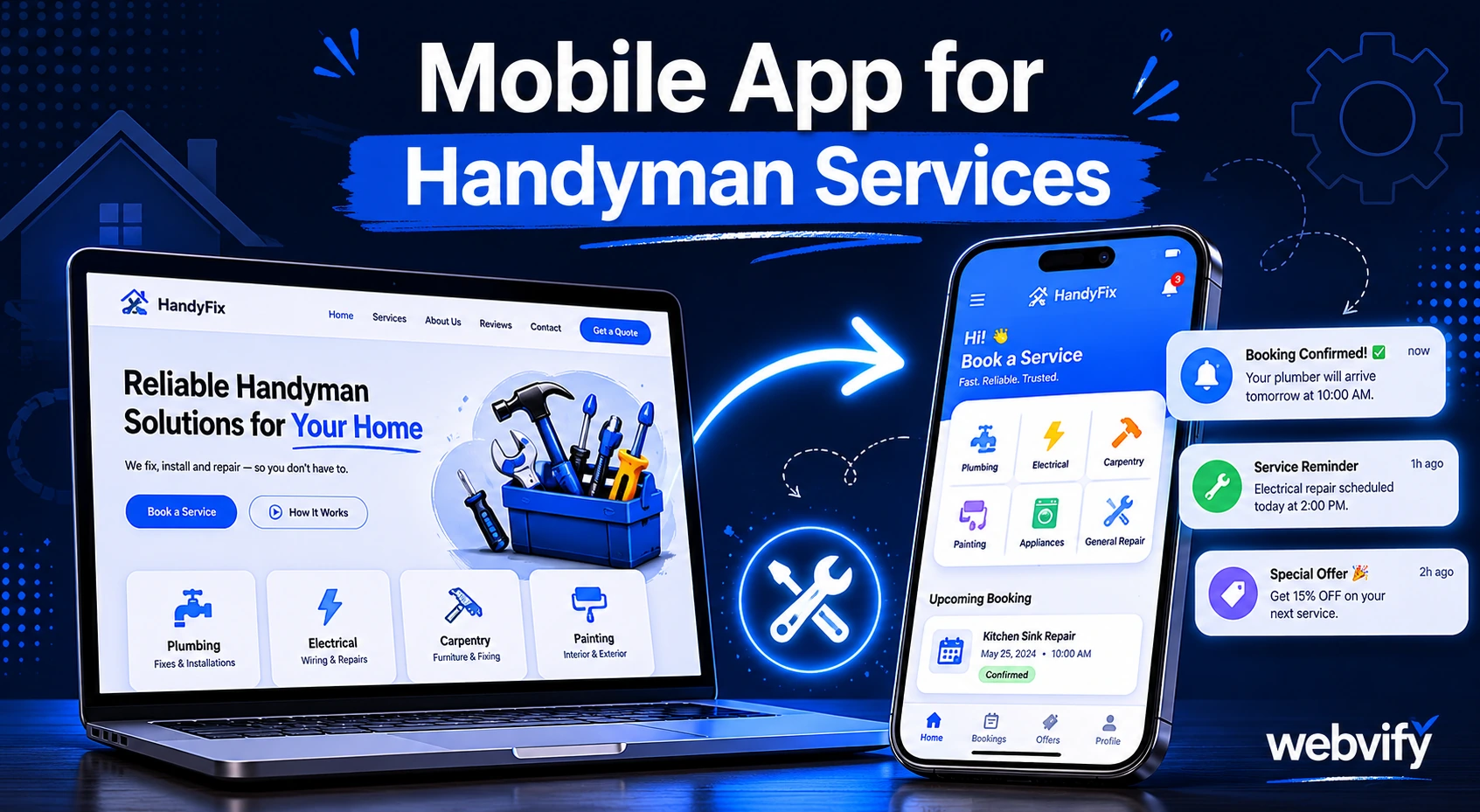
A mobile app gives handymen push notifications, home screen presence, and App Store credibility. Here's how to get one without a developer in days.
Inside this article
Most handyman customers finish a job satisfied — and then you never hear from them again. Not because the work was bad. Because when their next repair need arrives six months later, they search Google instead of looking for your number.
Why Handyman Businesses Lose Repeat Customers (It's Not the Work)
The average home generates 3–5 repair and maintenance jobs per year. But most customers place those calls with whoever shows up first in a search — not the person who already proved they could do the job.
This is the retention gap: a long stretch of silence between visits where nothing connects you to the customer. No reminder. No touchpoint. No reason to think of you before typing "handyman near me."
A branded mobile app on a customer's home screen changes that dynamic completely. Your name is there before they feel the need. When they think "I should fix that shelf," your app icon is already in front of them.
What a Mobile App Does for a Handyman Business
A mobile app gives you three things a website and social media cannot reliably deliver.
Push notifications that land on the lock screen. Email open rates for home services businesses average 20–28%. Push notifications from a mobile app are opened at 60–90%. That gap is the difference between a message that gets read and one that gets ignored.
Home screen presence. Every time a customer opens their phone, your brand is visible. This keeps your business top of mind during the weeks and months between jobs — the exact window where you're competing against a Google search.
App Store credibility. When a new customer searches "handyman [city]" in the App Store, your business appears. That listing — with reviews, your logo, and a download count — signals a level of professionalism that a website link or a Facebook page cannot match. For a trade where customers hand over home access, that signal matters.
Three Push Notification Campaigns That Work for Handymen
The real ROI of a mobile app is not the app itself — it's the notification sequences you send through it. Here are three that consistently drive repeat bookings for handyman businesses.
The seasonal opener. Spring and autumn trigger most home maintenance decisions. A push notification sent in early March — "Spring is here. Need anything patched, fixed, or refreshed before summer?" — reaches customers at the exact moment they're already thinking about their home. No paid ad. No algorithm.
The Day-21 post-job follow-up. Three weeks after a completed job, send a follow-up: "Hi [name], hope the [repair type] is holding up. Let us know if anything else needs attention." This turns a one-off transaction into an ongoing relationship. It also captures referral intent while the positive experience is still fresh.
The 12-month reactivation. Customers who haven't booked in a year are not lost — they just haven't needed you yet. A reactivation push at the 12-month mark ("It's been a while — anything on the to-do list?") costs nothing to send and reactivates a segment of your customer base that would otherwise drift to a competitor.
How Webvify Handles App Publishing Without a Developer
Getting a branded mobile app onto the App Store and Google Play used to require a mobile developer, months of back-and-forth, and costs starting at $15,000. That's not realistic for a handyman business with 50–300 active customers.
Services like Webvify handle the entire process end-to-end: they take your existing website, wrap it into a fully branded app, and submit it to both stores under your own developer accounts. You get an admin panel to manage notifications and content yourself after launch. No code. No Xcode. No waiting.
For handymen already using a booking tool like Jobber, ServiceTitan, or even a simple contact form — the existing site is all that's needed. The app packages what you already have and puts it on the App Store.
If you're curious about the overall cost picture, this breakdown of no-code mobile app pricing in 2026 covers what to expect across different service tiers.
What to Look for in an App Service for a Handyman Business
Not all app services are built the same. Three things matter for a small handyman operation:
End-to-end submission. Some tools give you an app file but leave App Store submission to you. Apple's developer portal and Google Play's compliance forms are not designed for non-technical users. Look for a service that handles submission completely.
Your own developer accounts. Your app should live under your Apple Developer and Google Play accounts — not the vendor's. If you ever switch providers, your reviews, downloads, and App Store ranking stay with you.
Push notification management. This is the core value driver. Make sure the admin panel lets you send segmented notifications without needing to log into a developer dashboard.
For a broader look at how this fits into the full mobile conversion picture, the no-code app builder vs custom development comparison walks through when each approach makes sense.
FAQ
How much does a mobile app cost for a handyman business?
Most no-code web-to-app services for small trades businesses range from $200 to $600 as a one-time fee, with optional monthly plans for ongoing support and push notification management. Custom native development starts at $15,000–$50,000 and is rarely justified for a service business with fewer than 500 active customers.
Do I need an app if I already have a Google Business Profile?
Google Business Profile handles discovery — customers finding you the first time. A mobile app handles retention — making sure customers who already used you come back instead of searching again. They solve different problems. A profile brings customers in; an app keeps them from leaving.
Will Apple approve a handyman app on the App Store?
Yes. WebView apps for local service businesses are approved regularly on the App Store. The key compliance requirement is Apple Guideline 4.2 (Minimum Functionality) — your app needs real utility, such as a booking form, service catalog, or contact system. A simple brochure-style app with no interactive features may be rejected. A service with booking integration, push notifications, and a contact form meets the standard easily.
Repeat bookings from customers you've already served are the lowest-cost revenue you can generate. A mobile app with three scheduled push notification campaigns per year is the system that captures that revenue instead of watching it go to the next Google result.
Get your handyman app built and live on the App Store in days → webvify.app