

How to Sell Mobile Apps to Local Businesses: Cold Outreach Scripts and Pricing
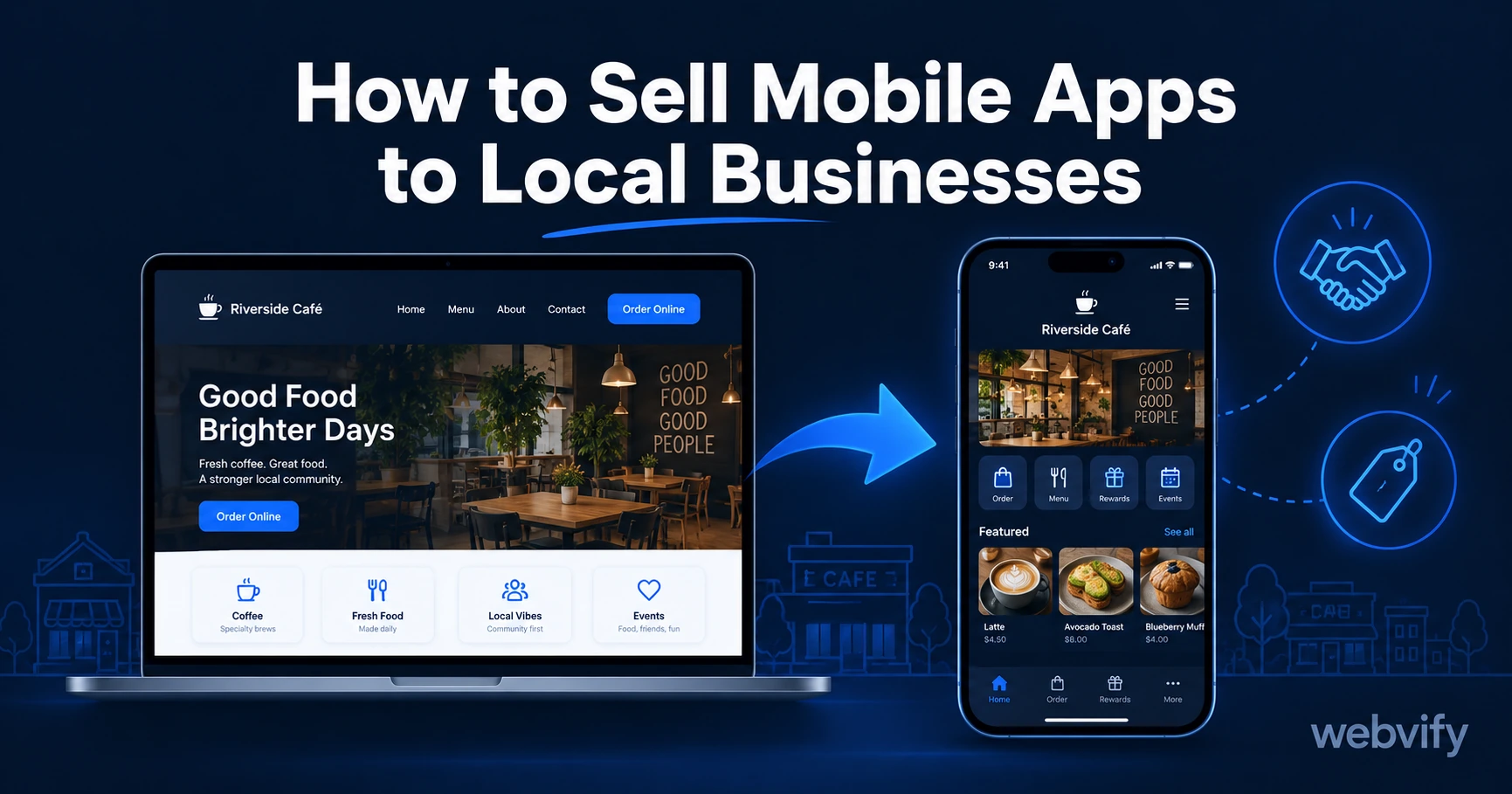
Learn how to sell mobile apps to local businesses — what to say, what to charge, and how to close the deal without being a mobile developer.
Inside this article
Most local businesses have a website, no mobile app, and a business owner who has never thought seriously about changing that. Your job is not to convince them they need an app — it is to show them what they are already losing without one.
This guide covers how to find the right prospects, what to say in an initial conversation, how to price the service, and how to close deals repeatedly without needing mobile development skills yourself.
Who to Target First
The easiest sale is to a business that already has an existing customer base and a website — not a brand-new startup. You want a business that is good at what it does but losing repeat customers to silence.
The highest-converting categories for cold outreach are:
Service businesses with repeat cycles: salons, gyms, yoga studios, cleaning companies, and chiropractors. Their customers come back on a schedule — a branded app with push notifications dramatically improves rebooking rates.
Appointment-based professionals: dentists, physiotherapists, accountants, and insurance agents. These businesses go months between client contacts. A push notification sent 30 days before a renewal or check-up is worth more than any email campaign.
Food and hospitality businesses: coffee shops, restaurants, bakeries. Their customers visit frequently but forget about the business the moment they leave. A loyalty program or a daily special push notification fixes that.
If a business owner can answer yes to "do your customers come back more than once a year?" — they are a strong prospect.
The First Conversation: What to Say
Most cold pitches fail because they open with a product, not a problem. Never lead with "I can build you a mobile app." Lead with the gap.
Here is a simple script for an in-person or phone cold approach:
"I work with [type of business] owners who have a website and a good customer base, but lose repeat customers because there's no easy way to stay in touch between visits. A branded app on your customer's phone — with push notifications — changes that. Email open rates average around 25%. Push notifications hit 70 to 90%. Most of my clients see more repeat bookings within the first month. Would that be useful for your business?"
If they say yes, you have a qualified lead. If they say "I don't know," ask: "When a customer finishes a session with you, how do you remind them to come back?" The answer almost always reveals the gap you are solving.
For email outreach, keep it shorter:
Subject: Mobile app for [Business Name]
Body: "Hi [Name] — I help [business type] owners get a branded mobile app on the App Store without hiring a developer. It takes about a week and costs a flat fee, not a monthly subscription. Would it be worth a 15-minute call to see if it's a fit for your business?"
That is 50 words. The specificity of "one week, flat fee" does most of the work.
How to Price a Mobile App Service
Pricing confusion kills more deals than objections do. Keep it simple: one upfront fee, one optional monthly retainer.
A common structure that works well for local businesses:
One-time setup fee: between $1,500 and $3,500 depending on complexity. This covers the app build, App Store and Google Play submission, and setup of push notifications and the admin panel. Services like Webvify handle the technical side end-to-end — you do not touch Xcode or Android Studio. Your margin is the difference between what you charge and what you pay the service provider.
Optional monthly retainer: $99 to $199 per month for ongoing management, updates, and sending push notification campaigns. Many clients opt into this because they do not have time to manage it themselves.
Do not offer hourly pricing. It creates budget anxiety and focuses the client on cost rather than value. A flat fee anchors to a result, not to your time.
When a client asks "why not just use an app from the App Store?" — the answer is: "A generic app doesn't have your branding, your customer list, or your push notification access. This is your app, under your business name, on the App Store under your developer account."
Handling the Most Common Objections
"I can't afford it right now." Ask: "What does a returning customer spend with you on average over a year?" If the answer is $200, and the app brings back even 10 customers who otherwise would not have returned, it has paid for itself in the first month. You are selling a retention tool, not a tech expense.
"I already have a website." Agree: "Yes, and that is exactly why this works. We turn your existing website into a mobile app — there is no rebuilding, no new content to manage. Your website runs the app." If you use a WebView wrapper service, this is literally true.
"Nobody downloads apps from local businesses." Counter with: "You are right that nobody downloads a random app. But when you tell your existing customers — in person, via email, or with a QR code at the counter — that your app has exclusive loyalty perks and push deals, your regulars download it. You are not trying to rank in the App Store. You are converting the customers you already have into app users."
For more context on how to position this service to web design clients specifically, see how to offer mobile apps to your web design clients without learning mobile dev.
The Close: Moving From Conversation to Contract
The two most common reasons deals stall after a good first conversation: the prospect is not sure it will work for their specific business, and the process sounds complicated.
Solve the first with a concrete example: "A cleaning company I work with added 40 rebookings in the first six weeks just from a push notification they sent on day 21 after a job. It said: 'It's been three weeks — ready to book your next clean?' That one message alone covered the cost of the app."
Solve the second with a process walkthrough in one sentence: "You give us your website URL, we build the app, handle the App Store submission, and you get an admin panel to manage it. You do not need to be technical — most clients are live within seven to ten days."
Then ask for the next step: "Do you want me to send over a one-page scope with the exact cost and timeline?"
Once you have a scope request, the sale is 80% done.
For a deeper look at the recurring revenue model this creates for agencies, see mobile app reseller program for agencies.
FAQ
How much should I charge to sell mobile apps to local businesses?
A one-time setup fee of $1,500 to $3,500 is a typical starting range for a fully managed app build and App Store submission service. Add a monthly retainer of $99 to $199 if the client wants ongoing push notification management. Price based on the value to the client — a restaurant rebooking 20 regular customers per month via push is seeing $2,000 to $3,000 in retained revenue, making your fee easy to justify.
Do I need to know how to build apps to sell them?
No. Managed web-to-app services handle the technical build, App Store submission, and admin panel setup. Your role is sales, relationship management, and occasional campaign strategy. You white-label the service and focus on what you are good at — the business relationship.
What is the best way to find local businesses to pitch?
Start with businesses you already know and whose owners you can reach directly. A warm introduction converts at three to five times the rate of a cold call. After that, look for local business owners active in chamber of commerce groups, local Facebook groups, or neighbourhood business associations. You do not need a large pipeline — five to ten good prospects at a time is enough to close two to three deals a month.
Ready to start selling? Webvify handles the app build, App Store submission, and admin panel — so you can focus on closing deals, not writing code.