

App Reseller Program for Agencies: Step-by-Step Guide
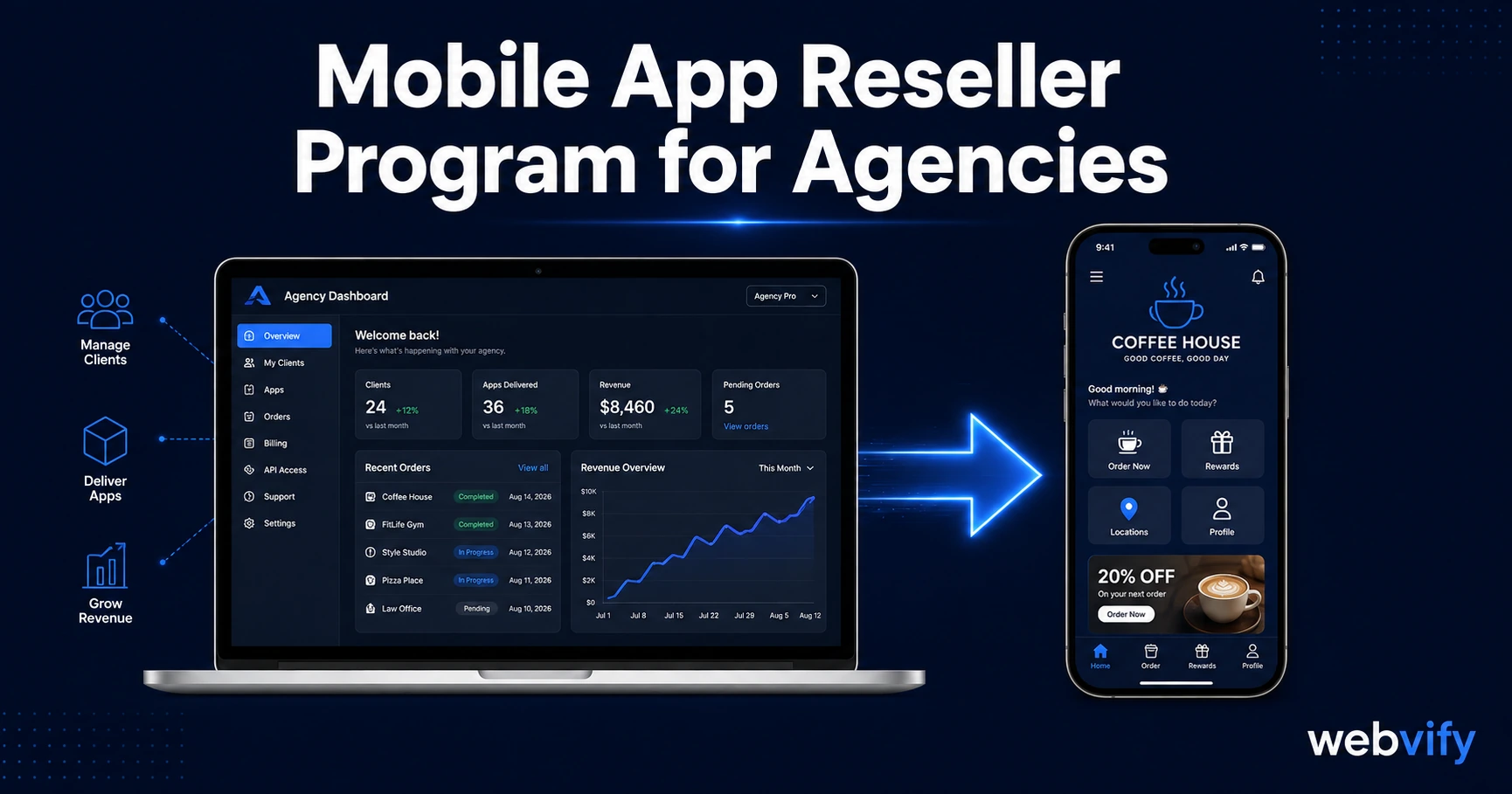
Join a white-label mobile app reseller program and add $3K–$8K per client to your agency. Covers pricing, onboarding, App Store submission, and scaling.
Inside this article
The average web project ends with a handoff file and then silence — sometimes for years. A mobile app reseller program converts one-time project clients into monthly subscribers without requiring a single line of mobile code.
This guide covers the operational side: how to structure the service, which clients to pitch first, what to charge, and how to handle App Store submission and ongoing management across multiple clients simultaneously.
What a Mobile App Reseller Program for Agencies Actually Looks Like
A mobile app reseller program is a service arrangement where your agency sells branded mobile apps to clients, and a white-label provider handles the technical side — building the app, submitting it to the App Store and Google Play, and maintaining it after launch.
Your agency owns the client relationship and sets the pricing. The provider handles the build-to-submission process. You don't need a mobile developer on staff, and you don't need to learn Xcode or Android Studio.
From the client's perspective, the app comes from your agency. From your perspective, you're adding a recurring revenue line to every website project without adding headcount.
The model works because most of your existing clients already have the one thing needed to get an app live: a working website. A WebView wrapper converts that website into a fully branded iOS and Android app, published under the client's name in the stores.
If you haven't looked at the revenue side of this model yet, the agency mobile app services ROI breakdown walks through realistic per-client margins in detail.
Which Agency Clients Are the Right Fit
Not every web client is a fit for a mobile app upsell. The ones most likely to say yes share a few characteristics.
They run a repeat-customer business. Restaurants, salons, fitness studios, coaching businesses, and e-commerce stores all have customers who come back. Those customers forget the business between visits — and a branded app on the home screen solves that problem. Push notification open rates run 60–90% compared to 20–30% for email, so clients who already feel the pain of low email engagement are naturally receptive.
They're frustrated with their digital retention. If a client has mentioned that their email list isn't converting, or that social media reach has dropped, a push notification channel is a direct answer.
They already have a solid website. The reseller model works by wrapping an existing site, so the site needs to be responsive, on a custom domain, and not dependent on incompatible payment flows (Apple's Guideline 3.1.1 restricts in-app purchases for digital content — physical goods sellers are typically exempt).
A good starting filter: has this client ever complained about slow seasons, losing repeat customers, or low engagement? If yes, the pitch writes itself.
How to Structure Your Mobile App Reseller Program Pricing
The standard agency structure is a two-part model: a one-time setup fee and a monthly retainer.
The setup fee covers everything up to the app going live — the build, App Store and Google Play submission, and your project management time. Most agencies charge between $2,500 and $4,000 for this phase, depending on how complex the client's site is.
The monthly retainer covers ongoing management: push notification support, app updates when the website changes significantly, and any compliance issues that arise from App Store policy updates. This typically runs $99–$199 per month per client.
For five clients at the lower end of both tiers, that's roughly $12,500–$20,000 in setup fees plus $5,940–$11,940 annually in recurring revenue — without any new client acquisition.
Services like Webvify handle the entire build and submission process end-to-end, which keeps your overhead low and your margin predictable. You're not managing developers or debugging Xcode build errors. You're managing the client relationship and collecting the margin.
For a more detailed breakdown of how agencies structure this offer, this guide covers the white-label reseller model including what to include in client contracts.
The Client Onboarding Workflow: From Signed Contract to Live App
Once a client agrees, the onboarding process is straightforward.
First, collect the essentials: the website URL, confirmation it's on a custom domain, and whether the client has existing Apple Developer ($99/year) and Google Play ($25 one-time) accounts. If they don't, you can set these up on their behalf — it takes about 30 minutes per platform.
Second, submit the build request to your provider. Turnaround is typically 5–7 business days for the initial build. You'll receive a testable version to review before submission.
Third, review the app with the client. Check that navigation works, pages load correctly, and the overall experience matches what they'd expect from a branded app.
Fourth, the provider submits to the App Store and Google Play. Apple reviews typically take 24–72 hours. Google Play is usually 1–3 days. The app appears under the client's developer account — not yours or the provider's — so they own the listing.
Fifth, deliver the "your app is live" moment. This is the highest-value touchpoint in the entire engagement. Make it a celebration. Send a screen recording of the app in the store. Most clients share this with their customers immediately, which drives the first wave of installs.
The whole process from signed contract to live app typically runs 10–15 days.
Running the Mobile App Reseller Program at Scale
The infrastructure challenge isn't the first client — it's the fifth. Managing simultaneous submissions, tracking App Store review status across multiple accounts, and fielding client questions about push notifications requires a simple system.
A shared project tracker with one row per client and columns for submission date, review status, go-live date, and monthly retainer status is enough to start. Nothing elaborate.
For push notification management, some agencies use their provider's dashboard to schedule campaigns on behalf of clients. Others hand the admin panel back to clients and offer campaign consulting as an add-on. Both models work — the key decision is whether you want to own the push strategy (higher margin, more involvement) or just own the infrastructure (lower involvement, still recurring).
The operational ceiling for a one-person service line is roughly 15–20 clients before the management overhead starts to require a dedicated coordinator. Below that threshold, the program runs with minimal time investment per client per month.
FAQ
How much does it cost to start a mobile app reseller program as an agency?
Your main startup cost is a provider relationship — typically a flat project fee per app or a wholesale rate you mark up. Most agencies start without any upfront cost structure beyond normal project quoting. You'll need an Apple Developer account ($99/year) if you help clients set one up, and a Google Play account ($25 one-time fee per account). No developer software, no infrastructure required.
Do clients need their own App Store accounts, or can I use mine?
Each client should have their own Apple Developer and Google Play accounts. This matters for two reasons: the app appears in the stores under the client's brand name, and if you ever part ways with a client, they keep ownership of their app. Using a shared agency account creates dependency that can complicate client relationships later.
What happens if a client's app gets rejected by the App Store?
Rejection is common on first submission — roughly 40% of new apps need at least one revision before approval. The most frequent issues for WebView apps are Guideline 4.2 (minimum functionality) and Guideline 3.1.1 (in-app purchase compliance for digital goods). A good white-label provider handles rejections as part of the submission service, resubmitting with corrections at no additional cost. Confirm this is included before committing to a provider.
Turn your next web project into an ongoing client relationship. Webvify handles the build and submission so your agency can offer mobile apps without a mobile developer.