

The Frictionless Frontier: Why Biometrics and One-Tap Checkouts Win in 2026
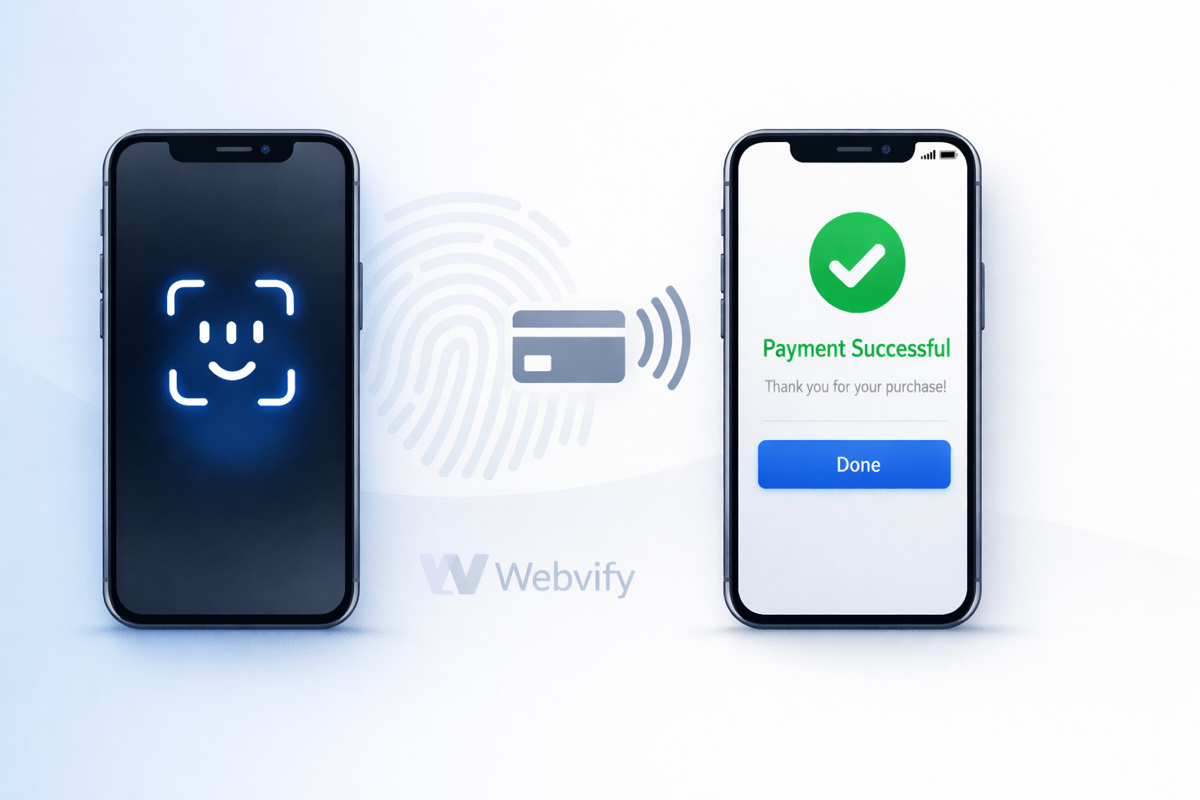
Is your checkout process killing your sales? Discover how biometric authentication and one-tap checkouts in mobile apps are transforming conversion rates in 2026.
Inside this article
- The Friction Tax: How Tiny Hurdles in the Mobile Browser Destroy Your Margins
- Biometrics as a Trust Signal: Why FaceID and TouchID Make Users Feel Safer Spending Money
- The Saved-State Advantage: Why Never Having to “Log In” Again Is the Ultimate Retention Hack
- The Five-Second Checkout: The Power of One-Tap Commerce
- The Strategic Shift: From Multi-Step Purchases to Instant Commerce
- Webvify’s Role: Bringing Native-Level Frictionless Checkout to Your Existing Platform
- The Future of Conversion Is Frictionless
The Friction Tax: How Tiny Hurdles in the Mobile Browser Destroy Your Margins
Most founders believe checkout abandonment is a pricing problem.
It usually isn’t.
It’s friction.
In mobile browsers, every step in the checkout process introduces what can be called a friction tax. A tiny obstacle. A moment of hesitation. A reason for the user to stop.
Type your email. Create a password. Confirm the password. Enter your address. Type your credit card number. Confirm the CVV. Approve a verification code.
Each step seems small. But together they form a slow, fragile process that leaks revenue at every stage.
Mobile users are especially sensitive to this. Typing on a phone keyboard is slow. Switching between password managers and browsers breaks flow. Even a few seconds of delay can break purchase intent.
And the numbers reflect it.
Mobile browser checkout flows frequently see abandonment rates above 70%. Not because customers don’t want the product — but because completing the purchase simply requires too much effort.
This is the hidden cost of browser-based commerce.
Every field you ask a user to fill out is a tax on conversion.
Every login screen is a leak in your revenue funnel.
And every additional second between “I want this” and “Purchase confirmed” reduces the probability of the sale.
In 2026, the brands that win are the ones that remove this tax entirely.
Biometrics as a Trust Signal: Why FaceID and TouchID Make Users Feel Safer Spending Money
Biometric authentication changes the psychology of checkout.
Instead of asking users to remember passwords, mobile apps ask them to simply confirm their identity.
FaceID. TouchID. Fingerprint sensors.
From a security standpoint, biometrics are extremely powerful. But their real impact in commerce is psychological.
Users trust them.
When a biometric prompt appears, the user sees a familiar system interface provided by the operating system itself. It signals legitimacy. It signals security. It signals control.
The checkout process stops feeling like a risky transaction on a website and starts feeling like a native financial action inside the device.
That difference matters.
Browsers create distance between the user and the transaction. Password fields feel fragile. Typing credit card numbers into forms feels exposed.
Biometric prompts eliminate that discomfort.
The experience becomes simple:
Confirm purchase → authenticate with FaceID → done.
The user never types a password. They never type a credit card number. They never re-enter personal data.
The phone verifies identity. The app completes the transaction.
In that moment, the device itself becomes the trusted intermediary.
That is why biometric checkout flows consistently outperform traditional browser forms. The purchase feels both faster and safer.
And in commerce, perceived security directly increases willingness to spend.
The Saved-State Advantage: Why Never Having to “Log In” Again Is the Ultimate Retention Hack
Browser sessions are temporary.
Apps are persistent.
This difference quietly defines the entire mobile commerce experience.
On the web, users constantly get logged out. Cookies expire. Sessions reset. Passwords must be re-entered. Verification emails appear. Password resets interrupt the flow.
Every time this happens, friction returns.
Apps eliminate this problem entirely.
When a user logs into an app once, the session can remain securely stored. Authentication tokens persist. Payment methods remain encrypted and available.
From that point forward, the user never needs to log in again.
The experience becomes continuous.
Open the app → browse → purchase.
No credentials required.
This persistent state transforms how frequently users transact.
Because the hardest part of buying online isn’t the payment itself.
It’s getting back into the system.
Removing login friction dramatically increases repeat purchases. The user doesn’t need to remember anything. They don’t need to recover accounts. They simply open the app and continue where they left off.
This is why app users consistently show:
- Higher repeat purchase frequency
- Higher lifetime value
- Significantly higher conversion rates
The barrier between intent and transaction disappears.
And when the barrier disappears, revenue grows.
The Five-Second Checkout: The Power of One-Tap Commerce
Imagine two checkout flows.
Browser Checkout
Open website Add product to cart Click checkout Log in or create account Enter shipping address Enter payment information Confirm purchase
Even in the best scenario, this takes two to three minutes.
Now compare that to a modern app experience.
App Checkout
Open app Tap product Tap “Buy” Authenticate with FaceID
Done.
Five seconds.
The difference between these two flows is not incremental.
It is exponential.
The faster a checkout completes, the lower the cognitive load on the user. Impulse decisions convert before doubt appears. Distractions have no time to interrupt the process.
This is the reason mobile apps frequently achieve 2–3× higher conversion rates compared to mobile websites.
Speed removes hesitation.
Simplicity removes abandonment.
Frictionless checkout turns intent directly into revenue.
The Strategic Shift: From Multi-Step Purchases to Instant Commerce
Commerce is moving toward a new default.
Users no longer expect to fill out forms. They expect purchases to happen instantly.
Apple Pay, Google Pay, and biometric authentication have retrained consumer expectations. People now associate mobile devices with fast, secure financial actions.
Brands that still rely on traditional browser checkouts feel outdated by comparison.
This shift is not about convenience alone.
It’s about competitive advantage.
When one brand requires three minutes to purchase and another requires five seconds, the faster experience wins.
Not occasionally.
Consistently.
Every improvement in checkout speed compounds over thousands of transactions.
That is why leading e-commerce brands are investing heavily in mobile app experiences. The difference in friction directly translates to measurable increases in conversion rate, retention, and lifetime value.
Webvify’s Role: Bringing Native-Level Frictionless Checkout to Your Existing Platform
Historically, achieving this level of checkout performance required fully native mobile development.
That meant large teams. Long timelines. Significant budgets.
For many companies, it simply wasn’t practical.
Webvify changes that equation.
Webvify allows brands to transform their existing web platforms into high-performance mobile apps in days — not months. Your storefront remains powered by your existing infrastructure while gaining the advantages of a native mobile environment.
This unlocks capabilities that are impossible in a browser:
- Biometric authentication (FaceID / TouchID)
- Persistent secure login states
- Push notifications for instant re-engagement
- Native payment integrations
- Distraction-free checkout environments
Instead of rebuilding your entire commerce stack, Webvify places it inside a mobile container optimized for conversion.
The result is immediate.
Your checkout flow becomes dramatically faster. Login friction disappears. Repeat purchases become effortless.
And most importantly, your brand gains a permanent presence on the customer’s home screen.
That single icon changes how users interact with your business.
They stop searching for you.
They start opening you.
The Future of Conversion Is Frictionless
In 2026, the brands that win mobile commerce are not the ones with the biggest advertising budgets.
They are the ones with the lowest friction.
Every unnecessary step in the purchase process leaks revenue. Every field you ask a user to type reduces conversion probability.
Biometric authentication and one-tap checkout eliminate those steps.
They replace passwords with identity.
They replace forms with confirmation.
They replace minutes with seconds.
The result is simple but powerful: customers buy more often because buying is effortless.
For modern commerce, frictionless checkout is no longer a luxury feature.
It is the new competitive baseline.
Brands that adopt it see immediate gains in conversion, retention, and lifetime value. Brands that ignore it continue paying the friction tax on every transaction.
If you want to bring biometric authentication, one-tap checkout, and native-level mobile experiences to your existing platform, Webvify makes it possible in days.
Start building your frictionless mobile commerce experience today: https://webvify.app?utm_source=blog&utm_medium=cta&utm_campaign=frictionless-biometric-checkout-2026