

How a Mobile App Helps Course Brands Increase Direct Enrollments and Student Retention
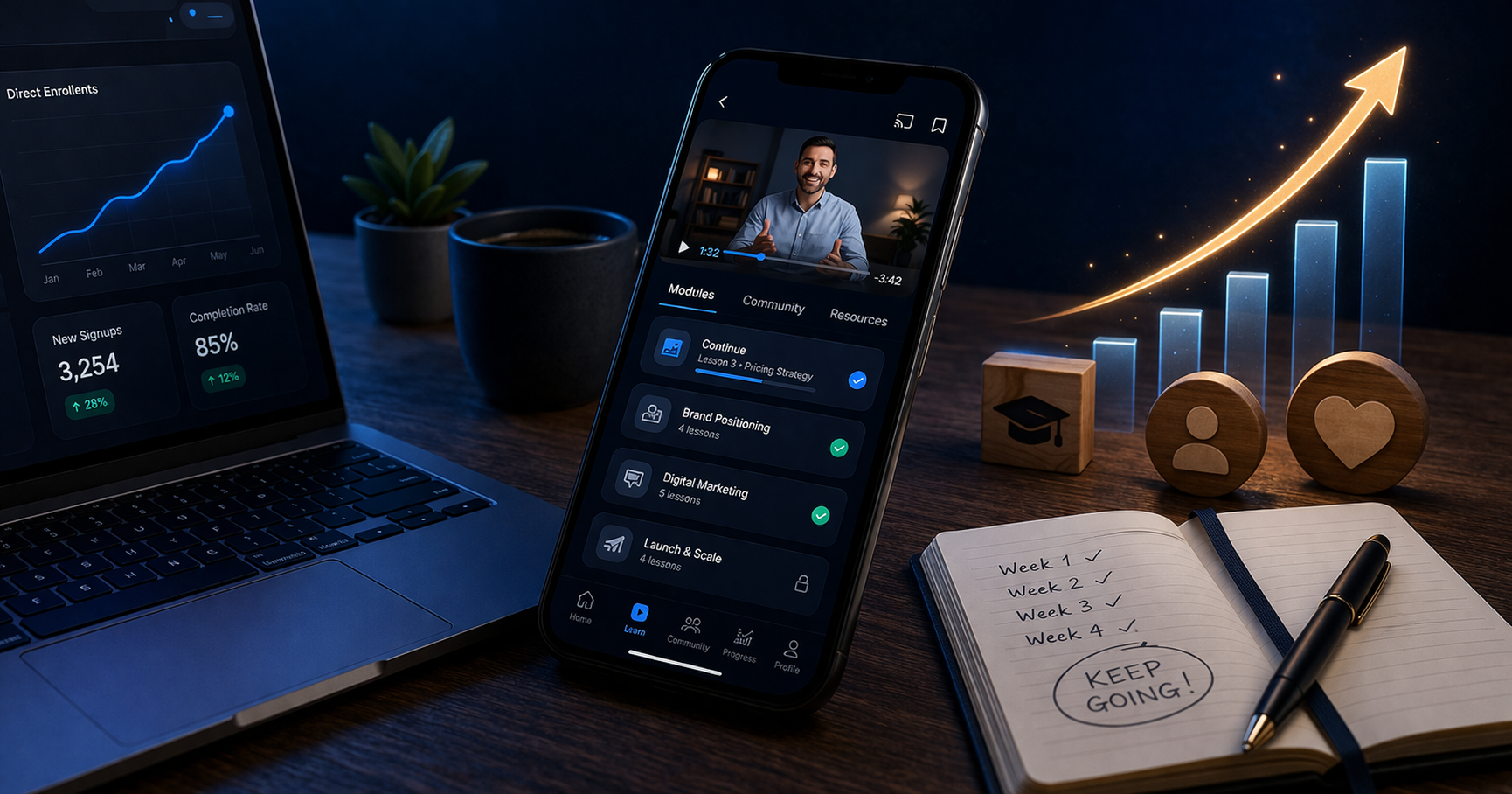
Learn how a course mobile app can increase direct enrollments, reduce platform dependence, improve student retention, and strengthen your brand on mobile.
Inside this article
- The short answer
- Why course brands lose enrollments on mobile
- How a mobile app helps increase direct enrollments
- How apps reduce platform dependency
- Why a mobile app improves student retention
- Mobile website vs mobile app for course brands
- Practical ways a course app can increase revenue
- When a course brand should consider an app
- What to look for in a launch partner
- FAQ
- Final takeaway
The short answer
A mobile app helps course brands increase direct enrollments and student retention because it makes discovery, sign-up, and ongoing learning easier on mobile.
That matters because many education businesses already have demand, but too much of that demand is lost through weak mobile checkout, platform dependence, and poor follow-up after the first purchase.
An app gives course brands a stronger direct channel and a better way to keep students engaged after enrollment.
Why course brands lose enrollments on mobile
Many course businesses already have:
- a website
- landing pages
- checkout pages
- webinar or lead funnels
- email automation
- some level of repeat offer potential
But having a mobile-friendly site is not the same as having a high-converting mobile experience.
Mobile intent is easy to lose
A large part of course discovery happens on phones.
People often find courses through:
- Instagram or LinkedIn
- YouTube
- email campaigns
- search
- a referral link
- a creator or community mention
They may be interested, but not fully ready yet.
If the page feels slow, crowded, or hard to act on, they leave.
Common friction points include:
- too many steps before payment
- weak mobile layout on long sales pages
- hard-to-read offer structure
- poor return path after leaving the page
- limited urgency or re-engagement once interest drops
These issues reduce direct enrollments quietly.
Platform dependence limits your growth
Many course brands rely on third-party course platforms, marketplaces, or social channels to create sales.
That can help with reach, but it also creates long-term limits.
You often lose:
- control over the student journey
- brand ownership
- retention opportunities
- direct upsell and reactivation power
If the platform becomes the habit and your brand does not, retention becomes harder.
Retention matters as much as enrollment
For course businesses, revenue is not always about one purchase.
Growth often comes from:
- course completion
- upsells into advanced programs
- renewals
- memberships
- cohort re-enrollment
- referral behavior from satisfied students
If students disappear after buying, lifetime value stays lower than it should.
How a mobile app helps increase direct enrollments
A mobile app improves the moments that affect action most.
Faster access reduces drop-off
Instead of reopening a browser, searching again, and scrolling through several tabs, the user taps the app and returns immediately.
That matters when someone is close to enrolling but needs one more reminder, one more nudge, or one cleaner path to purchase.
The enrollment journey feels simpler
A mobile app can make the path feel more focused by improving how users move through:
- offer discovery
- course browsing
- enrollment decisions
- checkout
- onboarding after purchase
Even if your website remains the core system, the app layer helps reduce distraction and hesitation.
Your brand stays visible on the phone
A website disappears after the visit.
An app icon stays on the home screen.
That increases recall when the person thinks:
- “I should enroll this week”
- “I want to continue learning”
- “Let me check that program again”
That visibility helps conversion and retention at the same time.
How apps reduce platform dependency
The goal is not always to abandon every platform.
The smarter goal is to reduce unnecessary dependence by building a stronger direct channel you control.
Returning buyers need a direct path back
If someone already knows your teaching style or brand, sending them back through a crowded platform or long browser path adds friction.
A mobile app gives you a cleaner return route.
That helps you:
- drive direct enrollments
- promote advanced offers
- increase repeat purchases
- build a stronger first-party audience
App-only offers are easier to position
A mobile app can support offers such as:
- direct-only pricing
- early access to cohorts
- enrollment reminders
- bonus content for app users
- limited-time upsell campaigns
These offers do not need to feel aggressive.
They just need to make the direct path feel easier and more valuable.
Why a mobile app improves student retention
Student retention is one of the strongest advantages of an app-based experience.
Students stay closer to the product
Learning is easier to continue when access is simple.
An app helps keep the course close to the student’s daily routine.
That matters because many students do not leave because the course is bad.
They leave because momentum breaks.
Push notifications help re-engagement
Push notifications can support useful reminders such as:
- lesson reminders
- cohort start alerts
- assignment nudges
- progress prompts
- launch announcements for new offers
Used well, they help reduce drop-off without relying only on email.
Convenience supports completion and upsell
A student who can quickly reopen the learning experience is more likely to:
- keep progressing
- finish the course
- buy the next offer
- stay connected to your brand
That makes the app valuable far beyond the first sale.
Mobile website vs mobile app for course brands
| Area | Mobile Website | Mobile App |
|---|---|---|
| Access | Requires search or saved link | One tap from home screen |
| Enrollment flow | More fragile on mobile | More focused and direct |
| Brand recall | Easy to forget after visit | Brand stays visible on phone |
| Re-engagement | Mostly email-based | Strong with push notifications |
| Retention support | More limited | Better ongoing engagement |
| Upsell path | Weaker | Stronger |
| Daily usage habit | Harder to build | Easier to build |
Practical ways a course app can increase revenue
An app becomes valuable when it supports clear business outcomes.
Direct enrollments
Use the app to:
- simplify mobile sign-up
- reduce checkout abandonment
- promote direct-only offers
- improve conversion from returning visitors
Student engagement
Use the app to:
- remind students to continue lessons
- highlight live sessions or cohort dates
- surface new modules and updates
- keep users active between learning sessions
Retention and expansion
Use the app to:
- promote advanced programs
- re-engage inactive students
- support memberships or communities
- increase repeat purchase behavior
When a course brand should consider an app
A mobile app makes strong business sense if you:
- already get regular traffic
- see meaningful mobile visits
- care about completion and retention
- want more direct enrollments
- sell multiple offers or learning paths
- want stronger control over your student relationship
If your audience is already discovering you on mobile, improving the mobile experience is a practical next step.
What to look for in a launch partner
If you decide to move forward, focus on business outcomes.
A good partner should help you:
- use your existing website as the base
- create a smooth mobile enrollment experience
- support push notifications
- keep launch complexity low
- publish properly to the app stores
- move faster than a traditional custom build
FAQ
Do I need to rebuild my course website to launch an app?
No. In many cases, you can turn your existing website into an app without rebuilding everything from scratch.
Can a course app really increase enrollments?
Yes. It can improve mobile conversion by reducing friction, improving brand recall, and giving returning visitors a simpler path to purchase.
Is an app only useful for large education companies?
No. Small course brands, niche educators, and cohort businesses can all benefit because retention and repeat purchases matter at every size.
Can an app help with student retention?
Yes. Push notifications, easier access, and a better mobile experience can help students stay engaged and continue learning.
How quickly can this launch?
With the right website-to-app model, much faster than traditional custom app development.
Final takeaway
Course brands do not only need more traffic.
They need a better way to turn mobile interest into direct enrollments and one-time buyers into long-term students.
A mobile app helps create that system by improving conversion, re-engagement, retention, and repeat revenue.
If you want to turn your existing course website into a mobile app without unnecessary complexity, Webvify can help.
See how it works at https://webvify.app