

Best Mobile App Ideas for Small Business in 2026
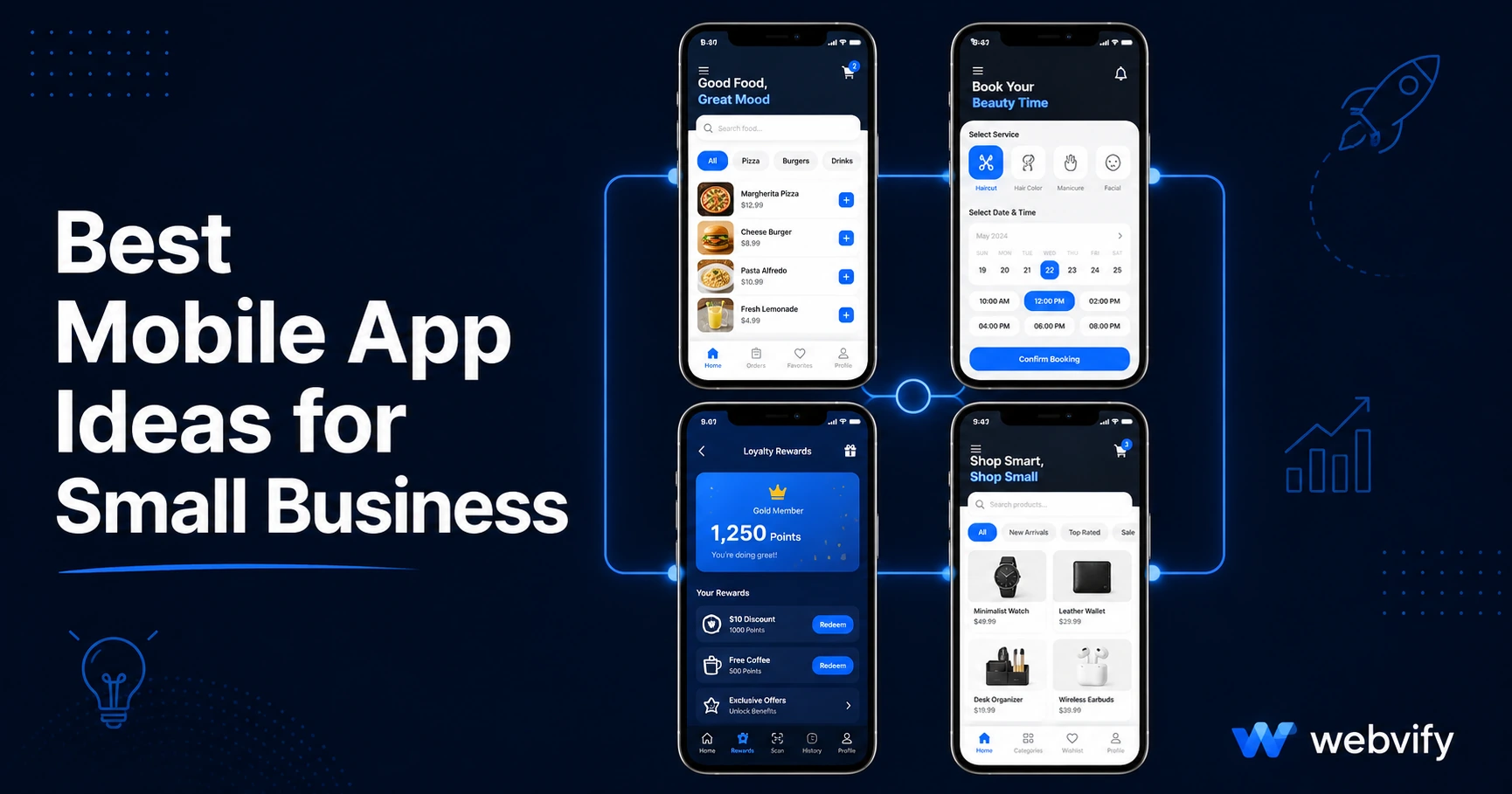
10 proven mobile app ideas for small businesses in 2026 — loyalty, booking, ordering, and more. Launch without a developer using your existing website.
Inside this article
Most small business owners searching for a "mobile app idea" already have one. It's sitting on their website right now — every service page, booking form, product catalog, and loyalty program they've built is already the core of their app. The missing step isn't creativity. It's packaging.
That said, knowing which type of app actually drives revenue for small businesses changes the decision. Below are the ten app ideas that consistently work — not because they're new, but because they solve a specific problem every small business has: keeping customers coming back.
Why Mobile App Ideas for Small Business All Share One Core Benefit
Before the list, one number worth knowing: push notifications sent through a mobile app reach customers at a 60–90% open rate. Email hovers at 25–30%. SMS is higher than email but comes with opt-in friction and per-message costs.
That gap is why nearly every app idea on this list works the same way at the core — it puts your brand on the customer's home screen with a direct line to their lock screen. The specific idea (loyalty, booking, ordering) is the wrapper. The retention mechanism is the same.
10 Mobile App Ideas That Work for Small Businesses
1. Loyalty and Rewards App
Best for: Coffee shops, retail stores, bakeries, local restaurants.
A digital punch card your customers actually use. Instead of a paper stamp card that gets lost in a wallet, a loyalty app sends a push notification when a customer is close to a reward. Redemption rates are 3–5x higher than physical cards because the reminder arrives at the right moment.
2. Online Ordering App
Best for: Restaurants, bakeries, food trucks, specialty food shops.
Third-party delivery platforms charge 15–30% per order. A branded ordering app routes orders directly to you at zero commission. The push notification channel lets you run flash promotions ("Order in the next 2 hours, free delivery") that a website alone can't match. This is one of the most common — and highest-ROI — mobile app ideas for small business owners in food and beverage.
3. Appointment Booking App
Best for: Salons, spas, med-spas, chiropractors, therapists, personal trainers.
The problem isn't that clients stop wanting your service. It's the gap between appointments — no reminder arrives, no prompt re-books them, and they drift to whoever shows up first when they're ready. An app with push notifications closes that gap. Automated pre-appointment reminders also cut no-shows by 20–40%. For a deeper breakdown, see the appointment booking mobile app guide →.
4. Member Portal App
Best for: Gyms, yoga studios, online coaching programs, membership sites.
Members who can access class schedules, progress tracking, or gated content through an app retain longer than those who log in through a browser. The friction of opening a browser, finding the site, and logging in is small but compounding over weeks. Home screen presence eliminates that friction. Push notifications for new classes or live sessions fill seats faster than email newsletters.
5. E-Commerce App
Best for: Shopify stores, WooCommerce shops, any online retailer with returning customers.
Mobile web converts at roughly 1–2%. Mobile apps convert at 3–5% for the same audience. The difference is checkout friction and trust — stored payment methods, biometric authentication, and the app UI make impulse purchases easier. Cart abandonment push notifications recover 5–10% of abandoned sessions that would otherwise be lost. For Shopify stores specifically, push notifications through a mobile app are the highest open-rate channel available →.
6. Local Service Booking App
Best for: Cleaning services, HVAC, landscaping, pest control, plumbing.
Service businesses live and die by repeat customers. A branded app lets a homeowner book a repeat service in two taps instead of a Google search that surfaces your competitors. Push reminders for seasonal services ("Time for your spring HVAC check") generate bookings that would never have come from inbound alone.
7. Real Estate Agent App
Best for: Independent agents and boutique agencies.
Real estate buyers search for 10+ weeks and talk to 3+ agents before deciding. During that window, whoever has home screen presence has a relationship advantage. A branded app with saved listings and push alerts for new properties keeps your name in front of the buyer every time a relevant listing hits the market — before major portals establish the habit.
8. Content and Newsletter App
Best for: Bloggers, podcast hosts, newsletter writers, local media outlets.
Email open rates for content businesses average 30–40%. Push notifications through a dedicated app reach 60–90% of subscribers. For creators building a paid membership or premium tier, an app also adds perceived value — a listing on the App Store signals professionalism that a website alone doesn't.
9. Healthcare and Wellness App
Best for: Dental clinics, physiotherapy, dermatology, nutrition, mental health practices.
Appointment adherence is the core problem. Patients miss follow-up appointments not because they don't value the service but because nothing reminds them at the right time. Push notification reminders, wellness check-ins, and easy rebooking flows inside a branded app address all three. An app also gives patients a private channel that email — with its spam filters and promotional tabs — can't match.
10. Professional Services Client Portal App
Best for: Accountants, lawyers, insurance brokers, financial advisors.
Client relationships in professional services require regular touchpoints to prevent churn. An app that surfaces documents, contract renewals, or status updates gives clients a reason to open something with your logo on it every week. Push notifications for time-sensitive actions (document signing, renewal deadlines) replace the email that ends up in Promotions.
What Makes a Small Business App Actually Work
Three things separate the apps on this list from apps that get downloaded and deleted:
A direct notification channel. Without push notifications, an app is just a mobile website. The notification channel is the retention mechanism that ties every idea on this list together.
A booking or ordering flow. Apps that let customers take an action (book, buy, redeem) retain users. Apps that only display information don't.
Your existing website as the foundation. The fastest — and most affordable — path to a working app for any business type is converting your existing website rather than rebuilding from scratch. Services like Webvify convert any website into a fully branded iOS and Android app, handling the App Store and Google Play submission end-to-end. No code, no rebuilding your content — your existing booking system, ordering platform, or member portal becomes the app.
How to Get Your Small Business App Live Without a Developer
The barrier most business owners assume is writing code. The actual barrier is App Store and Google Play submission — the developer accounts, the binary packaging, the review compliance.
A WebView-based app wraps your existing website in a native app shell. Apple and Google both approve these regularly. The compliance requirements (custom domain, responsive design, no IAP violations for digital goods) are straightforward if you know what to check.
End-to-end services handle the packaging, submission, compliance review, and admin panel setup so you're operational in days rather than months. The cost is a fraction of custom development — typically a one-time fee versus $50,000–$300,000 for a native build.
Frequently Asked Questions
What is the easiest mobile app idea to launch for a small business?
The easiest starting point is converting your existing website into a branded app. If you already have a booking system, ordering flow, or online store, that becomes your app without rebuilding anything. The technical barrier is App Store submission, not app development — and managed services handle that for you.
How much does it cost to build a mobile app for a small business?
Custom native development typically runs $50,000–$300,000 with ongoing maintenance costs. WebView-based apps that convert an existing website typically cost a one-time fee in the low thousands, with no ongoing developer dependency. For a detailed breakdown, see the mobile app development cost guide →.
Do I need coding skills to get a mobile app for my business?
No. WebView-based app services convert your existing website into a native app without any code on your end. The provider handles App Store and Google Play submission. What you do need: a live website with a custom domain, a responsive design (most modern website builders handle this), and an Apple Developer account ($99/year) and Google Play account ($25 one-time).
Ready to turn your existing website into an app for your small business? Webvify handles everything from build to App Store submission — no developer required.