

The Speed-to-Market Moat: Why WebView-Hybrid Apps are the Smartest Choice in 2026
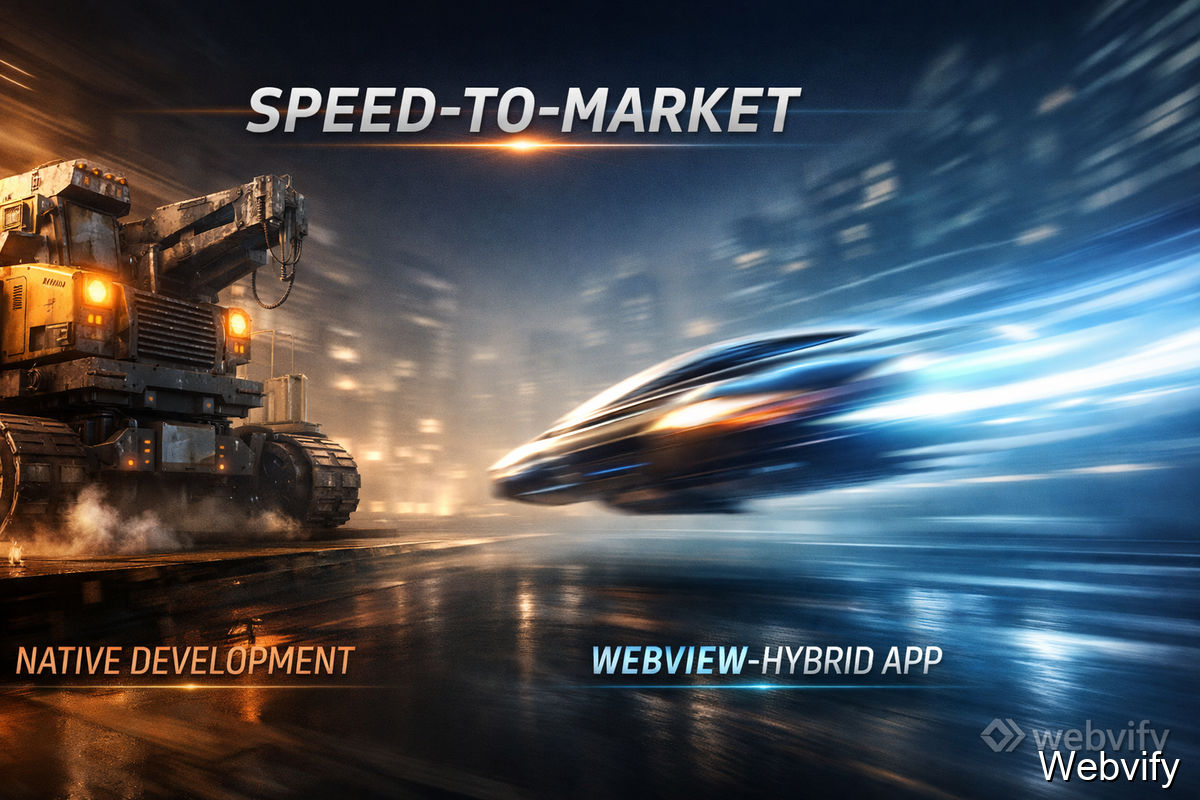
Stop waiting months for native development. Discover why the most agile brands in 2026 use WebView-Hybrid apps to launch instantly and dominate the App Store.
Inside this article
- The Speed-to-Market Moat
- The Native Fallacy: Why the “Native-Only” Obsession is Costing Businesses Months of Revenue
- The Bridge Strategy: Transforming Your Existing Web Investment into an App Store Presence
- Feature Parity in 2026: Why Modern WebView Performance Is Indistinguishable from Native for 95% of Use Cases
- Real-World ROI: Case Studies of Brands That Scaled Faster by Choosing Speed Over Perfection
- The Webvify Advantage: Zero-Code Deployment, Biometrics, and Push Notifications in Days
- Speed Is the New Competitive Advantage
The Speed-to-Market Moat
In 2026, the most valuable competitive advantage in digital products is not polish. It is speed.
Markets move faster than development cycles. Customer expectations evolve monthly. Ad costs change weekly. Platform algorithms update constantly.
Yet many companies still approach mobile apps using a 2015 playbook: commission a full native build, hire two platform teams, and wait 6–12 months before launching.
By the time the product reaches the App Store, the market has already moved.
Modern brands understand a different truth: speed-to-market itself is a strategic moat.
The faster you can ship, test, iterate, and capture user attention, the stronger your competitive position becomes. And this is precisely why WebView-Hybrid apps have become the preferred strategy for forward-thinking companies.
Instead of rebuilding everything from scratch, they bridge their existing web investment directly into the mobile ecosystem.
The result: an app in days instead of months.
The Native Fallacy: Why the “Native-Only” Obsession is Costing Businesses Months of Revenue
For over a decade, “native-only” development was treated as the gold standard.
The logic seemed sound: build separately for iOS and Android, optimize every interaction, and deliver a perfectly tailored experience.
But the reality for most businesses looks very different.
Native development introduces three structural problems:
1. Time-to-market delays
A traditional native app project often requires:
- iOS engineering
- Android engineering
- backend integration
- design adaptation
- QA across devices
- App Store compliance cycles
Even well-funded teams regularly spend 6–12 months before launch.
During that time, the business gains zero benefits from being in the App Store.
No push notifications.
No home screen presence.
No new acquisition channel.
No app-based retention.
2. Massive upfront costs
A serious native build can easily exceed:
- $80k–$150k for development
- months of engineering salaries
- ongoing maintenance for two codebases
For many brands, this turns mobile into a capital project instead of a growth lever.
3. Market opportunity loss
While the app is being built, competitors may already be capturing:
- App Store discovery traffic
- push notification engagement
- home screen real estate
- first-party behavioral data
In a digital economy driven by attention, waiting can quietly become the most expensive decision a company makes.
The obsession with “perfect native apps” often hides a more dangerous problem: strategic paralysis.
The Bridge Strategy: Transforming Your Existing Web Investment into an App Store Presence
Modern companies rarely start from zero.
Most already have:
- a mature website
- a checkout system
- a customer account infrastructure
- a mobile-optimized experience
- analytics and marketing integrations
The WebView-Hybrid model takes advantage of this existing investment.
Instead of rebuilding the entire product stack, the approach acts as a bridge between web and native environments.
Your existing web platform becomes the core experience inside a native mobile shell.
That shell provides access to the capabilities that mobile browsers cannot reliably deliver:
- push notifications
- home screen installation
- persistent login
- biometric authentication
- deeper OS integration
From a user perspective, the experience behaves like a standard mobile app.
From a business perspective, the transition can happen dramatically faster.
This bridge strategy unlocks three immediate advantages.
Instant App Store presence
The moment the app launches, your brand gains a permanent distribution channel through the App Store and Google Play.
Push notification engagement
Push notifications remain one of the highest ROI engagement channels available.
Unlike email or paid retargeting, reaching your own customers through push costs nothing.
Home screen real estate
When a customer installs your app, your brand occupies permanent visual territory on their phone.
That single icon can quietly outperform thousands of dollars in advertising spend.
Feature Parity in 2026: Why Modern WebView Performance Is Indistinguishable from Native for 95% of Use Cases
One of the most persistent myths in mobile development is that hybrid experiences are inherently inferior.
That might have been true a decade ago.
In 2026, it is largely outdated.
Modern mobile engines have evolved dramatically. Today's WebView environments run on the same high-performance rendering engines that power mobile browsers.
For most digital products, the user experience difference has effectively disappeared.
In fact, for 95% of commercial use cases, hybrid performance is indistinguishable from native.
Consider the types of apps most businesses actually build:
- e-commerce platforms
- SaaS dashboards
- marketplaces
- booking systems
- subscription products
- media platforms
- educational tools
These experiences are primarily interface-driven and API-backed.
They rely far more on network speed and backend performance than low-level device graphics.
Where native still excels is in areas such as:
- high-end gaming
- real-time 3D rendering
- hardware-intensive applications
- advanced AR or VR systems
For everything else, WebView-Hybrid delivers equivalent user value with dramatically lower development complexity.
Users do not open an e-commerce app and think about rendering engines.
They think about:
- speed
- reliability
- checkout friction
- convenience
If the experience is fast and seamless, the technology stack becomes invisible.
Real-World ROI: Case Studies of Brands That Scaled Faster by Choosing Speed Over Perfection
Across industries, companies that prioritize rapid deployment consistently outperform those waiting for perfect builds.
Consider three common scenarios.
E-commerce brands capturing repeat purchases
A direct-to-consumer brand launches a hybrid app within weeks using their existing storefront.
Within months they unlock:
- push notification campaigns
- app-exclusive offers
- frictionless checkout through biometrics
Repeat purchase rates increase significantly because returning customers no longer need to rediscover the brand through ads or search.
The app becomes a direct revenue channel.
SaaS platforms increasing retention
A SaaS product converts its web dashboard into a mobile companion app.
Users gain constant access to their workspace from their home screen.
This increases daily active usage and reduces churn because the product is always one tap away.
Marketplaces expanding discovery
A marketplace launches an app presence primarily for App Store visibility.
Organic installs become a new top-of-funnel acquisition channel that previously did not exist.
Even modest App Store discovery can offset thousands of dollars in paid advertising.
In each case, the growth driver was not “native perfection.”
It was launch velocity.
Companies that ship faster begin learning faster.
And companies that learn faster inevitably grow faster.
The Webvify Advantage: Zero-Code Deployment, Biometrics, and Push Notifications in Days
This is where Webvify fits into the modern mobile strategy.
Webvify was designed specifically for businesses that already have a strong web presence but want to unlock the power of mobile apps without rebuilding everything.
Instead of months of engineering work, Webvify enables companies to launch a fully functional mobile app using their existing website.
The platform provides:
Zero-code deployment
Your website becomes a mobile app without requiring a separate development team.
Biometric authentication
Users can log in instantly using Face ID or Touch ID, eliminating password friction.
Push notifications
Re-engage users instantly without paying for retargeting ads.
Persistent sessions
Customers stay logged in, enabling faster purchases and higher conversion rates.
App Store distribution
Your brand gains a permanent presence on iOS and Android marketplaces.
Most importantly, the timeline changes completely.
What used to take months can now happen in days.
Speed-to-market stops being a limitation and becomes a competitive weapon.
Speed Is the New Competitive Advantage
In digital markets, the companies that move fastest shape the landscape.
Waiting for a “perfect native build” is increasingly a legacy strategy.
While teams debate architecture and development timelines, faster competitors are already acquiring users, capturing attention, and collecting first-party data.
The brands that win in 2026 are not the ones with the most complex apps.
They are the ones that launch first, learn fastest, and iterate continuously.
WebView-Hybrid apps make that possible.
They turn your existing web platform into a mobile growth engine almost instantly.
If you are serious about capturing App Store distribution, reducing customer acquisition costs, and owning your audience directly, the smartest move is simple:
Launch now. Improve later.
Start building your mobile app today at: