

How a Mobile App Helps Restaurants Increase Direct Orders and Repeat Customers
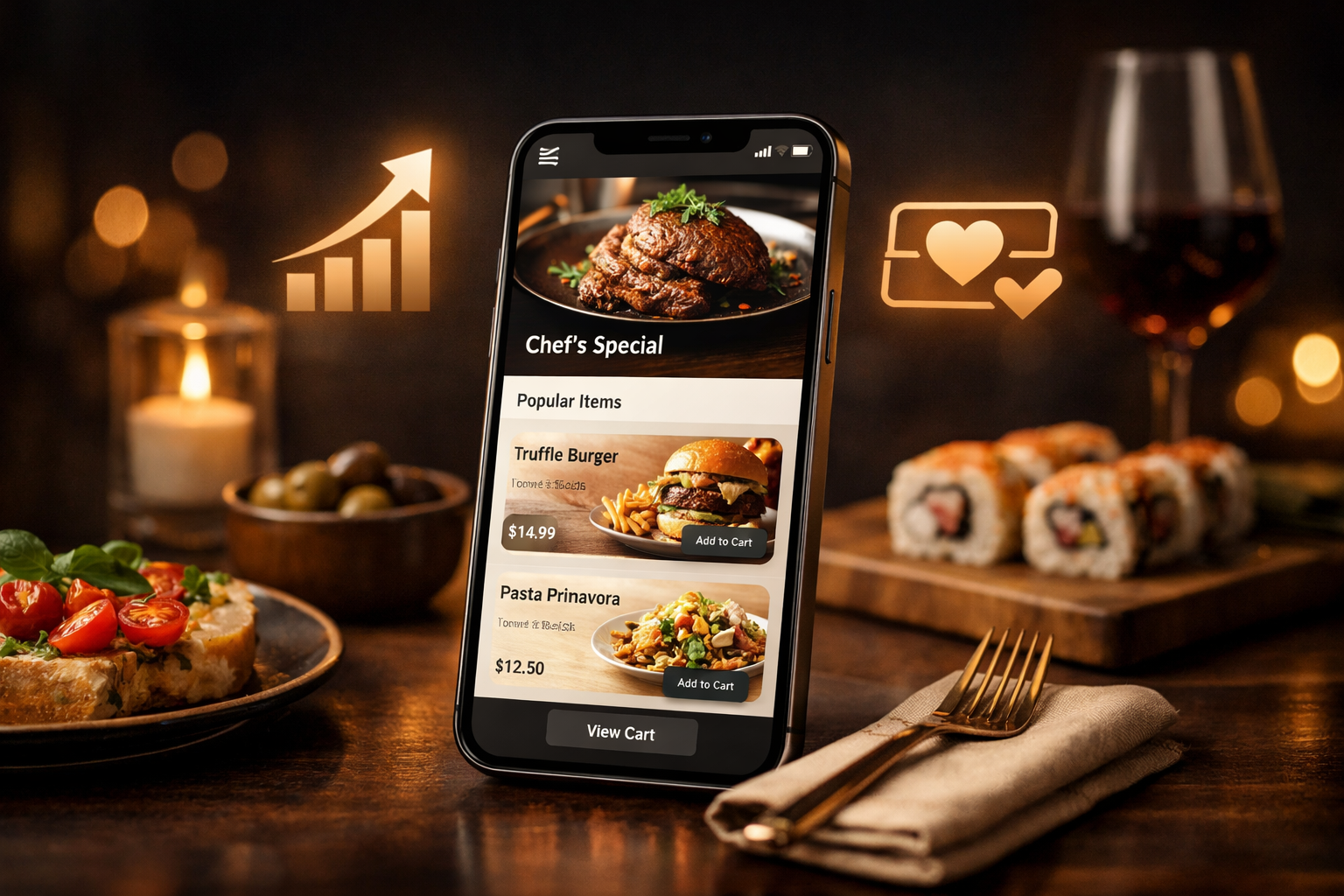
Learn how a restaurant mobile app can increase direct orders, improve repeat purchases, and reduce dependence on third-party delivery platforms.
Inside this article
- The short answer
- Why restaurants lose margin when they depend too much on marketplaces
- Why repeat customers matter more than one-time orders
- What changes when your restaurant has its own mobile app
- How a mobile app helps increase direct orders
- How a mobile app helps increase repeat customers
- Mobile website vs mobile app for restaurants
- A practical framework for restaurants that want more direct orders
- Why many restaurants do not need to build from scratch
- Where this matters most
- Common mistakes restaurants should avoid
- FAQ
- Final takeaway
The short answer
A mobile app helps restaurants increase direct orders and repeat customers because it removes friction, improves loyalty, and gives the brand a direct line to the customer.
Instead of waiting for people to open a marketplace, compare ten restaurants, and choose based on discounts, your restaurant becomes one tap away on the home screen.
That changes three important things:
- customers can order faster
- you keep more control over the relationship
- it becomes easier to bring people back again
A website helps people discover you. A mobile app helps them return.
For restaurants, cafés, QSR brands, and multi-location food businesses, that difference matters because repeat orders are where margin and stability usually improve.
Why restaurants lose margin when they depend too much on marketplaces
Third-party delivery apps are useful. They help restaurants get discovered, especially early on.
But over time, many brands realize they are building sales inside someone else’s system.
That creates two problems.
The margin problem
Every marketplace order comes with a cost.
Whether the commission is high, moderate, or hidden inside promotions and delivery terms, the effect is the same: your profit per order gets squeezed.
That means a restaurant may be busy, but still not feel healthy.
The business starts chasing volume just to protect margin.
The relationship problem
This is often even more important than commission.
When a customer orders through a delivery platform, the platform owns most of the journey:
- the app experience
- the notifications
- the re-engagement
- the promotions
- the habit
The customer may enjoy your food, but still remember the platform more than your brand.
That is risky, because next time the customer opens the same marketplace, your restaurant is simply one option in a long list.
Why repeat customers matter more than one-time orders
Many restaurants focus heavily on acquisition.
That makes sense. New customers matter.
But for most food businesses, strong growth comes from people ordering again, not just trying you once.
Repeat customers are valuable because they usually:
- order faster
- trust the brand more
- need less persuasion
- are more likely to respond to new offers
- create more predictable revenue
A restaurant app is not only about getting downloaded.
It is about creating a smoother path back to your brand.
What changes when your restaurant has its own mobile app
When you launch your own app, you stop depending only on search behavior and marketplace browsing.
You create a direct environment where your customer can come back without friction.
One-tap access changes ordering behavior
On a website, the customer usually has to:
- open a browser
- search for your brand or revisit a tab
- wait for the page to load
- go back through the ordering flow
In an app, the customer opens your brand directly.
That difference sounds small, but on mobile it is powerful. Every extra step lowers the chance that the user finishes the order.
Home-screen presence keeps your brand top of mind
A website needs to be rediscovered.
An app stays visible.
That home-screen presence helps your restaurant stay mentally available between meals. When someone thinks, “What should I order tonight?” your brand is already there.
That is very different from hoping they remember your name inside a crowded marketplace.
Saved checkout removes friction
Restaurants win when reordering feels easy.
A mobile app can make that easier by supporting experiences like:
- saved addresses
- saved payment details
- saved order preferences
- faster repeat checkout
When ordering takes seconds instead of minutes, customers are more likely to complete it.
How a mobile app helps increase direct orders
Direct orders usually grow when the customer journey becomes easier than the alternative.
A restaurant app helps make that happen in practical ways.
It gives customers a clean, focused ordering path
Inside your own app, customers are not being shown competing restaurants next to yours.
There are no side-by-side discount wars.
The experience is focused on your menu, your offer, and your brand.
It makes reordering easier
A returning customer often wants one of three things:
- the same meal as last time
- a slight variation of a previous order
- a fast checkout without starting over
An app can make that simple with options like:
- order again
- reorder favorites
- repeat last cart
That kind of convenience is hard to match on a generic ordering website and even harder inside a third-party marketplace.
It supports direct incentives without sharing the value
If you want to offer a discount, free dessert, bundle, or loyalty reward, it is much better when that incentive strengthens your own channel.
For example, you can use app-only offers like:
- 10% off your first in-app order
- free drink after three direct orders
- lunch combo deals for app users
This gives customers a real reason to order directly instead of through a marketplace.
How a mobile app helps increase repeat customers
A restaurant does not need endless promotions if it becomes easier to remember, easier to access, and easier to order from again.
That is where apps become valuable.
Push notifications bring people back at the right time
Push notifications are one of the biggest differences between a mobile website and a mobile app.
They allow you to reach the customer directly on their phone at the moment when action is most likely.
Examples:
- “Lunch is ready faster today. Order now.”
- “Your favorite burger is back this weekend.”
- “It’s been a while — here’s a direct-order reward.”
This is not about spamming.
It is about timing.
If the message is relevant, push notifications can help restaurants re-activate customers who may not have returned on their own.
Loyalty becomes easier to understand and use
A loyalty program only works when customers remember it and can see progress.
In an app, loyalty can feel much more real.
Customers can clearly understand:
- how many points they have
- what reward they are close to earning
- what they unlock by ordering direct
That visibility keeps the program active in the customer’s mind.
Personalization becomes more useful
With your own app, you can shape a better repeat-order experience.
You can highlight:
- favorite meals
- recently ordered products
- relevant add-ons
- targeted offers for different customer segments
That helps the app feel convenient, not generic.
Mobile website vs mobile app for restaurants
Here is the practical difference.
| Area | Mobile Website | Mobile App |
|---|---|---|
| Access | User opens browser and finds the site | User opens the app in one tap |
| Checkout | Often repeated each time | Faster with saved info |
| Reorders | Possible, but less convenient | Easier with favorites and repeat order flows |
| Notifications | Limited | Push notifications on the phone screen |
| Loyalty | Often less visible | More integrated and easier to track |
| Brand recall | Depends on memory or search | Stronger because of home-screen presence |
| Competition | User can quickly leave or compare tabs | More focused experience |
| Direct-order growth | Moderate | Stronger when app incentives are used |
A website is still important.
It helps with discovery, search visibility, and first-time visits.
But for repeat ordering and retention, a mobile app usually creates a stronger loop.
A practical framework for restaurants that want more direct orders
Restaurants do not need a complicated transformation plan.
A simple and focused rollout is usually better.
1. Keep your website as the base
If your current website already has a working menu and ordering flow, that is an advantage.
You do not need to throw it away.
2. Turn that experience into an app
This is where many businesses overestimate the complexity.
You do not always need to build a fully custom app from scratch.
In many cases, the smarter move is to convert your website into an app and improve the mobile customer journey around it.
That is often faster, more affordable, and easier to maintain.
3. Give customers a reason to install it
Do not just say, “Download our app.”
Give a clear benefit:
- app-only deals
- loyalty rewards
- faster reordering
- priority access to new items
- direct-order savings
The customer should immediately understand why the app is worth keeping.
4. Promote the app everywhere you already have attention
Good places to push adoption include:
- packaging inserts
- receipts
- in-store QR codes
- website banners
- order confirmation emails
- social posts
This helps you turn existing traffic into app users over time.
5. Use push notifications carefully
Good push strategy is simple:
- send fewer messages
- make them relevant
- tie them to real customer behavior
A useful push message can drive direct orders. A lazy push message trains users to ignore you.
Why many restaurants do not need to build from scratch
This is one of the biggest misconceptions in the market.
A lot of restaurant owners hear “mobile app” and assume:
- it will take months
- it will require a large budget
- it will mean rebuilding the business digitally from zero
That is not always true.
If your website already works, you may already have the foundation you need.
A web-to-app approach can help you launch faster, reduce cost, and keep your existing flow instead of creating two separate products to manage.
For many restaurants, that is the most practical path.
Where this matters most
This model is especially useful for:
- restaurants with repeat local customers
- cafés and coffee brands
- pizza, burger, and takeaway brands
- QSR businesses with frequent reorders
- multi-location food businesses
- delivery-first brands that want to reduce marketplace dependence
If repeat behavior matters to your business, a mobile app can support that pattern directly.
Common mistakes restaurants should avoid
Treating the app like a copy of the website
If the app does not feel easier, customers will not change behavior.
The app should be the fastest and most rewarding place to order.
Pushing too many generic offers
Constant discounts can train customers to wait for promotions.
It is better to mix incentives with convenience and loyalty.
Making onboarding too slow
If signing up, logging in, or placing the first order feels annoying, adoption drops quickly.
The first order experience matters a lot.
FAQ
Does a restaurant really need a mobile app if it already has a website?
If the goal is repeat orders and stronger direct relationships, yes. A website helps customers find you. An app helps them come back faster.
How does a mobile app increase direct orders?
It creates a simpler path to purchase, supports push notifications, improves reordering, and gives customers a reason to use your direct channel instead of a marketplace.
Will customers actually download a restaurant app?
They will when the value is clear. Faster checkout, loyalty rewards, app-only offers, and easier repeat ordering all make downloads more likely.
Is a mobile app only worth it for large restaurant chains?
No. Smaller restaurants often benefit a lot because margin, retention, and repeat local business matter even more.
Do restaurants need to build a custom app from scratch?
Not always. If the website and ordering flow already work, converting that experience into an app is often the faster and more practical route.
What is the biggest long-term advantage of a restaurant app?
Control. You gain a stronger relationship with the customer, more direct communication, and a better path to repeat orders.
Final takeaway
Restaurants do not grow only by getting discovered once.
They grow when customers come back easily.
That is why a mobile app matters. It helps restaurants increase direct orders, improve repeat customer behavior, and reduce overdependence on third-party delivery platforms.
If your restaurant already has a website, the next step may be much simpler than you think.
Webvify helps food brands turn existing websites into mobile apps so they can build stronger direct-order channels without starting from zero.
Learn more at https://webvify.app