

QR-to-App: How Retail & Local Brands Turn One-Time Visitors Into Repeat Customers in 2026
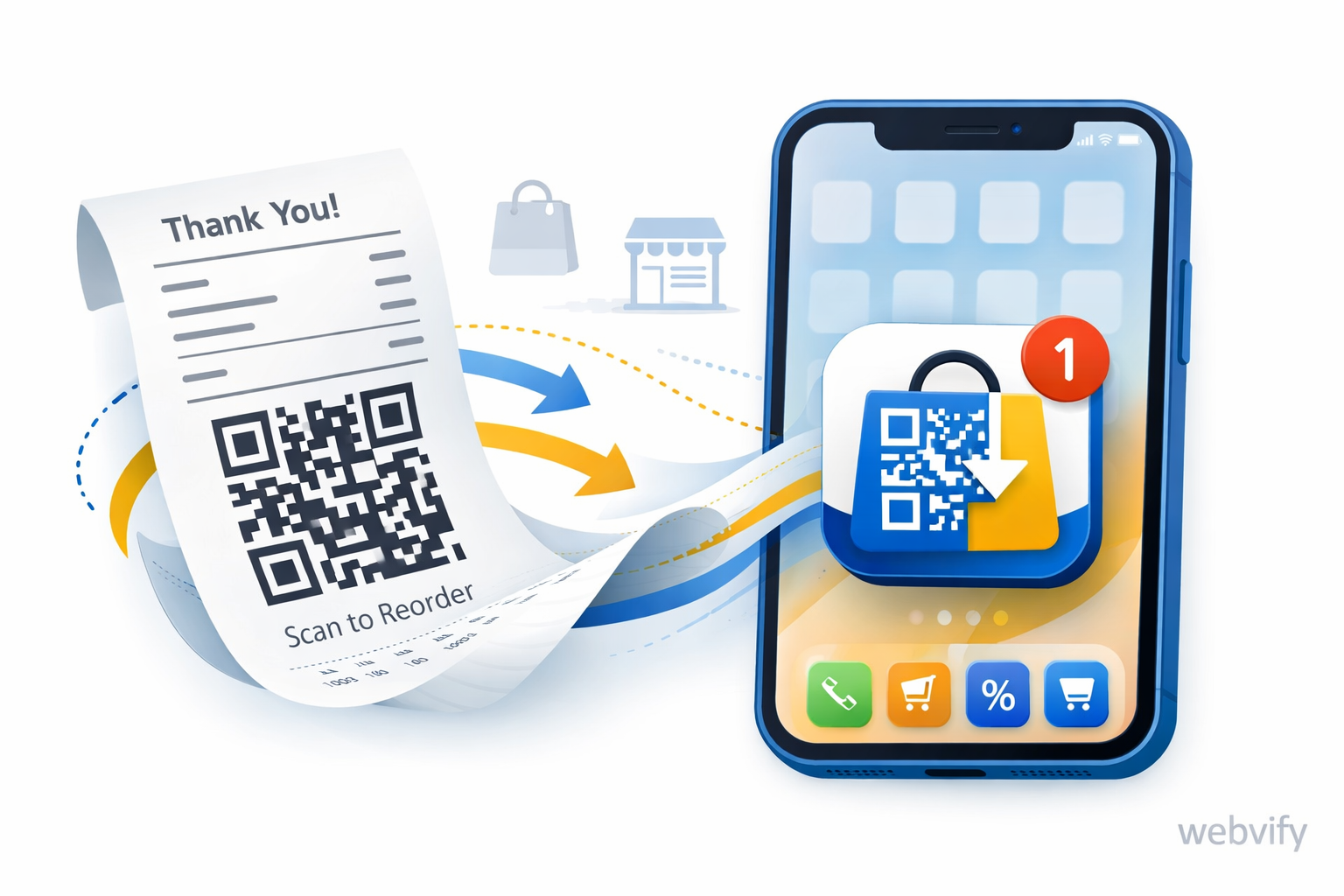
A practical playbook to turn in-store and web traffic into repeat customers using a WebView app, push notifications, and deep links—without a costly native rebuild.
Inside this article
- The Real Problem: One-Time Visitors
- Rented Reach vs Owned Reach
- Why Mobile Apps Work for Local and Retail Brands
- The QR-to-App Strategy
- The Simple Funnel
- Website Only vs Website + WebView App
- Why Speed Matters
- Practical Implementation Checklist
- Where Webvify Fits
- The Big Idea
- Ready to Turn Traffic Into Repeat Customers?
The Real Problem: One-Time Visitors
Retailers and local businesses spend a lot of time and money getting customers through the door.
A café prints flyers. A salon runs Instagram ads. A restaurant pays for Google Maps visibility. An e-commerce store buys Facebook traffic.
The customer visits once. Maybe they buy something.
Then they disappear.
The problem is not traffic. The real problem is retention.
Most small and medium brands rely on what can be called rented reach — platforms where you must constantly pay to reach the same people again.
Ads stop → traffic stops.
In 2026, the most efficient businesses focus on owned reach.
Owned reach means you can contact your customers directly whenever you want.
And the simplest way to achieve that today is:
Turning visitors into app users.
Not through an expensive native app project, but through a WebView-based mobile app connected to your existing website.
Rented Reach vs Owned Reach
Let’s make the difference very clear.
Rented Reach
Examples:
- Facebook Ads
- Google Ads
- Instagram promotions
- Influencer campaigns
- Marketplace listings
Benefits:
- Fast visibility
- Good for acquiring new customers
But there is a major downside.
You do not own the relationship.
You pay every time you want to reach the same user again.
Owned Reach
Examples:
- Email list
- SMS subscribers
- Mobile app users
- Push notification subscribers
These channels allow direct communication.
A mobile app is particularly powerful because it creates two permanent assets:
- Home screen presence (app icon)
- Push notification channel
This combination changes customer behavior dramatically.
Your brand becomes one tap away.
Why Mobile Apps Work for Local and Retail Brands
When a customer installs your app, three important things happen.
1. Your Brand Moves to the Home Screen
Instead of searching on Google or Instagram, the customer simply taps your icon.
That removes friction.
For example:
A restaurant customer wants to order again. If your app is on their home screen, they open it instantly.
No search. No competitors.
2. Push Notifications Bring Customers Back
Push notifications are one of the highest-performing marketing channels.
Typical engagement rates:
- Email open rate: ~20%
- Social reach: often below 5%
- Push notifications: 40–60% open rate
Examples:
A salon sends:
"Last-minute cancellation today at 4pm. 20% off if booked in the next hour."
A restaurant sends:
"Free dessert today with any dinner order."
A clothing store sends:
"Weekend sale — 30% off selected items."
These messages appear directly on the phone screen.
No algorithm.
No ad cost.
3. Deep Links Take Customers Exactly Where You Want
Deep links allow a push notification or QR code to open a specific page inside the app.
Examples:
- Product page
- Booking page
- Loyalty program
- Menu item
- Checkout page
This reduces steps between interest and purchase.
The QR-to-App Strategy
One of the simplest growth systems for physical businesses is QR-to-App.
Instead of sending customers to your website, you send them to install your app.
Once installed, the relationship becomes long-term.
Here are real examples that work well.
QR on Receipts
A clothing store prints this at the bottom of the receipt:
"Scan to install our app and get 10% off your next purchase."
The customer scans.
They install the app.
Now the store can send push notifications about:
- new arrivals
- flash discounts
- restocks
Table Tents in Restaurants
Restaurants place QR codes on tables.
Example text:
"Install our app and get a free drink on your next visit."
Customers scan while waiting for their food.
Later, the restaurant sends push notifications for:
- lunch offers
- weekday promotions
- new menu items
Packaging Inserts for E-commerce
E-commerce brands often miss this opportunity.
Inside every package, a small card can say:
"Install our app for exclusive drops and early access."
This converts buyers into long-term users.
Checkout Page Prompt
Online stores can show a simple message after checkout:
"Install our mobile app to track orders and get exclusive deals."
Because the user already trusts the brand, install rates can be surprisingly high.
Loyalty Program Entry Point
Many brands struggle with loyalty programs.
Apps solve this easily.
Example:
A coffee shop offers:
"Install the app and collect points for every purchase."
Customers open the app to check their points.
That means repeated engagement.
The Simple Funnel
Here is what the system looks like in practice.
Customer Visit
     │
     ▼
 QR Code / Website Prompt
     │
     ▼
 App Install
     │
     ▼
 Home Screen Presence
     │
     ▼
 Push Notifications
     │
     ▼
 Deep Link to Product / Offer
     │
     ▼
 Repeat Purchase
This funnel works because it removes the need to constantly reacquire the same customer.
Once the app is installed, retention becomes much easier.
Website Only vs Website + WebView App
Many businesses believe they need a fully native mobile app to achieve this.
In reality, that approach is often slow and expensive.
A WebView app connects directly to your existing website.
That means your site powers the app.
| Capability | Website Only | Website + WebView App |
|---|---|---|
| Home screen icon | ❌ | ✅ |
| Push notifications | ❌ | ✅ |
| Deep links to products | Limited | ✅ |
| App Store visibility | ❌ | ✅ |
| Development cost | Low | Low–Medium |
| Time to launch | Instant | Very fast |
This approach allows brands to launch in weeks instead of months.
Your existing Shopify, WooCommerce, or custom website becomes the core of the app.
When you update the website, the app reflects those changes automatically.
Why Speed Matters
Many companies delay mobile apps because they imagine a long development cycle.
Traditional native apps can take:
- 6–12 months
- large budgets
- ongoing maintenance
For many retail or local businesses, that timeline makes no sense.
The goal is not to build the most complex app.
The goal is to capture customer attention and bring them back.
A WebView-based app solves that quickly.
Practical Implementation Checklist
If you want to try a QR-to-App strategy, start with this simple checklist.
- Create a mobile app connected to your website
- Place QR codes in physical locations (receipt, table, packaging)
- Offer a small incentive for installing the app
- Send 1–2 push notifications per week
- Use deep links to direct customers to specific products or offers
Consistency is more important than complexity.
Even simple promotions can drive significant repeat traffic.
Where Webvify Fits
Building, publishing, and maintaining a mobile app can feel complicated.
That is where implementation partners become useful.
Webvify focuses on helping brands convert existing websites into mobile apps quickly, without rebuilding everything from scratch.
Instead of replacing your website, the platform connects it to a mobile app structure that supports:
- push notifications
- deep links
- App Store distribution
- home screen presence
For many retail and local businesses, this approach offers the fastest path to turn occasional visitors into repeat customers.
The Big Idea
Customer acquisition is getting harder and more expensive.
But most brands already have the traffic they need.
What they lack is a system to bring those customers back.
The QR-to-App model does exactly that.
It converts:
- store visitors
- website buyers
- restaurant guests
- service clients
into long-term mobile users.
Once your brand lives on the customer’s phone, repeat purchases become much easier.
Ready to Turn Traffic Into Repeat Customers?
If you already have a website, you may be closer to a mobile app than you think.
Learn how it works at https://webvify.app
A simple app icon on the home screen can be the difference between a one-time visitor and a loyal customer.