

Why the Post-Purchase Experience Should Live in a Mobile App, Not in Email, in 2026
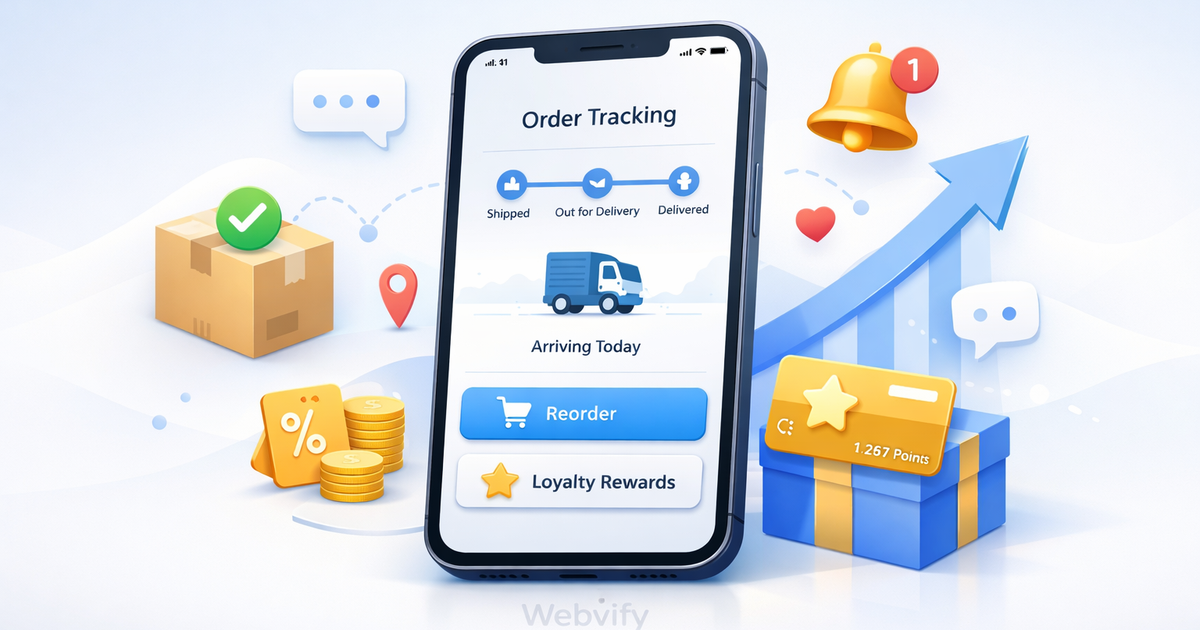
Learn why ecommerce brands are moving post-purchase journeys from email into mobile apps to improve retention, repeat orders, and customer experience.
Inside this article
- The short answer
- The real problem: everyone optimizes checkout, almost no one optimizes what comes after
- Why email breaks down in the post-purchase phase
- What changes when post-purchase lives inside a mobile app
- Key post-purchase use cases that work better in an app
- Email vs mobile app for post-purchase
- Why this matters more in 2026
- Do you need to build a native app from scratch?
- The strategic shift: from campaigns to environment
- Where Webvify fits in
- FAQ
- Final thought
The short answer
In 2026, email is no longer enough for post-purchase engagement.
The brands that win are the ones that move the post-purchase experience into a mobile app, where customers can track orders, reorder, get updates, and stay connected in one place.
Apps create habit, visibility, and direct communication. Email creates noise.
The real problem: everyone optimizes checkout, almost no one optimizes what comes after
Most ecommerce teams are obsessed with getting the sale.
Better landing pages. Faster checkout. More payment options. More conversion rate tweaks.
That work matters, but it also creates a blind spot.
What happens after the customer buys?
For many brands, the answer is simple:
- a confirmation email
- a shipping email
- maybe a follow-up campaign
Then the relationship becomes weak again.
Sometimes the customer gets random promotional emails that feel disconnected from the actual purchase. Sometimes they get no meaningful follow-up at all.
This is where retention is won or lost.
Because the real money in ecommerce does not come from the first purchase. It comes from:
- the second purchase
- the third purchase
- the habit of coming back
And that habit is rarely built in the inbox.
Why email breaks down in the post-purchase phase
Email still has a role. But using it as the main post-purchase channel is a weak strategy for many brands in 2026.
1. Email is passive by nature
Email waits for attention.
Even your best post-purchase flows compete with:
- newsletters
- promotions
- spam
- work emails
- other brand campaigns
You do not control the moment. You borrow it.
2. There is no real destination
An email is not a place customers return to.
Nobody wakes up and thinks, "I should go back and check that order confirmation email."
So every new interaction depends on sending another message.
That is not retention. That is interruption.
3. The experience becomes fragmented
Think about a common post-purchase journey on email:
- order confirmation in one email
- tracking in another email
- support on a separate website
- reordering back on the store
- loyalty points somewhere else
Everything is disconnected.
The customer keeps getting pushed between channels instead of staying inside one familiar experience.
4. Timing is often wrong
Email often arrives at the wrong moment.
It can be too early, too late, buried, or ignored.
And once it is missed, the opportunity usually fades.
What changes when post-purchase lives inside a mobile app
A mobile app changes the model.
Instead of sending updates out and hoping for engagement, you create a place customers can return to whenever they need something.
That shift changes behavior.
1. You create a habit loop
An app icon on the home screen is not just a shortcut. It is a reminder that your brand exists.
Every time the user unlocks their phone, your brand stays visible.
Over time, this builds:
- familiarity
- trust
- revisit behavior
Email does not create that kind of presence. Apps do.
2. Everything lives in one place
Inside an app, the post-purchase experience becomes structured and predictable.
Customers can:
- check order status
- track shipments
- contact support
- view past orders
- reorder in seconds
- see loyalty rewards
No searching. No inbox digging. No unnecessary friction.
3. Push notifications replace guesswork
Instead of hoping an email gets opened, you can communicate directly at the right moment.
Useful examples include:
- "Your order has shipped"
- "Your package arrives tomorrow"
- "You are running low on this product"
- "Back in stock: your size is available again"
Push notifications are timely, contextual, and easier to notice.
More importantly, they bring users back into the app, not just into a one-time message.
4. Repeat purchases get easier
Reordering becomes much simpler.
Instead of searching the website, logging in, and finding the product again, the customer can:
- open the app
- tap reorder
- check out faster
That sounds like a small difference, but small friction changes often decide whether a repeat purchase happens at all.
Key post-purchase use cases that work better in an app
These are the moments where mobile apps consistently outperform email-based journeys.
Order tracking
Instead of digging through old emails, users can open the app and instantly see:
- order status
- delivery timeline
- shipping updates
This reduces support tickets and improves customer confidence.
Reorder flows
For repeat-purchase categories such as supplements, skincare, pet food, grocery, and household products, speed matters.
Apps make reordering feel natural. Email usually pushes users back into a longer process.
Back-in-stock alerts
Email alerts can easily get lost.
Push notifications inside an app are more immediate and more likely to reach customers when intent is still high.
That matters even more for high-demand products, limited sizes, and fast-moving collections.
Loyalty and rewards visibility
When rewards live inside an app, customers check them more often.
Progress feels visible. Points feel usable. Member benefits feel real.
In email, rewards are easy to forget.
Support access
Instead of asking, "Where do I contact support?", the customer can find help directly in context.
That might include:
- chat
- a help center
- order-linked support
This creates a more reliable post-purchase experience.
Product education and onboarding
After purchase, apps can guide customers with:
- how-to content
- setup guidance
- usage tips
- personalized recommendations
Email can support this, but it rarely feels organized. In an app, the experience is easier to revisit.
Referral and sharing loops
Apps can make referrals part of the experience instead of treating them like one-off campaigns.
A customer can share, invite, or unlock a reward without leaving the environment where they already interact with the brand.
Email vs mobile app for post-purchase
| Aspect | Email-Based Experience | App-Based Experience |
|---|---|---|
| Access | Requires opening the inbox | One tap from the home screen |
| Visibility | Competes with other emails | Always visible through the app icon |
| Order tracking | Search for the right message | Real-time inside the app |
| Reordering | Multiple steps | Faster repeat purchase flow |
| Communication | Delayed or ignored | Immediate through push |
| Experience | Fragmented | Centralized |
| Habit formation | Weak | Stronger over time |
| Retention impact | Limited | Compounding |
This is not about replacing email completely.
It is about deciding where the core experience should live.
Why this matters more in 2026
Customer expectations have changed.
People already use banking apps, delivery apps, subscription apps, and travel apps every day.
They expect:
- real-time updates
- simple actions
- persistent access
When ecommerce brands rely only on email for post-purchase engagement, they do not always look broken. But they can feel behind.
At the same time, acquisition is getting more expensive.
That means:
- you cannot afford to lose customers after the first purchase
- you need stronger retention loops
- you need better ways to bring buyers back without paying to reacquire them
The post-purchase phase is no longer a support layer. For many brands, it is one of the clearest growth levers available.
Do you need to build a native app from scratch?
Usually, no.
This is where many brands hesitate. They assume building an app means:
- high development cost
- long timelines
- a full app team
- rebuilding the entire store experience
That used to be more common.
It is not the only path now.
If you already have:
- a Shopify store
- a WooCommerce store
- a working mobile-friendly website
you may be much closer to a useful app than you think.
The goal is not to reinvent the business.
The goal is to extend what already works into a stronger retention channel.
The strategic shift: from campaigns to environment
Email is campaign-based.
You send something. You wait. You send again.
A mobile app is different. It becomes an environment customers can return to, explore, and use repeatedly.
That changes retention from:
- "How do we send more emails?"
to:
- "How do we create a place customers want to come back to?"
That is the shift many brands still have not fully made.
Where Webvify fits in
If your ecommerce store is already working, the biggest gap may not be your product catalog or your checkout.
It may be the layer that comes after the sale.
Webvify helps brands turn an existing website into a mobile app without rebuilding everything from scratch.
That can mean:
- faster time to launch
- lower cost than full native development
- push notifications for direct communication
- a central place for orders, support, loyalty, and repeat purchases
Instead of relying only on email, you give customers a better way to return.
FAQ
Is email still useful for ecommerce retention?
Yes. Email still works well for receipts, confirmations, and broader campaigns.
But it should not be the only post-purchase channel. For many brands, email works best as a support layer, while the core experience lives in the app.
Do customers actually use brand apps after purchase?
They do when the app provides real utility.
That usually means features like:
- order tracking
- easy reordering
- rewards visibility
- fast support access
If the app removes friction, usage becomes much easier to justify.
Is this only for large ecommerce brands?
No.
Smaller and mid-sized brands often benefit even more because they depend heavily on repeat purchases and stronger customer relationships.
An app can help them compete without needing enterprise-scale development.
What kind of stores benefit most from a mobile app?
Brands with repeat-purchase or revisit behavior usually gain the most.
That includes:
- skincare
- supplements
- pet products
- fashion
- grocery
- niche ecommerce brands with loyal buyers
Will an app replace my website?
No.
Your website still matters for discovery, browsing, and acquisition.
The app becomes the retention and engagement layer, especially after the first purchase.
How long can it take to launch?
With modern web-to-app approaches, it can be much faster than traditional native development.
In many cases, you build on top of what you already have instead of starting from zero.
Final thought
Most ecommerce brands do not have a traffic problem first.
They have a return problem.
Email tries to solve that problem with more messages.
A mobile app solves it by creating a place customers actually come back to.
If you want the post-purchase experience to drive more repeat orders, stronger retention, and a more direct customer relationship, Webvify gives you a practical way to launch without rebuilding your entire stack: https://webvify.app