

The Modern Loyalty Program: Why a Mobile App Beats SMS, Email, and Punch Cards in 2026
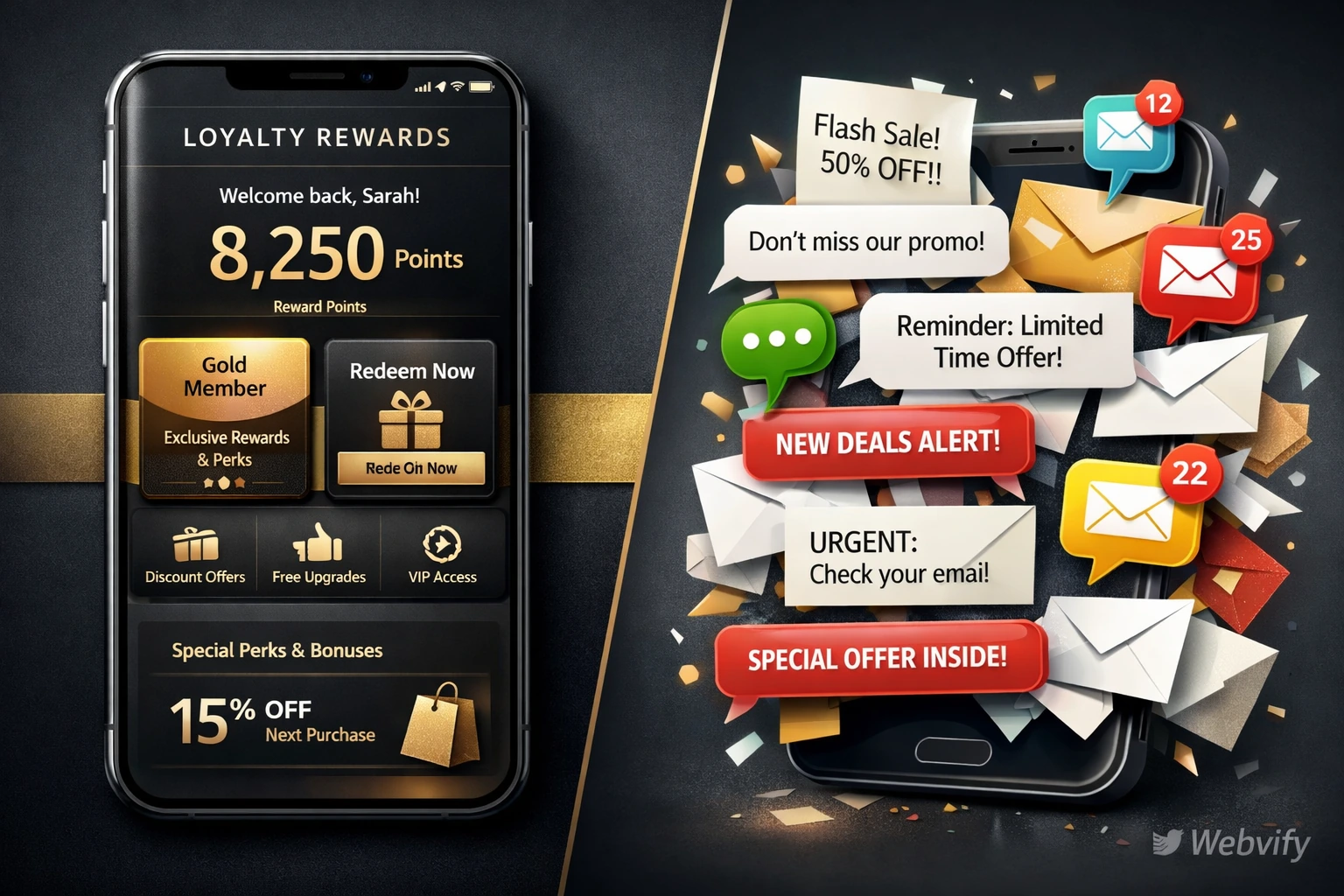
If your loyalty program lives in inboxes, it gets ignored. Learn how an app icon + push notifications create repeat purchases with less discounting.
Inside this article
- The Loyalty Problem Most Businesses Don’t See
- The Attention Economy: Why Loyalty Channels Fail
- The Modern Loyalty Loop
- The Power of the App Icon
- Push Notifications: The Modern Loyalty Trigger
- Channel Comparison: SMS vs Email vs PWA vs Mobile App
- Real-World Example
- Actionable Checklist: Building a Modern Loyalty System
- Why Lightweight Apps Are the Future
- FAQ (Quick Answers)
- Final Thoughts
The Loyalty Problem Most Businesses Don’t See
Most loyalty programs look good on paper.
“10% off your next order.”
“Buy 5 coffees, get 1 free.”
“Subscribe to SMS for exclusive deals.”
But in reality, most customers simply forget your brand exists.
Their inbox is crowded.
Their SMS inbox is noisy.
Their wallet no longer carries punch cards.
In 2026, the biggest loyalty problem isn’t discounts.
It’s attention.
If your brand is not visible on a customer’s phone, you’re competing against hundreds of other businesses for a tiny moment of attention.
That’s why the most effective loyalty programs today aren’t based on coupons.
They’re based on presence.
And nothing creates stronger presence than a mobile app icon on the home screen.
The Attention Economy: Why Loyalty Channels Fail
Let’s look at how traditional loyalty channels behave in the real world.
SMS Loyalty Programs
SMS has high open rates, but it also creates fatigue.
Customers quickly start to see promotional messages as spam.
Common problems:
- Customers unsubscribe after too many messages
- Messages feel transactional rather than brand-driven
- No persistent brand presence
SMS works for alerts, not for building brand habit.
Email Loyalty Programs
Email is useful for newsletters and promotions, but it has a major limitation.
Your message lives in the inbox — not in the customer’s daily environment.
Typical issues:
- Low visibility in crowded inboxes
- Promotions tab filtering
- Slow engagement cycles
Email helps with communication, but not with habit formation.
Punch Cards (Physical Loyalty)
Punch cards were once effective because they lived in the wallet.
But wallets are disappearing.
Today’s consumer carries:
- a smartphone
- a payment app
- a few essential apps
Physical loyalty cards simply don’t fit modern behavior anymore.
The Modern Loyalty Loop
Modern loyalty programs aren’t just about rewards.
They create a loop:
- Brand visibility
- Easy re-entry
- Timely reminders
- Repeat purchase
A mobile app naturally supports this loop.
Here’s why.
The Power of the App Icon
A mobile app icon does something subtle but powerful.
It becomes a permanent reminder of your brand.
Every time a customer unlocks their phone, they see it.
This creates what behavioral economists call passive brand recall.
For example:
- A coffee shop app icon appears during the morning commute.
- A fitness studio app appears before the evening workout window.
- An e-commerce brand appears when customers open their shopping folder.
The result?
Customers return without needing a discount.
Push Notifications: The Modern Loyalty Trigger
Push notifications are the most underused loyalty tool for small businesses.
Unlike SMS or email, push notifications have three advantages:
- Higher visibility
- Lower cost
- Better timing
Examples:
Coffee shop:
“Your free coffee is waiting ☕ — stop by today.”
Fitness studio:
“2 spots left in tonight’s HIIT class.”
E-commerce brand:
“Your size is back in stock.”
Push notifications work because they connect context + timing.
And customers can return with one tap.
Channel Comparison: SMS vs Email vs PWA vs Mobile App
| Channel | Visibility | Brand Presence | Notification Power | User Effort | Loyalty Strength |
|---|---|---|---|---|---|
| SMS | High initially | None | Medium | Low | Weak |
| Low | None | Low | Medium | Weak | |
| PWA | Medium | Limited | Limited | Medium | Moderate |
| Mobile App | Very High | Permanent | Strong | Very Low | Strong |
Why mobile apps win:
- permanent home screen presence
- push notifications
- one-tap access
- brand credibility
Even simple apps dramatically increase repeat engagement.
Real-World Example
Imagine a local café.
Traditional Loyalty
Customer receives:
- SMS discount
- email promotion
- punch card
Most customers forget.
They visit only when they remember.
App-Based Loyalty
Customer installs the café’s app.
Now:
- The app icon sits on their phone.
- Their loyalty progress is visible.
- Push notifications remind them at the right time.
Example notification:
“You’re 1 coffee away from a free drink ☕”
That single reminder can trigger a visit the same day.
The loyalty system becomes active instead of passive.
Actionable Checklist: Building a Modern Loyalty System
If you want to modernize your loyalty strategy, follow this framework.
Step 1: Keep Your Website
Your website remains your central system.
You do not need to rebuild your entire platform.
Step 2: Turn the Website into a Mobile App
A lightweight mobile app can wrap your existing website.
This allows:
- push notifications
- home screen presence
- faster access
Step 3: Design a Simple Loyalty Loop
Your loyalty system should be simple.
Examples:
- points for purchases
- progress toward rewards
- app-exclusive offers
Complex systems reduce engagement.
Step 4: Use Push Notifications Carefully
Do not spam.
Use triggers like:
- reward progress
- product restocks
- appointment reminders
- limited offers
The goal is relevance, not volume.
Step 5: Promote the App at Every Touchpoint
Encourage installs using:
- QR codes at checkout
- receipts
- packaging inserts
- website banners
The faster you grow installs, the stronger your loyalty loop becomes.
Why Lightweight Apps Are the Future
Many businesses assume apps are expensive.
Historically, that was true.
But modern tools allow businesses to turn their existing websites into apps quickly.
This creates the benefits of native apps without a full rebuild.
For small brands, this is the fastest path to:
- higher retention
- more repeat purchases
- less reliance on discounts
FAQ (Quick Answers)
Do small businesses really need a mobile app?
Yes — if repeat customers matter.
An app icon keeps your brand visible and makes returning effortless.
Isn’t SMS enough for loyalty?
SMS is useful, but it lacks brand presence.
Once the message is read, your brand disappears.
What about PWAs?
PWAs are helpful, but most customers still interact more consistently with native-style apps that support push notifications and home screen presence.
Are mobile apps expensive to build?
Traditional apps can be expensive.
But modern solutions can convert an existing website into a mobile app quickly and affordably.
Do customers actually install small business apps?
Yes — when there is clear value.
Examples:
- loyalty rewards
- order tracking
- appointment booking
- exclusive offers
The key is utility + convenience.
Final Thoughts
Loyalty in 2026 is not about bigger discounts.
It’s about staying present in the customer’s daily digital life.
SMS disappears.
Emails get buried.
Punch cards get lost.
But an app icon stays on the home screen.
For businesses that rely on repeat purchases — cafés, salons, fitness studios, and e-commerce brands — that presence can make the difference between one-time customers and loyal fans.
If you want to turn your existing website into a mobile app and build a stronger loyalty loop, you can explore solutions like Webvify designed specifically for businesses that want repeat customers without the cost of a full native app rebuild.