

The Silent Revenue Thief: How Website Redirection and "Open in Browser" Prompts Kill Your Sales (And How a Native App Moat Stops It)
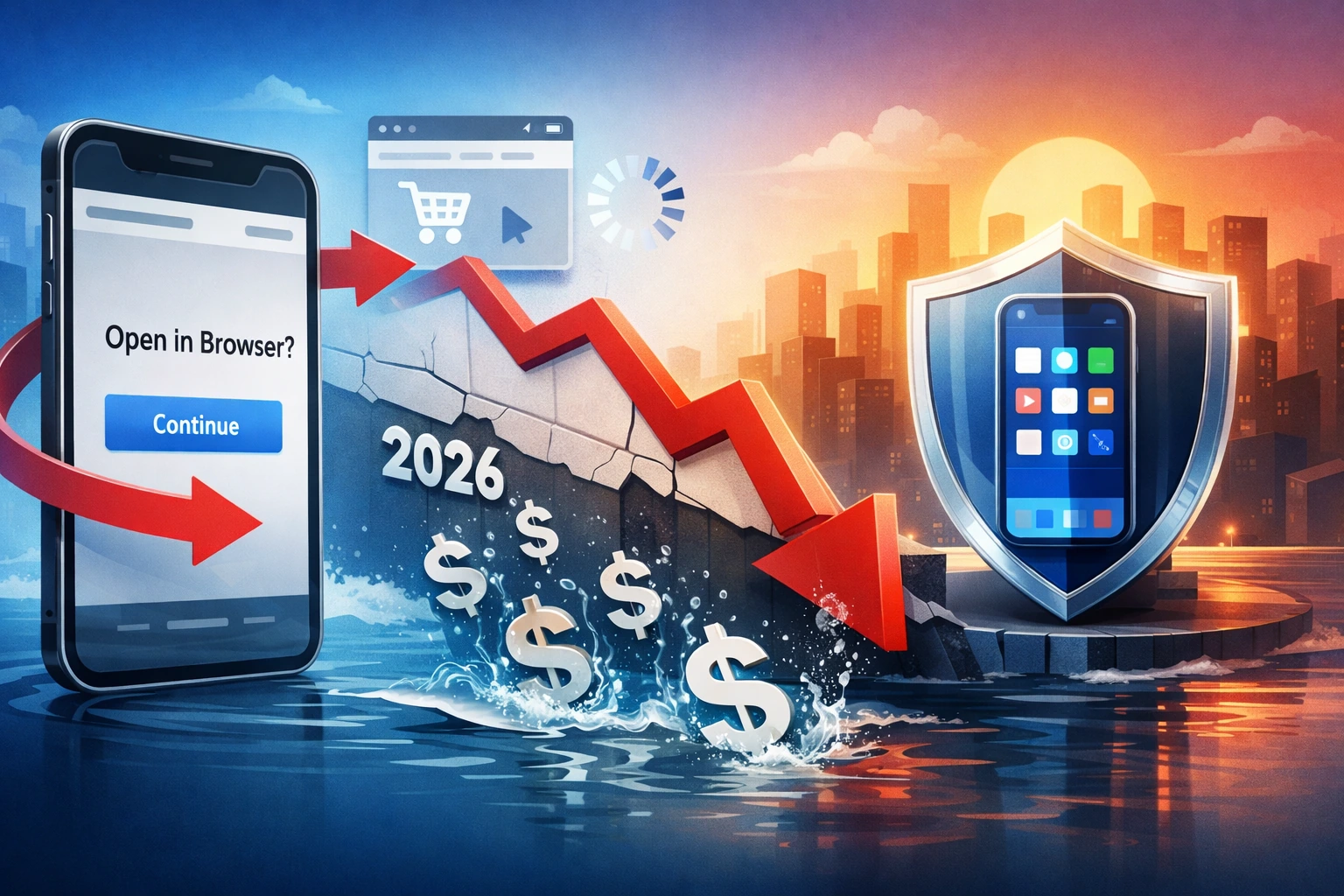
Many Shopify and WooCommerce brands unknowingly lose revenue when social media traffic is forced through fragile mobile web flows. Here is why the social-to-web trap destroys conversions — and how a native app moat protects your revenue.
Inside this article
- The Silent Revenue Leak Most Brands Never See
- The Instagram Browser Problem
- Why Social Traffic Is the Most Fragile Traffic
- The Social-to-Web Trap vs. The Social-to-App Bridge
- The Deep Linking Advantage
- Why Native Apps Create a Revenue "Closed Loop"
- The Strategic Shift Smart Brands Are Making
- When a Mobile App Becomes Essential
- FAQ
- The Bottom Line
- Protect Your Revenue with a Native App
The Silent Revenue Leak Most Brands Never See
If you run a Shopify store, WooCommerce shop, or sell courses online, a surprising amount of your traffic probably comes from social platforms.
Instagram. TikTok. Facebook. You post a product, someone taps the link, and they land on your site.
Simple.
Except it isn't.
Behind the scenes, that click often enters a fragile, multi-step mobile journey that silently destroys conversions:
- Social app browser loads your site
- Session tracking behaves inconsistently
- Login state is lost
- Checkout authentication fails
- The user abandons
This phenomenon is what I call the Social-to-Web Trap.
And it is one of the most underestimated revenue killers in mobile commerce today.
The Instagram Browser Problem
Most users do not open your store in Safari or Chrome.
Instead, platforms like Instagram and TikTok open links inside an embedded in-app browser.
This creates several issues:
1. Cookie and Session Instability
Embedded browsers often restrict cookies and tracking.
This means:
- Returning users may appear logged out
- Cart sessions may reset
- Analytics may fragment sessions
For Shopify and WooCommerce, this can break checkout continuity.
2. Authentication Breaks
When customers reach checkout:
- Payment providers sometimes require external authentication
- OAuth redirects may fail
- Login states reset after redirects
The result?
Customers encounter unexpected login screens or empty carts.
That moment of confusion is where conversions die.
3. The “Open in Browser” Friction
You've probably seen this flow:
- Customer taps your Instagram link
- Site loads inside Instagram browser
- Checkout fails or loads slowly
- User taps "Open in Safari/Chrome"
- Page reloads from scratch
Each step introduces drop-off risk.
And most users simply abandon.
Why Social Traffic Is the Most Fragile Traffic
Social media traffic has three characteristics:
- Impulse-driven
- Short attention span
- Low patience for friction
If the purchase flow breaks even slightly, the customer disappears.
This is especially painful for:
- Shopify product launches
- WooCommerce course sales
- Limited-time offers
- Influencer traffic spikes
You paid for that attention.
But your mobile web funnel leaks it.
The Social-to-Web Trap vs. The Social-to-App Bridge
| Factor | Social-to-Web Trap | Social-to-App Bridge |
|---|---|---|
| Entry Point | Social link opens inside embedded browser | Link opens directly in branded app |
| Session Stability | Often lost or reset | Persistent user session |
| Authentication | Users frequently logged out | Stored login credentials |
| Checkout Speed | Multiple reloads and redirects | Native one-tap checkout |
| Payment Trust | Browser warnings and redirects | App-level payment integration |
| Conversion Reliability | Highly volatile | Predictable conversion flow |
The difference is not small.
It is structural.
The Deep Linking Advantage
This is where Deep Linking changes the entire game.
Deep linking allows a link to:
- Detect if your app is installed
- Open a specific screen inside the app
- Preserve user context
For example:
Instagram Post → Product Link → Opens Product Page Inside Your App
No browser.
No session resets.
No login friction.
Just a direct purchase environment.
Why Native Apps Create a Revenue "Closed Loop"
A branded mobile app creates something extremely powerful:
A controlled commerce environment.
Inside an app:
- Sessions persist
- Users remain authenticated
- Checkout flows are optimized
- Payment integrations are native
- Push notifications bring users back
This creates a closed revenue loop.
Traffic enters your ecosystem and never leaves it.
Contrast this with the open web:
Social → Browser → Redirect → Login → Payment → Drop-off
Each step leaks revenue.
Apps remove those steps.
The Strategic Shift Smart Brands Are Making
Many high-growth brands are shifting their thinking:
Old model:
Website is the primary storefront.
New model:
Mobile app is the revenue engine.
Website is the discovery layer.
Traffic from:
- TikTok
- Ads
...should ideally land inside a native app environment where conversions are predictable.
When a Mobile App Becomes Essential
If any of the following are true, you are likely losing revenue to the social-to-web trap:
- Your traffic is mobile-first
- Instagram is a top sales channel
- You sell courses or memberships
- You run limited-time product drops
- Your checkout requires authentication
These scenarios amplify friction.
A native app removes it.
FAQ
Why does the Instagram browser hurt conversions?
Instagram's in-app browser limits cookie persistence and often interferes with authentication flows. This causes users to appear logged out or lose cart sessions during checkout.
What is deep linking in mobile commerce?
Deep linking allows a link to open a specific page inside a mobile app, preserving context such as product selection, user login state, and checkout progress.
Do small Shopify or WooCommerce brands really need an app?
Increasingly, yes.
Mobile apps are no longer reserved for large brands. With modern tooling, smaller stores can launch apps to protect conversions, stabilize sessions, and capture returning customers.
Is a mobile app mainly about push notifications?
Push notifications are valuable, but the bigger advantage is conversion stability.
Apps eliminate browser friction and create a controlled buying environment.
The Bottom Line
Most brands assume their biggest growth problem is traffic.
In reality, the problem is often mobile friction.
The silent revenue thief isn't your marketing.
It's the fragile social-to-web conversion path.
A native mobile app turns that fragile path into a stable revenue bridge.
Protect Your Revenue with a Native App
If your Shopify or WooCommerce store depends on mobile traffic, building a branded app is one of the most powerful ways to:
- Stabilize conversions
- Eliminate browser friction
- Capture returning customers
- Build a true direct-to-consumer channel
Create your mobile app today:
Turn fragile mobile traffic into predictable revenue.