

Mobile App for Tree Service Companies: Win More Repeat Jobs and Stop Losing Customers to Silence
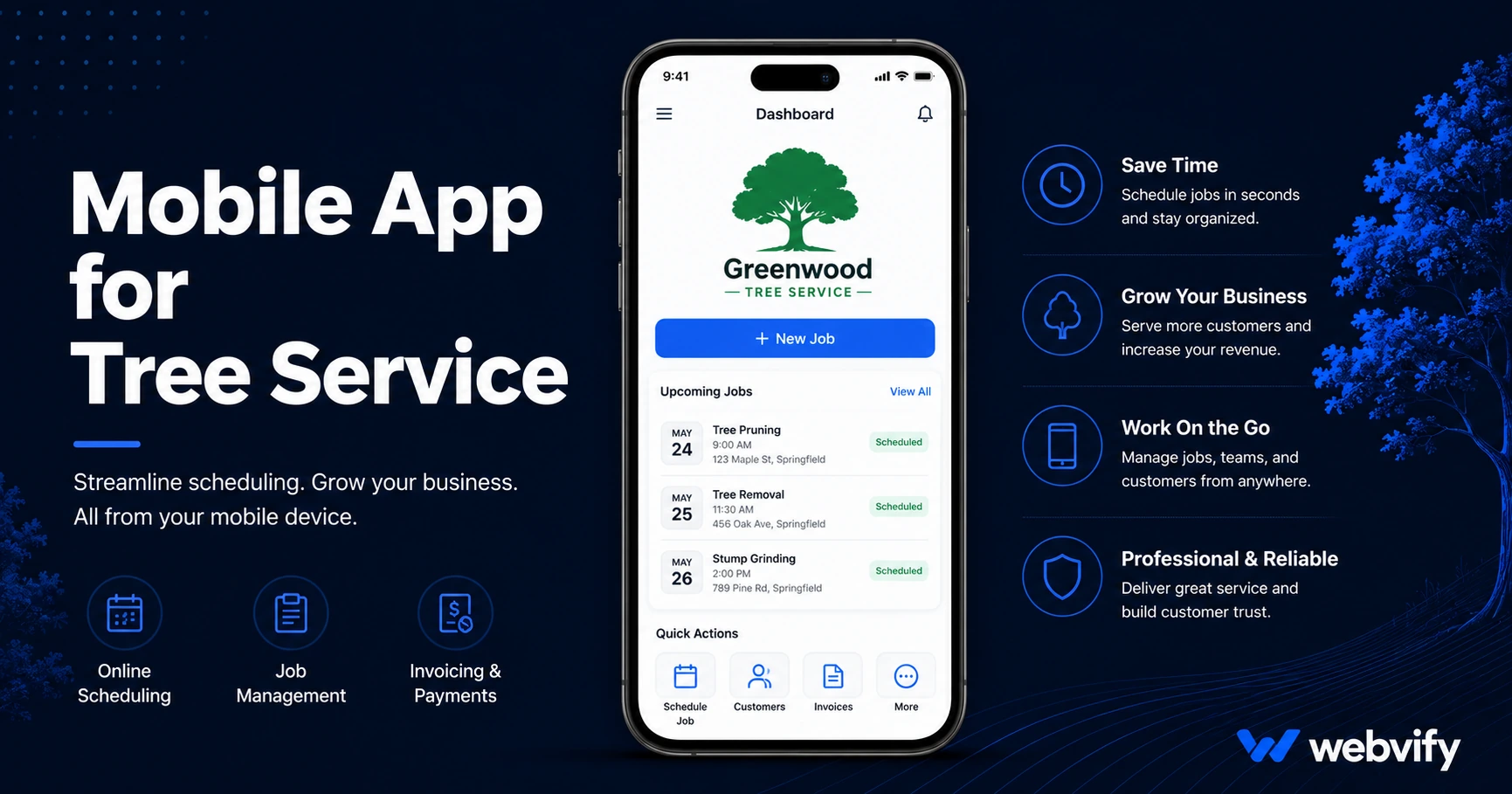
A mobile app helps tree service companies win repeat jobs with seasonal push notifications. Here's how to get one without hiring a developer.
Inside this article
Tree service customers are happy after every job. Then they forget your name for two years — and Google someone else when the next storm drops a limb on their roof.
The gap between jobs is where tree service companies lose repeat business. Not because the work was bad. Because there was no reason to stay in touch.
A branded mobile app changes that equation. It puts your business on the customer's home screen, lets you send push notifications directly to their lock screen, and builds the kind of visibility that keeps your number top of mind when a tree problem shows up — seasonal or emergency.
Why Tree Service Companies Lose Repeat Customers
A typical residential tree service customer books a job every one to three years. Storm damage brings some calls outside that cycle, but most work is seasonal: spring cleanup, summer growth control, autumn prep, winter hazard removal.
Between those windows, you're invisible. Email newsletters get ignored. Facebook posts reach maybe 5% of your followers. A business card gets lost in a drawer.
Push notifications are different. They go directly to the lock screen. Open rates for push notifications average 60–90%, compared to 20–28% for email in the home services category. That's the gap most tree service companies never close — because they don't have a channel that reaches customers between jobs.
A mobile app gives you that channel.
What a Mobile App for Tree Service Actually Does
A mobile app for a tree service company isn't a custom-built booking system. The simplest and most cost-effective approach is a WebView app — your existing website packaged as a native mobile app and submitted to the App Store and Google Play.
Your customers download the app once. It sits on their home screen. You can send them push notifications at any time.
That's the core value: home screen presence plus push notification access. Everything else — your website's booking form, contact page, photo gallery of past jobs — is already inside the app because the app loads your website.
If you run a site on WordPress, Wix, Squarespace, or any other platform, you already have everything you need. The app wraps what's already there.
Services like Webvify handle the end-to-end process — building the WebView app, submitting it to the App Store and Google Play under your business accounts, and giving you an admin panel to send push notifications whenever you need to. No developer required.
The Three Push Notification Campaigns That Drive Repeat Jobs
The real value of a mobile app for tree service isn't the app itself — it's the push notification sequences you run through it. These three campaigns cover the highest-ROI windows in the tree service calendar.
Spring Cleanup Opener (February–April)
This is your highest-volume campaign window. Winter damage assessment, dead limb removal, canopy thinning before spring growth — customers think about trees in spring, but they need a nudge to pick up the phone.
Send a push notification in late February: "Spring is coming — now's the time to assess winter damage before new growth hides it. Tap to book your spring cleanup."
This campaign alone typically generates 20–30% of a tree service company's repeat bookings for the year.
Post-Storm 48-Hour Alert
After a named storm or significant wind event, customers with trees in their yard are actively worried. A push notification within 48 hours — "Storm damage? We're taking emergency assessments this week. Tap to schedule." — reaches them at exactly the moment they're ready to act.
This is a time-sensitive campaign that only works with push notifications. Email arrives too late. A Facebook post competes with everything else in the feed. A push notification hits the lock screen while the concern is fresh.
12-Month Dormant Reactivation
Identify customers who haven't rebooked in 12 months or more. A single push notification — "It's been a year since your last tree service. Ready for another inspection?" — converts a meaningful percentage of dormant customers at almost zero cost.
The 12-month trigger works across all service trades, but it's particularly effective for tree service where annual or biannual maintenance is genuinely appropriate for most properties. For a similar approach in a related trade, see how landscaping companies use push notifications to win back customers between seasonal jobs.
What to Look for in a Tree Service App
Not all mobile app solutions work the same way. When evaluating options, look for these three things:
App Store submission included. Many app builders give you the app file and leave submission to you. Apple's App Store review process is strict — rejection rates for first-time submissions are high. Look for a service that handles submission, responds to reviewer feedback, and gets your app actually live. (For context on what the submission process involves, see our guide to submitting an app to the App Store without a developer.)
Push notification admin panel. You need to be able to send push notifications yourself, without a developer. If the service doesn't include a simple admin panel where you type a message and hit send, it's not built for a small business.
Published under your own accounts. Your app should live in the App Store under your business name, not under the vendor's developer account. If the vendor account closes, your app disappears. Always confirm your app is submitted under Apple and Google accounts you own.
App Store Credibility in a Trust-Sensitive Trade
Tree service is a trust-sensitive business. Customers are handing you access to their property, their vehicles, their garden — and in many cases paying $500 to $5,000 or more for a single job.
An App Store listing adds a layer of credibility most competitors don't have. It signals that you've invested in your business, that you're established, that you're serious. For a customer evaluating two tree companies with similar reviews and pricing, the one with a branded app on the App Store carries implicit legitimacy that the one without it simply doesn't.
This is the same dynamic that applies to contractors and other trades where property access and large invoices are involved — professional presence is a genuine differentiator.
FAQ
How much does a mobile app for a tree service company cost?
The cost depends on the approach. Custom native development starts at $15,000–$50,000 and takes months. A WebView app — where your existing website is packaged as a native app — typically costs a fraction of that and can be live within days. The WebView approach delivers push notifications, home screen presence, and App Store and Google Play listings without rebuilding anything you've already built.
Do I need a developer to submit a tree service app to the App Store?
No, but the submission process is detailed. Apple requires an Apple Developer account ($99/year), specific binary formats, and compliance with App Store review guidelines. Many businesses use a done-for-you service that handles submission, responds to reviewer questions, and ensures the app gets approved — so you don't need to navigate Apple's portal yourself.
Can I send push notifications to all my customers at once?
Yes. If your customers have downloaded the app, you can send push notifications to all of them simultaneously through an admin panel. You can also segment by location or job type if your admin panel supports it. Most WebView app services include a basic broadcast push notification tool — confirm this is included before you sign up.
Tree service customers don't leave because of bad work. They leave because something else shows up on their phone first.
A mobile app keeps your business on their home screen between jobs — so when the next storm hits or spring cleanup season starts, they tap your icon instead of searching Google.
Get your tree service app live on the App Store and Google Play with Webvify →