

Mobile App for Psychologists: Keep Clients Engaged Between Sessions
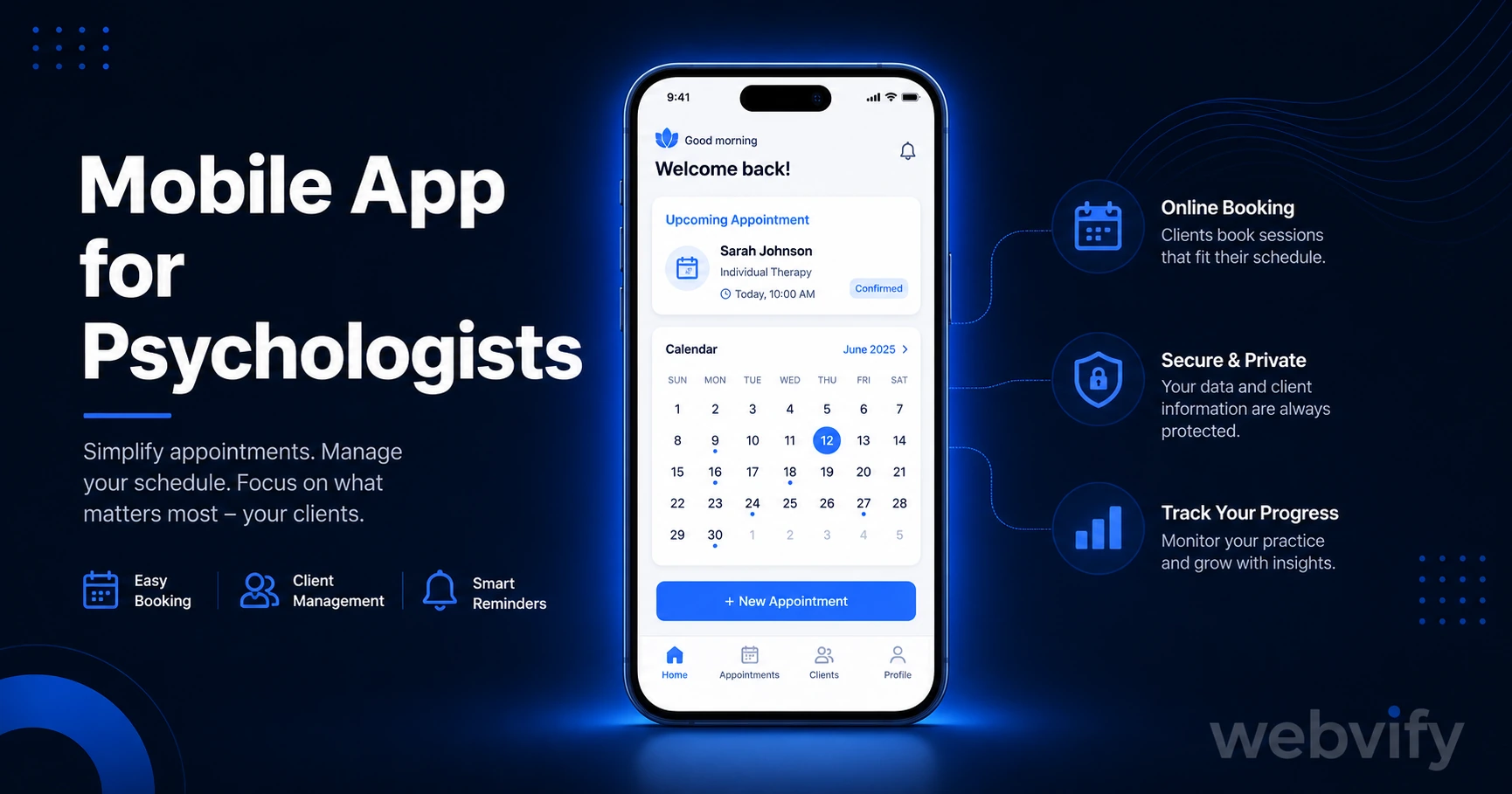
A branded mobile app helps psychologists reduce no-shows, improve client engagement between sessions, and grow their practice — without a developer.
Inside this article
- Mobile App for Psychologists: Keep Clients Engaged Between Sessions
- Why Psychologists Lose Clients Between Sessions
- What a Mobile App Actually Does for a Psychology Practice
- Three Push Notification Campaigns Every Psychology Practice Should Run
- App Store Credibility Matters More in Mental Health Than in Most Fields
- How to Get a Mobile App for Your Psychology Practice
- FAQ
Mobile App for Psychologists: Keep Clients Engaged Between Sessions
Clients often arrive at their next session having drifted from the work done in the previous one. Not because they didn't care — but because nothing kept the connection alive in between. A branded mobile app gives your psychology practice a direct line to clients between sessions, without the overhead of constant outreach.
Why Psychologists Lose Clients Between Sessions
The gap between appointments is where momentum fades. A client finishes a strong session on Wednesday, but by the following Tuesday they've stopped journaling, skipped the breathing exercises, and almost cancelled the rebooking. This isn't a motivation problem — it's a visibility problem.
Email newsletters go unread. Text reminders feel clinical. And your clients are already spending most of their screen time inside apps, not browsers.
A psychology practice app puts your name and a gentle nudge directly on their home screen. That single change — being present without being intrusive — is what keeps clients engaged through the therapeutic process.
What a Mobile App Actually Does for a Psychology Practice
A branded app built on your existing website does several things that email and text cannot:
Push notifications reach the lock screen directly. Unlike email with a 20–25% open rate in healthcare, push notifications average 60–90% open rates. A Day-3 homework reminder or a Day-7 rebooking nudge gets seen.
Home screen presence is a trust anchor. When your app icon is on a client's phone, you stay top of mind. That's meaningful in a profession where clients often feel ambivalent about continuing therapy — the friction of searching for your number is removed.
Appointment reminders reduce no-shows. No-shows are costly for private practices. A push notification sent 24 hours before a session, followed by a 2-hour reminder, is more reliable than an email buried under newsletters.
Session notes and resources stay accessible. If your website includes a client portal, a journaling page, or downloadable worksheets, your app delivers those resources to clients instantly — no hunting through emails for a link.
Three Push Notification Campaigns Every Psychology Practice Should Run
The highest-ROI push campaigns for psychologists map to the natural rhythms of a therapy relationship:
The Day-3 Home Exercise Nudge. Most therapeutic homework is forgotten within 72 hours of a session. A brief push notification three days after each appointment — "A quick reminder to check in with your journal this week" — is enough to maintain the habit without feeling intrusive.
The Day-14 Rebooking Reminder. Clients who book infrequently or who cancelled without rescheduling are most likely to drift. A push notification at the 14-day mark — "It's been two weeks since your last session — ready to book your next one?" — recovers a significant portion of at-risk clients before they go fully inactive.
The Seasonal Re-engagement Campaign. January and September are the two highest-demand windows for psychology practices. A push notification in the first week of each — "New year, new intention. We're here when you're ready." — reaches dormant clients at exactly the moment they're reconsidering therapy.
Services like Webvify handle building and publishing the app end-to-end — you don't need a developer or any technical knowledge. Your existing website becomes the foundation, and the app is submitted to the App Store and Google Play under your own practice name.
App Store Credibility Matters More in Mental Health Than in Most Fields
Trust is foundational to a therapeutic relationship — and it begins before the first session. A branded app on the App Store signals professional credibility in a way a mobile website alone cannot.
When a prospective client is choosing between two psychologists with similar credentials, the one with an App Store listing looks more established. The app icon sits alongside the banking apps and healthcare tools they already trust.
This matters especially for practices that work with anxious or risk-averse clients. An App Store presence functions as a credibility shortcut that takes no time to earn — it simply comes from having the app listed.
For practices worried about Apple's submission process, it's worth knowing that WebView apps — apps that wrap a properly functioning website — are approved on the App Store every day. The key compliance point is Apple Guideline 4.2 (Minimum Functionality): your website needs to offer genuine content and utility, which any active psychology practice website already provides. A specialist service handles the submission details so you don't have to.
If you're also considering how to handle client-facing booking or payment flows within the app, take a look at this guide on converting a website to a mobile app — it covers the platform-specific rules clearly.
How to Get a Mobile App for Your Psychology Practice
The process is simpler than most practitioners expect:
-
Your existing website is the foundation. Whether you use Squarespace, Wix, WordPress, or a custom CMS, the app is built from what you already have. No content migration, no rebuilding.
-
A specialist packages it as a native app. The app is compiled into the format required by Apple and Google — this is the step that blocks most practice owners who try to do it themselves.
-
The app is submitted and approved under your practice name. Both the App Store and Google Play listings carry your brand, not a third-party platform's name.
-
You get an admin panel to manage push notifications. Once live, you write and schedule notifications from a simple dashboard — no developer needed for ongoing use.
Most psychology practices are live on both stores within 5–7 business days of starting the process.
FAQ
How much does a mobile app cost for a private psychology practice?
A WebView-based practice app typically costs a fraction of custom development. Custom native apps for healthcare start at $20,000–$50,000 and require ongoing developer involvement. A specialist web-to-app service like Webvify wraps your existing website and handles App Store submission for a flat fee, making it accessible for solo practitioners and small group practices. The exact cost depends on the provider and the scope of features.
Can I use a mobile app to send appointment reminders to therapy clients?
Yes — push notifications sent through a mobile app are one of the most reliable ways to reduce no-shows in a psychology practice. Unlike email, push notifications appear directly on the client's lock screen and average 60–90% open rates. You can schedule reminders for 24 hours before and 2 hours before each appointment, or send them manually through your admin panel.
Do I need a developer to build a mobile app for my psychology practice?
Not if you use a web-to-app service. These services take your existing psychology practice website and package it as a native iOS and Android app, then handle the App Store and Google Play submission process on your behalf. You don't write any code, and you don't manage the technical review process with Apple or Google. Once the app is live, you manage push notifications and basic settings through a non-technical admin panel.
Psychology clients who stay engaged between sessions progress faster, rebook more consistently, and are far less likely to drop off after a difficult session. A mobile app doesn't replace the therapeutic relationship — it protects the continuity of it.
Ready to get your practice app live on the App Store and Google Play? See how Webvify works →