

Mobile App for Plumbers: Turn One-Time Callers Into Repeat Customers
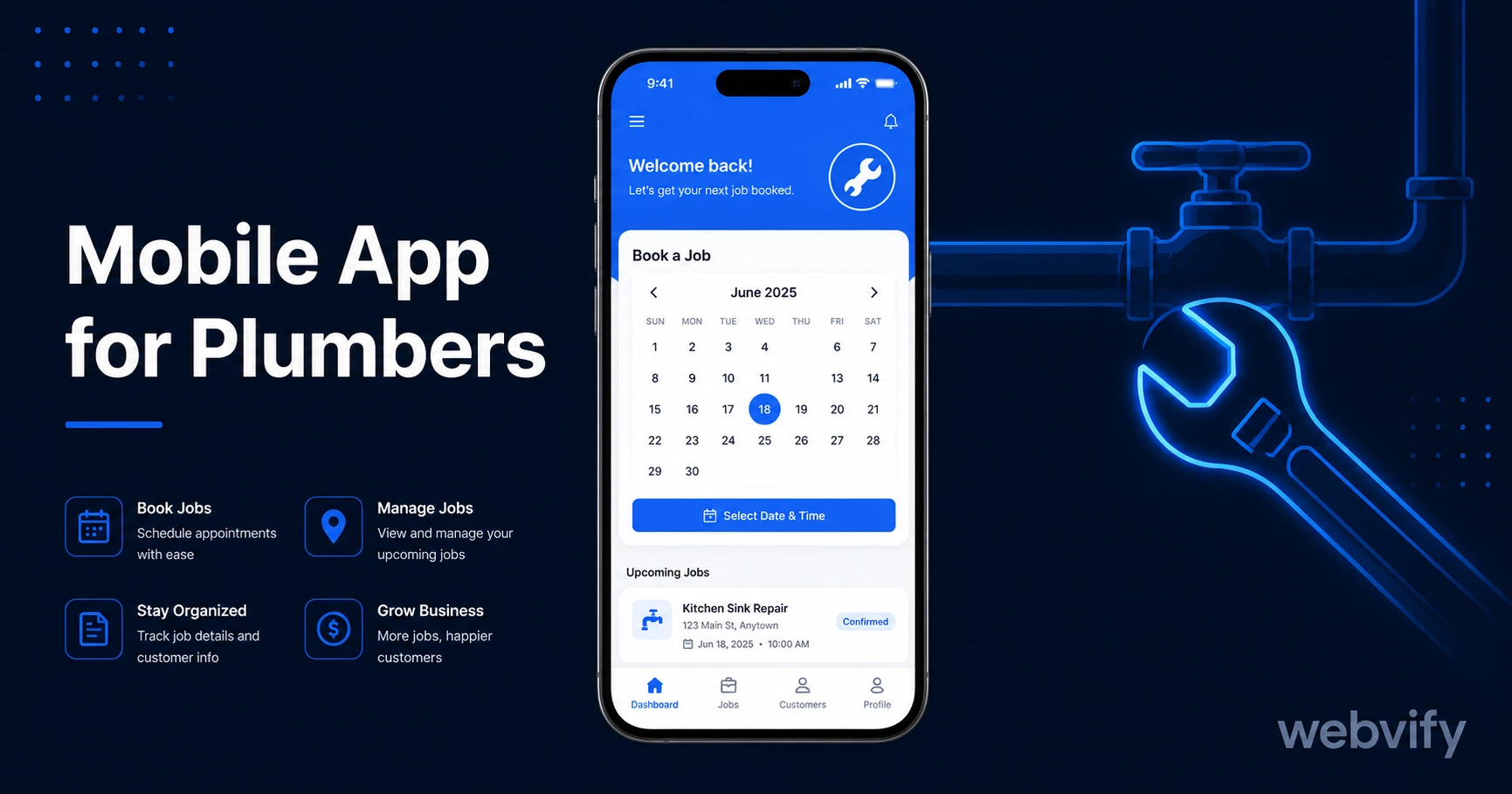
Most plumbers lose repeat customers to silence between jobs. A mobile app with push notifications fixes that — without a developer. Here's how.
Inside this article
- Mobile App for Plumbers: Turn One-Time Callers Into Repeat Customers
- Why Plumbers Lose Repeat Business (It's Not What You Think)
- What Push Notifications Can Do for a Plumbing Business
- How a Mobile App for Plumbers Actually Works
- App Store Presence: The Trust Signal Plumbers Underestimate
- Getting Your Plumbing App Live: What to Expect
- Frequently Asked Questions
Mobile App for Plumbers: Turn One-Time Callers Into Repeat Customers
Most plumbers do great work and still lose repeat customers — not because of bad service, but because the customer forgets their name the moment the pipe stops leaking. A mobile app for plumbers changes that equation without hiring a developer or rebuilding your website.
When a homeowner has a burst pipe, they call the first plumber they can find on Google. When it's time to replace a water heater or book an annual drain check, they call whoever is on their phone. That distinction — reactive search vs. proactive relationship — is the gap between a one-time job and a loyal customer.
Why Plumbers Lose Repeat Business (It's Not What You Think)
The gap between plumbing calls can be months or even years. A kitchen tap repair in March. A boiler service in October. Nothing in between. During that silence, your customer sees a competitor's van in the neighborhood, gets a flyer through the door, or just types "plumber near me" into Google again and picks whoever appears.
You did nothing wrong. You simply weren't visible.
A mobile app solves this by giving your business a permanent presence on your customer's home screen — the same place they open their bank, their coffee loyalty card, and their food delivery app. When a push notification lands on their lock screen from "City Plumbing Pro," they already trust the name.
Email averages a 20–25% open rate for trade businesses. Push notifications delivered through a mobile app reach the lock screen directly at 60–90% open rates. That difference is why home service businesses that invest in app-based communication consistently outbook their competitors on repeat work.
What Push Notifications Can Do for a Plumbing Business
Push notifications are the highest-ROI feature of any mobile app for plumbers. Here are the campaigns that generate the most repeat bookings:
Seasonal drain check reminder (October/November): "Winter's coming — is your drainage ready? Book your annual check before the cold sets in." This one campaign, sent to your existing customer list, fills schedule gaps and prevents the reactive emergency calls caused by frozen or blocked pipes.
Water heater service window (Spring): Most water heaters need a service or flush every 12–18 months. A push notification timed to 12 months after a customer's last boiler or water heater job creates a predictable revenue stream from work customers already need.
Post-job follow-up (Day 7): "How's everything since your repair? If you spot anything, we're one tap away." This single message has two effects — it catches minor issues before they become emergencies, and it cements the relationship before the customer forgets you.
Slow-week slot filler: "We have two slots open this Thursday — priority booking for existing customers." A direct, honest push campaign fills the schedule without discounting.
These campaigns don't require a marketing degree. They require a mobile app with a push notification panel — and the discipline to use it.
How a Mobile App for Plumbers Actually Works
A common misconception is that getting a mobile app means starting from scratch. Most plumbers already have a website — a booking form, a contact page, their list of services. A web-to-app conversion wraps that existing website into a native iOS and Android app and submits it to the App Store and Google Play under your business name.
Your customers download it, it sits on their home screen, and you send push notifications from an admin panel — no code required.
Services like Webvify handle this process end-to-end: building the app, configuring push notifications, and submitting it to both stores under your own developer accounts. You own the app. You manage it through a simple dashboard. No developer needed after launch.
This is the same approach used by local service businesses that generate consistent repeat bookings without spending money on ads. The investment is in visibility, not acquisition.
For more on how this approach works across service businesses, see How to Get a Mobile App for Your Cleaning Business and Mobile App for Electricians — the retention mechanics are the same.
App Store Presence: The Trust Signal Plumbers Underestimate
There's a trust problem specific to trade services. When a homeowner lets a plumber into their home, they are making a judgment call about that person. An app in the App Store — with your logo, your name, your reviews — signals a level of professionalism that most local competitors don't have.
Search "plumber [your city]" in the App Store. The results are almost always empty or dominated by aggregator platforms like TaskRabbit and Angi. A branded plumbing app stands out immediately.
This matters because younger homeowners — who are becoming the majority of the home-buying market — make decisions based on digital presence. A plumber without a website is a risk. A plumber with an App Store listing is a business.
App Store presence also creates a second discovery channel. Homeowners searching for a plumber in your area can find you directly in the App Store, without competing against paid Google Ads from national aggregators.
Getting Your Plumbing App Live: What to Expect
The process is simpler than most plumbers expect:
Your existing website becomes the app. No rebuilding, no new content to manage. If your website already has a booking form, an FAQ, and your contact details, the app is ready to build.
Apple and Google review and approve apps like this regularly. The typical timeline from build to live in both stores is 7–14 days, depending on review times.
After launch, you manage push notifications from a web-based admin panel. Schedule a seasonal campaign, send a same-day slot filler, or set up automatic job-anniversary reminders — all without touching code.
The cost of a managed web-to-app service is a fraction of what one repeat customer is worth over a year. A homeowner who books an annual drain check, a water heater flush, and an emergency repair generates several hundred dollars in revenue. That's the math that makes a plumbing app worth building.
Frequently Asked Questions
How much does it cost to get a mobile app for a plumbing business?
A web-to-app conversion through a managed service typically costs a one-time fee in the range of $500–$2,000 depending on the provider and what's included. This is significantly cheaper than custom development ($20,000–$100,000+) and includes App Store submission. Ongoing admin panels are usually included. The break-even point is typically one or two additional repeat bookings per month from push notification campaigns.
Do I need a developer to submit a plumbing app to the App Store?
No. Managed web-to-app services like Webvify handle the entire App Store and Google Play submission process. You need an Apple Developer account ($99/year) and a Google Play account ($25 one-time), but the service handles all the technical compliance and submission on your behalf. Most plumbing businesses have their app live within two weeks of starting.
What can I do with push notifications in a plumbing app?
Push notifications let you send direct messages to your customers' lock screens — seasonal maintenance reminders, job anniversary follow-ups, slot fillers for open schedule gaps, and emergency outreach during local weather events (frozen pipes, flood warnings). Open rates for push notifications are 60–90%, compared to 20–25% for email. For a plumbing business, the highest-ROI campaigns are seasonal drain checks in autumn and water heater service reminders timed 12 months after the last job.
Ready to turn your existing plumbing website into a mobile app that keeps you visible between jobs? Webvify handles the build, the App Store submission, and the push notification setup — so you can focus on the work.