

Mobile App for Landscapers: Win More Repeat Jobs and Stop Losing Customers to Silence
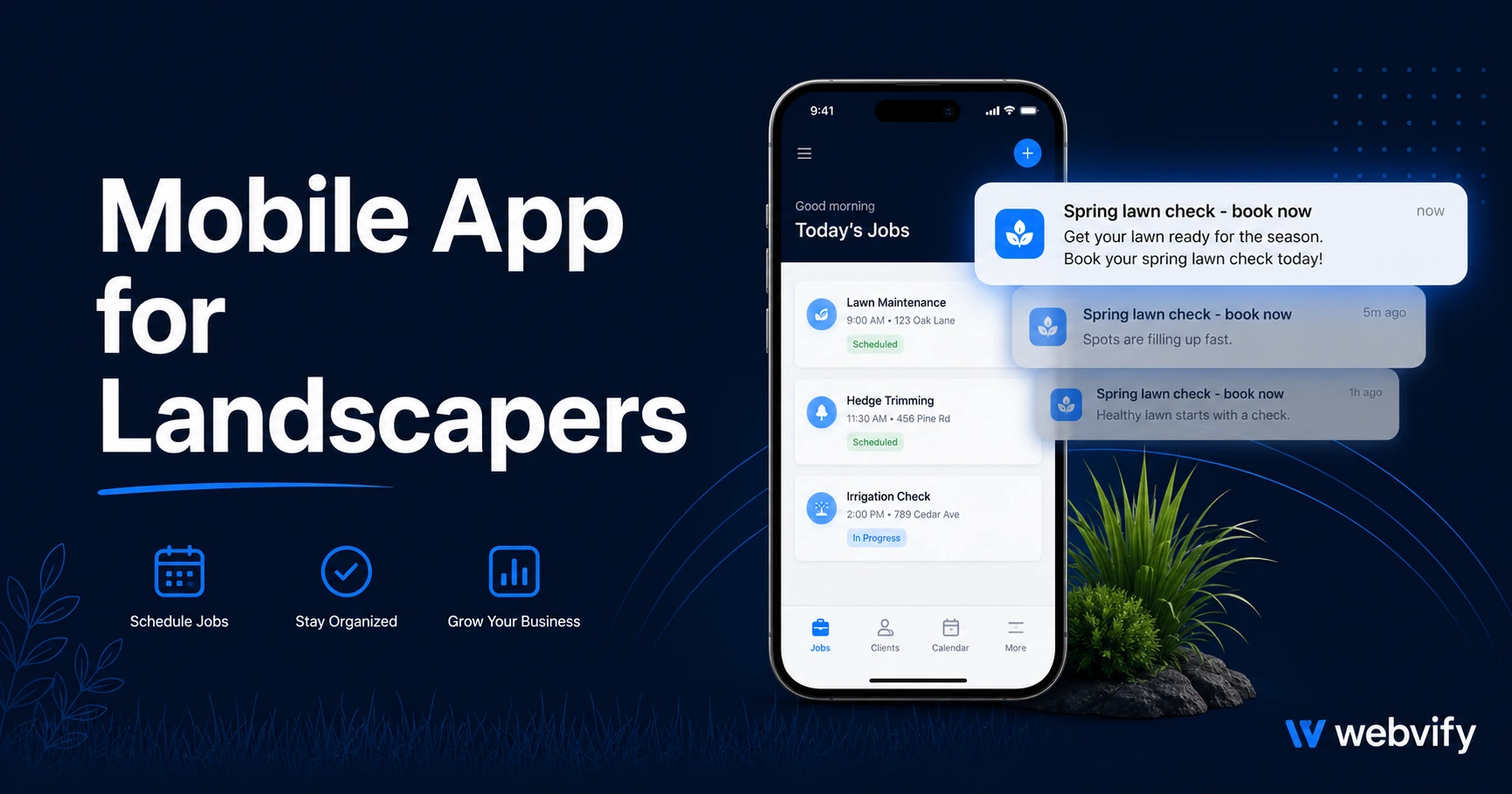
Landscaping customers don't leave — they just forget you exist. Here's how a mobile app with push notifications keeps you booked season after season.
Inside this article
- Mobile App for Landscapers: Win More Repeat Jobs and Stop Losing Customers to Silence
- Why Landscaping Businesses Lose Repeat Customers
- The Three Push Notification Campaigns That Drive Repeat Jobs
- App Store Credibility in a Trust-Sensitive Business
- What Your Landscaping App Actually Contains
- Getting Your Landscaping App on the App Store
- FAQ
Mobile App for Landscapers: Win More Repeat Jobs and Stop Losing Customers to Silence
Landscaping customers don't leave because the work was bad. They drift away because spring arrives, they can't find your number, and they Google "lawn care near me" instead.
A mobile app on their home screen — with push notifications you control — closes that gap. Here's how landscaping businesses use it to keep customers booked and stop losing repeat jobs to silence.
Why Landscaping Businesses Lose Repeat Customers
The seasonal nature of landscaping creates a reliability problem. A customer loves your spring clean-up. Winter passes. By the time March rolls around, they've forgotten your name and your number is buried in an old text thread.
This isn't a service quality problem. It's a visibility problem.
Email marketing for home services averages a 20–25% open rate. Most seasonal reminder emails get ignored entirely. Push notifications through a mobile app reach the lock screen directly, with open rates of 60–90%. That's the difference between a customer who re-books and one who books your competitor instead.
The home screen placement matters too. When your branded app icon sits alongside apps your customers check every day, you're always one tap away — not buried in a contact list they haven't opened since last summer.
The Three Push Notification Campaigns That Drive Repeat Jobs
For landscaping businesses, three campaign windows deliver the highest return:
Spring opener (late February/early March): Send a notification when lawns are about to need attention. "Spring is here — your lawn is ready for its first cut of the year. Tap to book." This catches customers before they've already searched for someone else. First-mover advantage every season.
Autumn leaf and garden close-down (late September/early October): A single notification — "Before the frost hits: autumn tidy-up and leaf clearing, book before slots fill." Autumn clean-up is often a second billable visit that gets skipped entirely when there's no reminder in place.
Off-season reactivation (January/February): For customers who went quiet after last autumn, a reactivation nudge in January wakes them up before peak season demand compresses your availability. "New season bookings are open — lock in your regular slot before March." Dormant customers re-book at significantly higher rates than cold leads.
Services like Webvify handle the full process — building the app, submitting it to the App Store and Google Play under your own developer accounts, and giving you an admin panel to send these campaigns yourself without a developer.
App Store Credibility in a Trust-Sensitive Business
Landscaping involves giving someone regular access to your property. Customers don't make that decision lightly.
A landscaping business with a branded app on the App Store signals something that a Facebook page or a generic website can't — that this is an established business, not a one-person operation that might disappear mid-season.
When two landscapers quote the same job, the one with a recognisable app listing carries a trust advantage. Customers search by name before they book. An App Store listing confirms you're legitimate.
This matters especially when expanding into commercial landscaping contracts, where facilities managers and property managers run basic due diligence before awarding recurring work.
What Your Landscaping App Actually Contains
Your app doesn't need to be complex. The core value comes from three things: your contact details and service areas, an easy way to request a quote or booking, and a push notification channel you control.
If you already have a website — even a basic one — a WebView-based mobile app converts it directly into a native app. There's nothing to rebuild. Your existing booking form, service pages, and contact information are all there from day one.
You can use your app to share seasonal offers, announce availability windows, promote referral discounts, and re-engage customers who've gone quiet — all without relying on an algorithm deciding who sees your post.
For home services businesses running on tools like Jobber, HouseCall Pro, or a basic booking form, the app wraps what you already have. No duplicate systems, no second calendar to manage.
If you're also running a lawn care or landscaping website, this is the same infrastructure that helps other home services businesses stay booked. The approach that works for HVAC companies managing seasonal demand and contractors managing long gaps between jobs applies directly to landscaping.
Getting Your Landscaping App on the App Store
The App Store submission process puts off most business owners — not because it's technically difficult, but because it involves Apple and Google developer accounts, compliance rules, and a review process most people haven't navigated before.
For a landscaping app built on a WebView wrapper, the key compliance point is Apple's Guideline 4.2 (Minimum Functionality) — your app needs to deliver genuine value beyond just displaying a website. Booking functionality, service area pages, push notifications, and a customer contact portal all satisfy this requirement. A static single-page brochure does not.
Done-for-you services handle the submission, the developer account setup, and any rejection responses — so you don't have to become an expert in Apple's review guidelines to get your app live.
FAQ
How much does it cost to build a mobile app for a landscaping business?
Custom native app development typically costs $20,000–$80,000 and takes 6–12 months. A WebView-based app that converts your existing landscaping website into a fully published App Store and Google Play app costs a fraction of that — and can be live within weeks. The ongoing cost is an Apple Developer account ($99/year) and a Google Play account ($25 one-time fee).
Can I send push notifications to all my customers from the app?
Yes. Once a customer installs your app and accepts push notification permissions, you can send them notifications directly from an admin panel — no developer required. You can schedule seasonal campaigns in advance, target customers who haven't booked in 60+ days, or send same-day slot-filler offers when a cancellation opens up.
Will a WebView landscaping app pass App Store review?
Yes, provided it delivers real functionality — not just a static website wrapper. Apps with booking forms, contact pages, service galleries, and push notification infrastructure consistently pass Apple and Google review. Apps that are thin marketing pages without interactive features are the ones that get rejected.
Ready to stop losing repeat customers to silence? Webvify converts your existing landscaping website into a branded mobile app — App Store, Google Play, push notifications, and admin panel included — without you writing a single line of code.