

Mobile App for Ice Cream Shops: Keep Customers Scooping All Year
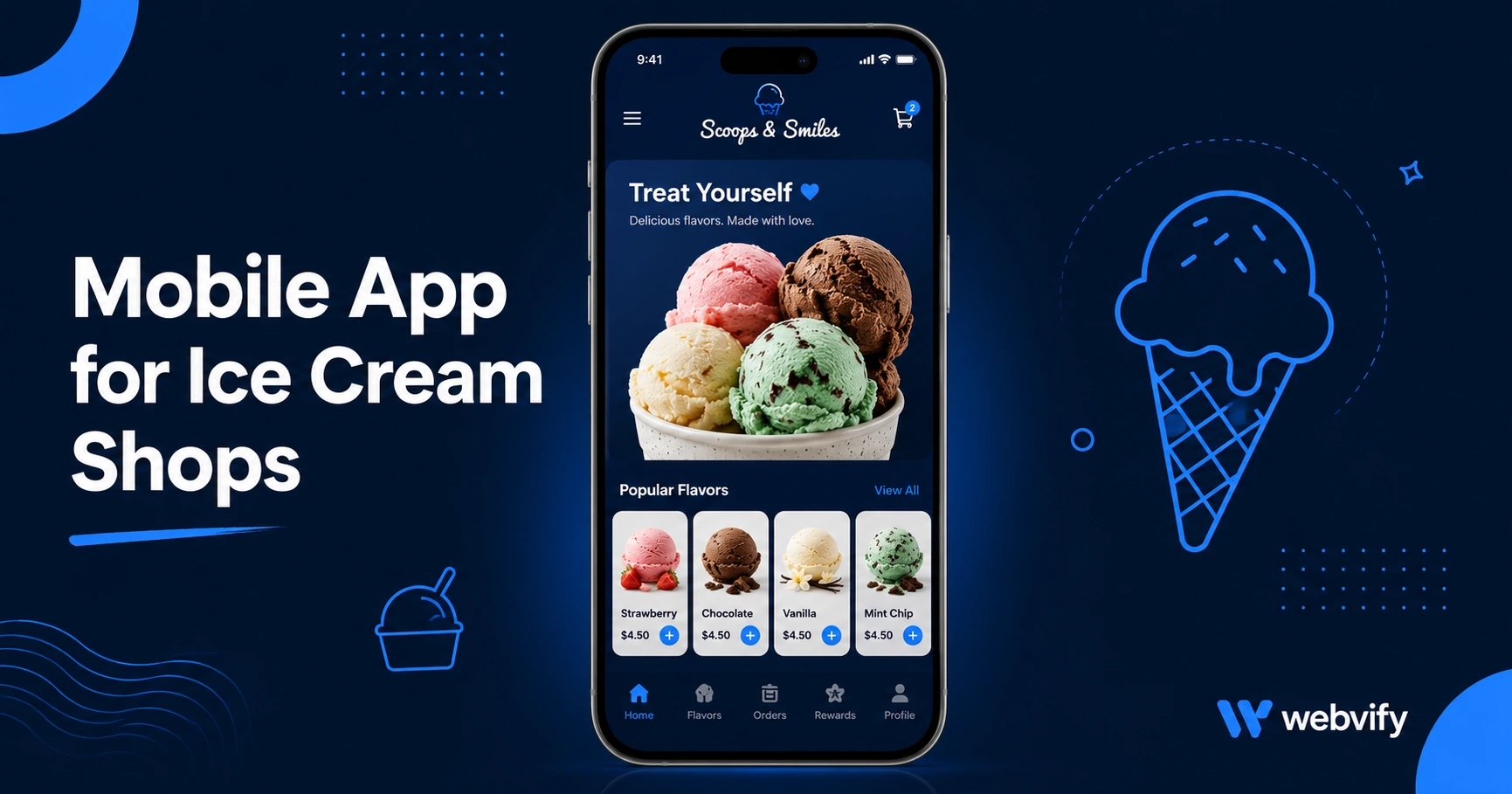
Most ice cream shops go silent in winter — and lose customers to competitors. Here's how a branded mobile app keeps them coming back year-round.
Inside this article
- Mobile App for Ice Cream Shops: Keep Customers Scooping All Year
- Why Ice Cream Shops Lose Customers Between Seasons
- What a Mobile App for an Ice Cream Shop Actually Does
- The 3 Push Campaigns That Drive Ice Cream Shop Revenue
- Home Screen Presence vs. Social Media: What Actually Keeps You Top of Mind
- Do I Need a Developer to Get on the App Store?
- How Much Does a Mobile App for an Ice Cream Shop Cost?
- FAQ
Mobile App for Ice Cream Shops: Keep Customers Scooping All Year
Your busiest day in August doesn't guarantee a customer comes back in February. For most ice cream shops, the summer rush is real — but the October silence is where loyal customers quietly drift to whoever's in front of them next spring.
The average ice cream shop customer visits 4–6 times per year when the weather cooperates. But there is no natural reminder tied to that cycle. Email newsletters go unread. Instagram posts get buried by the algorithm. And by February, the customer who loved your salted caramel cone has already forgotten you exist.
A branded mobile app changes that equation — not by creating loyalty points, but by putting your shop on their lock screen and keeping you in the conversation all twelve months.
Why Ice Cream Shops Lose Customers Between Seasons
Unlike a dentist (who has appointment reminders) or a gym (with monthly billing), ice cream shops are impulse-purchase businesses. Customers show up when they feel like it, enjoy the experience, then disappear — not because they stopped liking you, but because nothing brought you back to mind.
The businesses that survive seasonal slowdowns are the ones that maintain visibility when foot traffic drops. Push notifications from a branded app are the most direct way to do that.
Email averages a 20–30% open rate and competes with hundreds of other inbox items. A push notification from your app lands on the lock screen with a 60–90% open rate — and there is no algorithm deciding who sees it.
What a Mobile App for an Ice Cream Shop Actually Does
A mobile app for your ice cream shop is not a loyalty punch card on a screen. It is a direct communication channel to your customer's phone, available the moment you want to reach them.
With a WebView-based app — which converts your existing website into a native-feeling mobile experience — you get:
- Push notifications delivered directly to the lock screen at 60–90% open rates
- Home screen presence — your brand icon visible every time the customer unlocks their phone
- App Store listing on both the App Store and Google Play, giving your independent shop the same credibility as a chain
You do not need to rebuild your website. A WebView app wraps your existing site and publishes it as a native app under your own name and developer accounts. Your menu, your booking system, your loyalty page — all of it works inside the app exactly as it does on the web.
If you run a café alongside your shop or are exploring apps for your food business generally, the same approach applies — we covered the coffee shop version in detail in How to Get a Mobile App for Your Coffee Shop →.
The 3 Push Campaigns That Drive Ice Cream Shop Revenue
Push notifications are only valuable if you send the right message at the right moment. These three campaign sequences are the highest-ROI moves for ice cream shop owners:
1. Seasonal Opener (Late March — Before the Rush)
Send this campaign before your busy season starts, while competitors are silent:
"Spring is here. We're back to full hours on April 1 — and the seasonal menu just dropped. Come see what's new."
This reactivates customers who drifted over winter before they form a new routine elsewhere. The timing matters: send it 5–10 days before you officially open full hours, not on opening day when you're already at capacity.
2. New Flavor or Limited Run Alert
When you drop a new flavor, a collaboration, or a one-day special:
"New today: Blackberry Basil Sorbet. We only made 50 servings — come in before it's gone."
Push notifications are uniquely suited to urgency-based messaging. An email about a limited flavor takes 2–3 days to generate action (if it generates any at all). A push notification lands the moment you send it, during the exact decision window you want to influence.
3. Slow-Day Slot Filler (Tuesday–Thursday Afternoons)
When Tuesday foot traffic is slow and you want to move product before the day ends:
"Quiet afternoon special: free topping with any two-scoop order today only — show this notification at the counter."
This turns underbooked hours into revenue without discounting publicly or training customers to wait for deals. App-member exclusivity keeps it feeling earned rather than desperate.
Home Screen Presence vs. Social Media: What Actually Keeps You Top of Mind
Your Instagram reaches your followers when the algorithm decides to show it. Your branded app icon sits on your customer's home screen every single day.
That persistent, passive visibility changes the decision point. When someone thinks "ice cream tonight," your app icon is already in their peripheral vision before they open Google Maps or Yelp. They are not searching for an ice cream shop — they are opening your app.
Services like Webvify handle the entire process end-to-end: converting your existing website, building the native app, submitting it to both the App Store and Google Play, and giving you a simple admin panel to manage push notifications and updates yourself. You do not need to touch Xcode or Android Studio.
Do I Need a Developer to Get on the App Store?
Most ice cream shop owners assume getting onto the App Store requires hiring a mobile developer. It does not — at least not with a WebView-based approach.
What the submission process actually involves:
- An Apple Developer account ($99/year)
- A Google Play Developer account ($25 one-time fee)
- App screenshots, icon, and metadata
- Apple's review (typically 24–48 hours)
- Google Play's review (typically 3–7 days)
The part most business owners struggle with is not the technical build — it is navigating Apple's compliance guidelines, particularly Guideline 4.2 (Minimum Functionality) and Guideline 3.1.1 (in-app purchase rules for digital goods). A managed submission service handles these for you.
For a full breakdown of what App Store submission looks like step by step, see How to Submit Your App to the App Store Without a Developer →.
How Much Does a Mobile App for an Ice Cream Shop Cost?
A custom-built native app costs $50,000–$200,000 and takes 6–12 months to build. That model exists for enterprise chains with dedicated engineering teams — not for independent ice cream shops.
A WebView-based app converts your existing website into a native mobile experience at a fraction of that cost. You are not rebuilding anything from scratch: your current website becomes the app, which means the development effort is measured in days, not months.
For most independent shops, the math is simple: one reactivated loyal customer who visits four times per year instead of drifting away in winter pays back the app investment in the first month.
FAQ
How long does it take to get an ice cream shop app live on the App Store?
With a WebView-based approach, the build typically takes a few business days. Apple's review process takes 24–48 hours for most first submissions, and Google Play takes 3–7 days. Most shops go from initial request to a live app in under two weeks.
Does my ice cream shop need a website to get a mobile app?
Yes — a WebView app converts your existing website into a native mobile experience, so you need an accessible site with a custom domain. If you are using Squarespace, Wix, WordPress, Shopify, or any standard CMS, you already qualify. Your menu, ordering system, and contact pages all work inside the app exactly as they do on the web.
Will a mobile app help if my ice cream shop is only open part of the year?
Seasonal businesses actually benefit the most from mobile apps. Push notifications let you reach dormant customers before your season reopens — before they form a new habit with a competitor. A single "we're back for the season" push campaign in late March, sent to your entire app user base, is the highest-ROI touchpoint a seasonal ice cream shop can run.
Your ice cream shop's best customers are not gone — they're just waiting for a reason to come back. A branded mobile app gives you the direct channel to reach them before a competitor does. Webvify converts your existing website into a fully branded app, handles every step of the App Store and Google Play submission, and gives you a simple admin panel to manage it all.