

Mobile App for Franchise Businesses: Keep Customers Coming Back to Every Location
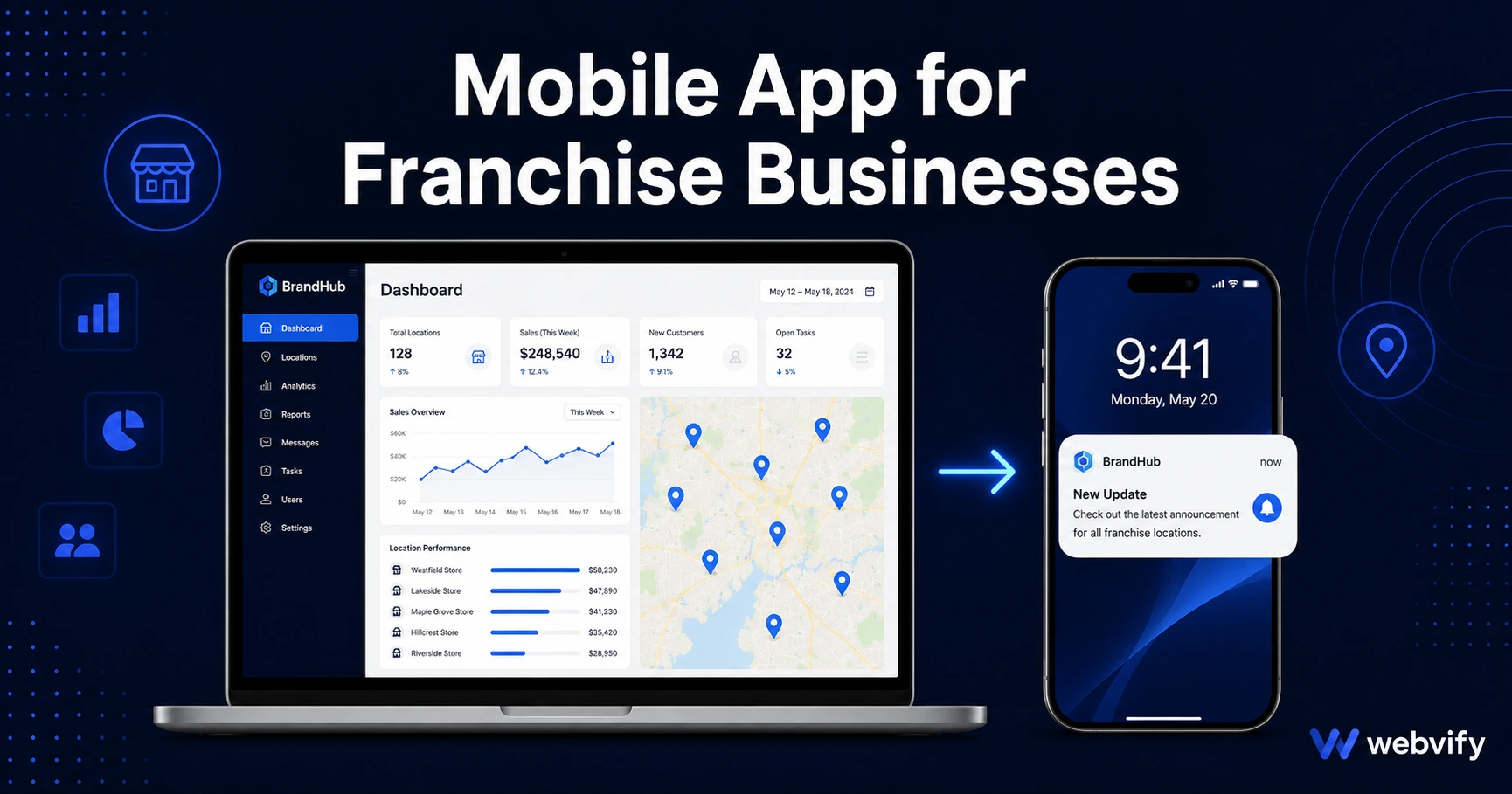
Franchise customers drift between locations and silently go elsewhere. A branded mobile app with push notifications changes that — here's how it works.
Inside this article
- Why Franchise Customers Leave Without Warning
- The Multi-Location Retention Gap
- What a Franchise Mobile App Actually Does
- Three Push Notification Campaigns That Drive Repeat Visits
- What to Look for in a Mobile App for Your Franchise
- How Long Does It Take to Launch?
- Frequently Asked Questions
- Ready to Get Your Franchise on Every Customer's Home Screen?
Why Franchise Customers Leave Without Warning
Your customer had a great experience at your downtown location last month. Two weeks later, they needed the same service near their office — and Googled the nearest option. It wasn't you.
Franchise businesses face a retention problem that single-location businesses don't: customers move between locations, neighborhoods, and daily routines. When nothing connects them to your brand specifically, they fall back on convenience and search results. A mobile app for franchise businesses changes that equation — and it doesn't require a developer or a six-figure budget.
The Multi-Location Retention Gap
Most franchise owners focus on consistency — same product, same training, same standards across every location. That consistency is the foundation. But it doesn't solve the visibility problem.
A customer who visits your location three times might have no idea where to find you when they're in a different neighborhood. Email newsletters get buried. Social media reaches maybe 5% of your followers on a good day.
Push notifications sent from your branded app reach the lock screen directly. The average push notification open rate is 60–90%, compared to 20–30% for email. That's the gap that drives repeat visits — and a mobile app for franchise businesses is what makes it available at scale.
What a Franchise Mobile App Actually Does
A branded app for your franchise isn't a loyalty card replacement or a website rebuild. It's a direct communication channel that lives on your customer's home screen.
Here's what it gives you in practice:
Home screen presence. Your brand logo sits next to Instagram, WhatsApp, and the apps customers open dozens of times a day. That visibility alone changes how often they think of you.
Push notifications. Send targeted messages — a new location opening nearby, a seasonal offer, a rebooking nudge, a flash deal on a slow Tuesday. Each notification delivers directly to the lock screen, without an algorithm deciding who sees it.
Unified brand recognition across locations. When a customer moves or travels, the app follows them. They're still your customer regardless of which location they visit next.
Booking and ordering via your existing website. Services like Webvify convert your existing website into the app — no content rebuild, no second system to maintain. The app loads your website in a native shell, which means any update you make to your website reflects in the app automatically.
Three Push Notification Campaigns That Drive Repeat Visits
The push notification strategy for franchise businesses differs from single-location businesses because you're working with customer mobility, not just time gaps.
New location opener. When you open a new location near where a customer has previously visited, notify them. This is the single highest-ROI push campaign for growing franchise brands — customers who already trust one location convert immediately when they hear there's one closer to them now.
30-day rebooking nudge. If a customer hasn't visited in 30 days (adjusted to your typical purchase cycle), a single push notification — "It's been a while. Your [Brand] is ready when you are" — recovers drifting customers before they find a competitor. Push notifications outperform email for time-sensitive re-engagement by a wide margin.
Seasonal or quarterly opener. New menu items, seasonal services, or limited-run offers are ideal push notification content. The key is sending it as a push — not as an email, where it sits at position 47 in an inbox.
What to Look for in a Mobile App for Your Franchise
Not every mobile app builder handles franchise use cases well. Here's what to evaluate before committing:
Single app, multi-location awareness. You want one branded app with the ability to push notifications by geography or customer history. Some tools require separate apps per location — avoid this.
App Store and Google Play submission handled for you. Navigating Apple's developer portal and Google Play Console is the step that trips up most franchise owners. Look for a service that handles the full end-to-end submission and publishes the app under your own developer accounts.
Your website as the source of truth. The simplest and most maintainable path is a WebView app — your app loads your existing website in a native shell. No duplicate content, no second CMS to update, no risk of your app going out of sync with your website. Seven more reasons this matters are covered in this overview of converting your website to a mobile app.
Push notification management. Look for a simple admin panel where you can create and schedule push campaigns without touching code. Everything — iOS and Android — should be manageable from one dashboard.
How Long Does It Take to Launch?
From signing up to a live app on both stores, the typical timeline with a web-to-app service is 7–14 days. Most of that is Apple's review queue, not the build itself. The app can be built from your existing website in hours using a WebView wrapper approach — compared to months and tens of thousands of dollars for a native custom build.
Frequently Asked Questions
Is a mobile app worth it for a small franchise with 2–5 locations?
Yes — the ROI threshold is lower than most franchise owners expect. A single location recovering 10 dormant customers per month via push notification campaigns is typically worth the cost of the app many times over. The app also adds brand credibility that matters when customers are choosing between you and a competitor of similar size.
Can one branded app cover all my franchise locations?
One app, published under your brand on the App Store and Google Play, can serve customers across all locations. You control which notifications go out and when — to all customers or targeted by geography. The customer sees your brand, not "Location A" vs "Location B."
How much does a mobile app for franchise businesses cost?
A WebView-based app from a managed service typically runs $500–$2,000 for the build and submission, with ongoing management fees of $50–$200 per month. That compares to $30,000–$150,000 for a custom native app with the same feature set. For most franchises with 2–10 locations, the web-to-app route covers everything they need.
Ready to Get Your Franchise on Every Customer's Home Screen?
If you have a website and want your franchise on the App Store and Google Play — without hiring a developer or rebuilding anything — Webvify handles the full process end-to-end: build, submission, and admin panel.