

How to Get a Mobile App for Your Food Truck (Without Hiring a Developer)
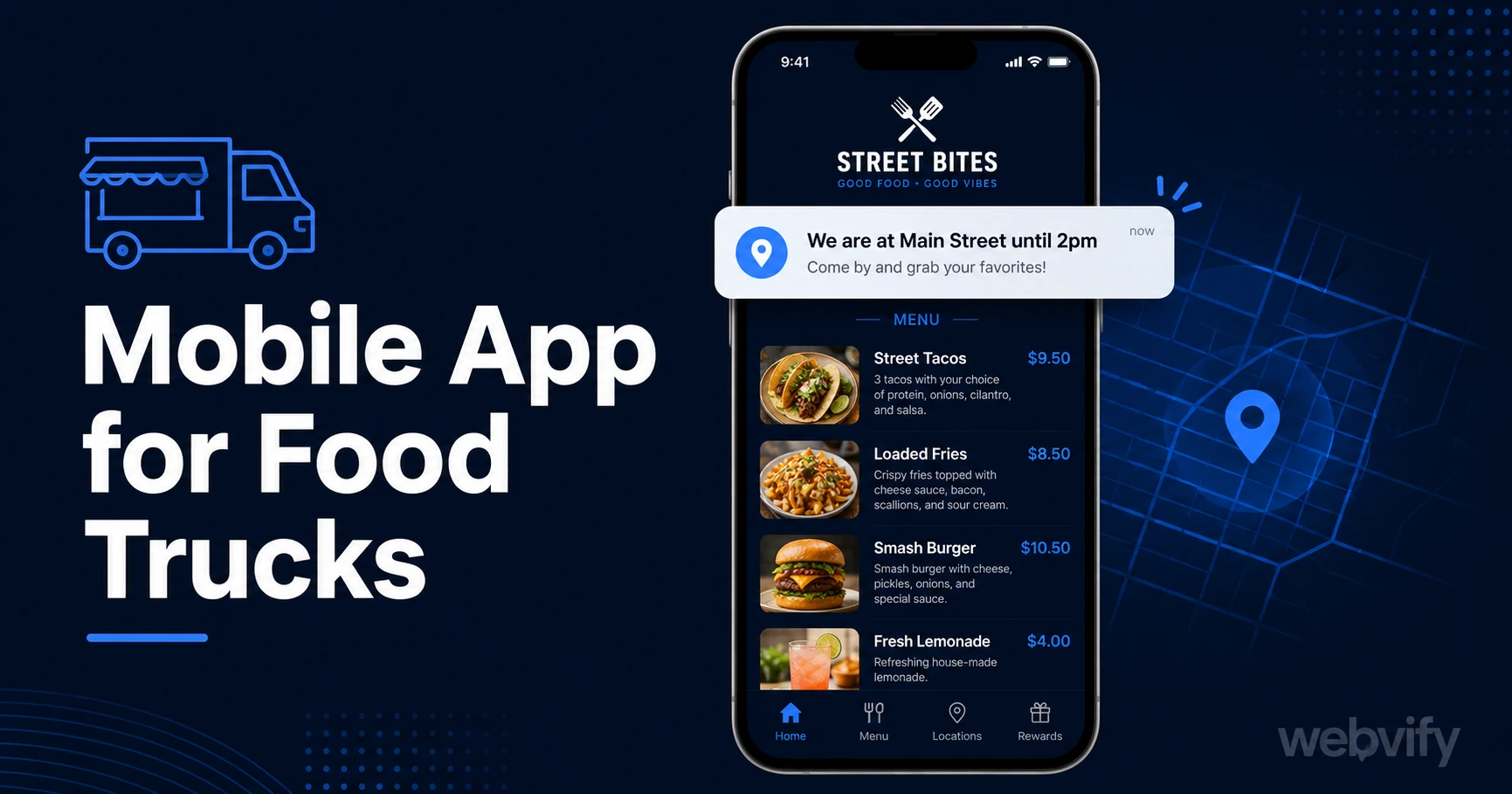
Learn how to get a mobile app for your food truck without a developer. Push notifications, location alerts, and pre-orders — here's how to do it in days.
Inside this article
Food truck customers love your food but can't always find your truck. They check Instagram, Google it, give up, and grab something else. A mobile app with push notifications solves that problem — and you don't need a developer to build one.
Why Food Trucks Need a Mobile App
The food truck model has a visibility problem that no other restaurant format shares. You move. Your customers don't know where you are unless they follow you on every platform, check multiple apps, or just get lucky.
Instagram helps, but the algorithm buries your posts. Google Maps updates, but not in real time. A text blast works once — then customers opt out. The only channel that reliably reaches your audience at the right moment is a push notification sent directly to their lock screen.
Food trucks that run a branded mobile app see one clear outcome: repeat customers. When someone can tap a notification that says "We're at Oak Street Farmers Market until 3pm today," they show up. That's the core value of a mobile app for food trucks — not features, but presence.
What a Food Truck App Actually Does
A food truck mobile app doesn't need to be complex. The three things that drive business results are:
Location push notifications. Send a quick message whenever you set up at a new spot. Customers who would have otherwise forgotten about you see your location the moment they're deciding where to eat.
Daily specials and pre-order alerts. Announce a new special or limited item with a notification. Customers who see it can plan ahead, pre-order online, or tell friends before you sell out.
Loyalty and return visits. When your app is on someone's home screen, you exist in their world. They see your icon every time they unlock their phone. That passive visibility compounds over weeks and months — it's the reason food trucks with apps report more regulars than those without.
A basic website doesn't do any of this. Browser push notifications are blocked on iOS. SMS lists feel spammy and get opt-outs. The app is the only channel with a 60–90% open rate and no algorithm between you and your customer.
How to Get a Mobile App for Your Food Truck Without a Developer
If you already have a website — even a simple one — you're closer than you think. A mobile app for your food truck doesn't require building anything new. It wraps your existing website into a native app that runs on iOS and Android, then gets submitted to the App Store and Google Play under your business name.
Here's the basic path:
- You provide your website URL. Your menu, ordering system, and about page are already there. The app mirrors your site inside a native shell.
- Push notifications get added. A notification layer sits on top of your website and lets you send messages directly to customers' phones.
- The app gets submitted to both stores. This is where most food truck owners get stuck — Apple and Google's review process has compliance requirements that feel overwhelming. Services like Webvify handle the full submission end-to-end, including the Apple Developer account setup and Google Play Data Safety form.
- You manage it yourself after launch. Once the app is live, you log into an admin panel to schedule notifications, update specials, and track installs — no developer needed.
The entire process takes days, not months. And because it wraps your existing website, your menu stays current automatically — update your site, and the app reflects it immediately.
If you're also running a loyalty program or online ordering, those work inside the app too. The app doesn't replace your current setup; it delivers it through a better channel.
Submitting Your Food Truck App to the App Store
One place food truck owners hit a wall is App Store submission. Apple reviews every app for compliance — and WebView apps (apps built by wrapping a website) have a specific checklist to pass.
The main requirement is Apple's Guideline 4.2 — your app needs to offer meaningful functionality beyond just a website link. For a food truck app, this is straightforward: push notifications, location updates, and a dedicated ordering or loyalty experience all count. A bare-bones wrapper with no interactivity will get rejected.
The other common issue is digital goods. If you sell anything like gift cards or prepaid meal packages through your site and process payment inside the app, Apple requires a 30% cut via their in-app purchase system. The workaround is directing those purchases to an external browser (the same method Uber Eats uses). For standard food orders and tips, this doesn't apply — you're selling physical goods, not digital content.
Google Play has fewer restrictions on WebView apps, but it requires an AAB file format (not APK), a completed Data Safety form, and a privacy policy link in your app listing.
For most food truck owners, the submission process is the only technical hurdle. If you'd rather not navigate it yourself, a done-for-you service handles all of it — you get a live app without touching Xcode or Android Studio.
You can also check out our guide on how to submit your app to the App Store without a developer if you want a step-by-step breakdown of what the review process looks like.
The Push Notification Playbook for Food Trucks
The real ROI of a food truck app comes from how you use push notifications. Here are three campaigns that consistently drive traffic:
Daily location alert. Send a push when you set up each morning or afternoon. Keep it short: "We're at Main & 5th until 2pm. Carnitas tacos today." Customers who are deciding on lunch get a direct answer to "where are you?"
Pre-sell before you arrive. Send a notification 30–60 minutes before you park: "Pre-order your lunch — we're heading to the Tech Campus at noon." Customers can order in advance, you reduce the midday queue, and you know your sell-through before you arrive.
Slow-day slot filler. On a Tuesday with light foot traffic, send a short push: "Slow day — first 20 orders get a free drink." Customers who might have skipped lunch out make the detour. This campaign costs you a few sodas and drives 20+ orders.
Push notifications average a 60–90% open rate. Email from a food truck averages around 20–28%. SMS works once before customers opt out. The math is clear.
For comparison, this is the same retention mechanic that coffee shops and other repeat-visit businesses use — the push notification is the one channel that reaches customers without the algorithm tax. If you want to see how this plays out in another repeat-visit business, our mobile app for coffee shops guide covers the same push sequence in detail.
FAQ
How much does a mobile app for a food truck cost?
A done-for-you food truck app — built by wrapping your existing website, submitted to both the App Store and Google Play — typically costs a few hundred to a couple thousand dollars depending on the service. This is far less than custom development, which runs $20,000–$100,000+. No-code platforms that wrap existing websites bring the cost down significantly while still giving you a fully branded, store-listed app.
Do I need a website to get a food truck mobile app?
Yes, if you're using a WebView wrapper (the fastest and most affordable approach). Your existing website becomes the app's content — your menu, ordering page, and contact info are all already there. If you don't have a website yet, you'll need one before wrapping it. Most food truck owners have at least a simple site or ordering page that works perfectly as the app foundation.
Can customers order food through my app?
Yes. If your website has an ordering system — Square, Toast, Slice, or any online ordering tool — it works inside the app automatically. The app wraps your site, so your full ordering flow is available. For iOS compliance, physical food orders don't trigger Apple's in-app purchase rules, so you won't owe Apple a percentage of your food sales.
A mobile app doesn't make your food truck successful — your food does that. But it removes the one thing that costs you repeat customers: the "where are you today?" friction. When your customers can open an app and find you in 10 seconds, they come back more often.
Get your food truck app live on the App Store and Google Play →