

Mobile App for Appliance Repair: Win More Repeat Calls and Stop Losing Customers to Silence
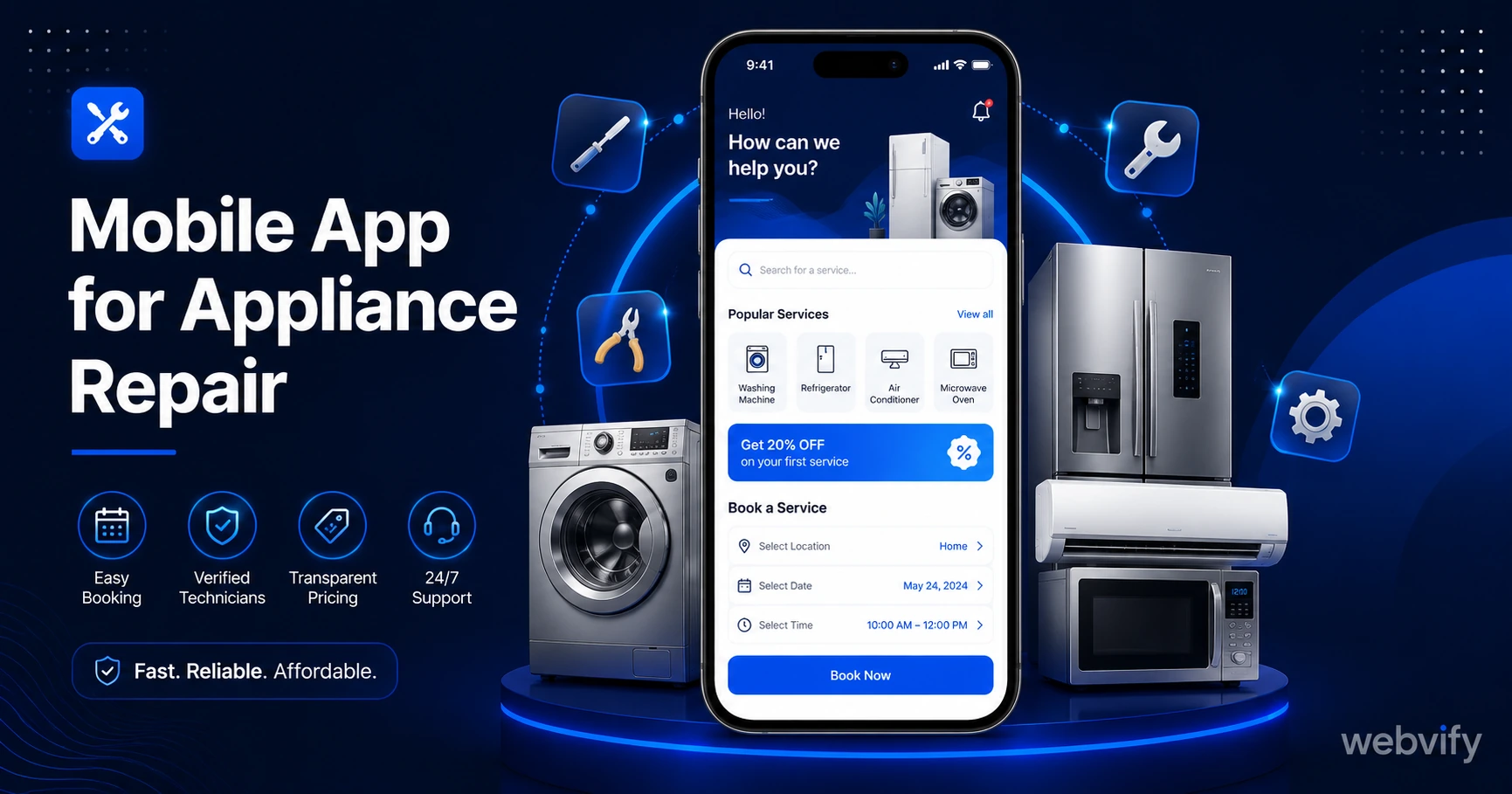
Appliance repair customers are happy after every job — then Google a competitor when the next breakdown hits. Here's how a mobile app keeps you visible between calls.
Inside this article
Your last repair job ended with a happy customer. When their washing machine fails again fourteen months later, they open Google and type "appliance repair near me." Your competitor's listing comes up first. That is not a word-of-mouth problem or a pricing problem. It is a visibility gap — and a mobile app for appliance repair is the most direct way to close it.
Why Appliance Repair Businesses Lose Repeat Customers
Appliance repair has one of the longest and most unpredictable repeat cycles in home services. A customer whose dryer you fixed this year might not need you again for 12 to 36 months — sometimes longer. There is no built-in reason for them to stay in contact with your business during that gap.
Most businesses rely on a fridge magnet, a website, and a Google My Business listing. None of these reach a customer proactively. They wait to be found. During a breakdown, a customer is in a hurry and reaches for Google first — not for the magnet they stopped noticing months ago.
The result: customers who genuinely liked your work call a competitor simply because they cannot find your number at the moment they need it. You did nothing wrong. You just went quiet.
Word of mouth and referrals help, but they depend on your customer remembering your business at the exact moment a friend asks. Owning a channel that puts your name in front of customers on your schedule — not theirs — is the only reliable solution.
What a Mobile App for Appliance Repair Actually Does
A mobile app for your appliance repair business does two things that no other channel does together: it places your business on the customer's home screen, and it lets you send push notifications directly to their lock screen.
Push notifications reach 60–90% of recipients, compared to 20–28% for service business email. That is not an incremental improvement. It is the difference between being seen and being filtered into a promotions tab that no one opens.
The home screen presence has independent value. When a customer sees your branded app icon next to their banking app and their calendar every day, you remain visible even during the long months of silence between jobs. When something breaks, they see your icon before they open a search engine.
For a trade where the customer only calls during a crisis, being present before the crisis is the entire competitive advantage.
The Push Notification Campaigns That Win Repeat Calls
The most effective push notification sequences for a mobile app for appliance repair follow a seasonal and lifecycle pattern that requires no guesswork.
Seasonal transition windows. Early spring (April–May) and early autumn (September–October) are when appliances face their first real stress after months of heavy or light use. An "appliance check" campaign sent during these windows — "Spring is here. Let's make sure your appliances are ready before summer demand peaks." — converts well because it lands at the moment when customers are already thinking about home maintenance.
Post-repair rebooking nudge. Sent 11–13 months after a service visit, this is a simple reminder that a year has passed and a check-up might prevent a bigger breakdown. For appliances like refrigerators and dryers where a second failure often follows the first, this timing is statistically precise.
Dormant reactivation. Any customer who has gone 18+ months without contact is at risk of permanent loss. A brief message — "It's been a while. Here's a loyalty discount for your next job." — reactivates a meaningful percentage of lapsed customers who simply drifted, not those who were dissatisfied.
None of these campaigns require a developer to manage. They run through the app admin panel the same way you would send a text message. The infrastructure is already built into the app.
If you also service HVAC equipment, the seasonal window framing works identically — the mobile app for HVAC guide covers the same spring and autumn trigger campaigns in detail.
App Store Credibility in a Trust-Sensitive Trade
Appliance repair technicians enter people's homes. Customers are handing a stranger access to their kitchen, laundry room, and utility areas. In that context, every trust signal counts.
A published app on the App Store and Google Play carries credibility that a website alone does not. It signals permanence, investment, and official review — three things that matter when a homeowner is deciding between two businesses they have never used.
When a customer compares two appliance repair companies — one with a website, one with an App Store listing — the app creates a perception of legitimacy that influences the decision, especially for first-time customers. This is the same dynamic that benefits any trade where technicians are trusted with home access, as covered in the mobile app for contractors guide.
Reviews, photos, and Google ratings matter too. But an app listing adds a layer of credibility those signals cannot replicate on their own.
How to Get a Mobile App Without Rebuilding Your Website
Building a native app from scratch costs $30,000–$150,000 and takes 4–12 months of developer time. For an appliance repair business, that investment is not practical.
A WebView wrapper converts your existing website into a fully branded mobile app — same booking flow, same service pages, same contact information — packaged for the App Store and Google Play. The app publishes under your business name on both stores, and you own it through your own developer accounts.
Services like Webvify handle the process end-to-end: they build the app, manage the App Store and Google Play submission, and hand over an admin panel so you can run push campaigns after launch. You do not need to touch Xcode or Android Studio. The app can be live within days.
The push notification system is included. The home screen presence is immediate. The App Store listing is permanent and indexed.
FAQ
How much does a mobile app for an appliance repair business cost?
Custom native app development costs $30,000–$150,000 and requires ongoing developer maintenance. A WebView-based app — which wraps your existing website — costs a fraction of that and can be live in days. Apple Developer enrollment adds $99/year and Google Play adds a one-time $25 registration fee.
Do I need my own Apple and Google developer accounts?
Yes, and your app should publish under your own accounts so your business owns the listing outright. If you ever switch services, the app stays with you. Most managed app services handle account setup and submission on your behalf so you do not need to navigate the Apple Developer portal yourself.
Will my appliance repair website pass App Store review?
Apple and Google approve WebView apps daily when they meet their guidelines — primarily that the app delivers a complete, functional experience rather than a thin single-page wrapper. A full appliance repair website with a booking system, service descriptions, and contact information typically meets these requirements. The main submission risk is Apple's Guideline 3.1.1 for in-app purchases, which applies only if you process digital payments inside the app — standard service booking flows are not affected.
Ready to put your appliance repair business on your customers' home screens? Get started at webvify.app