

Best Kajabi Alternatives in 2026 (For Creators Who Already Have a Website)
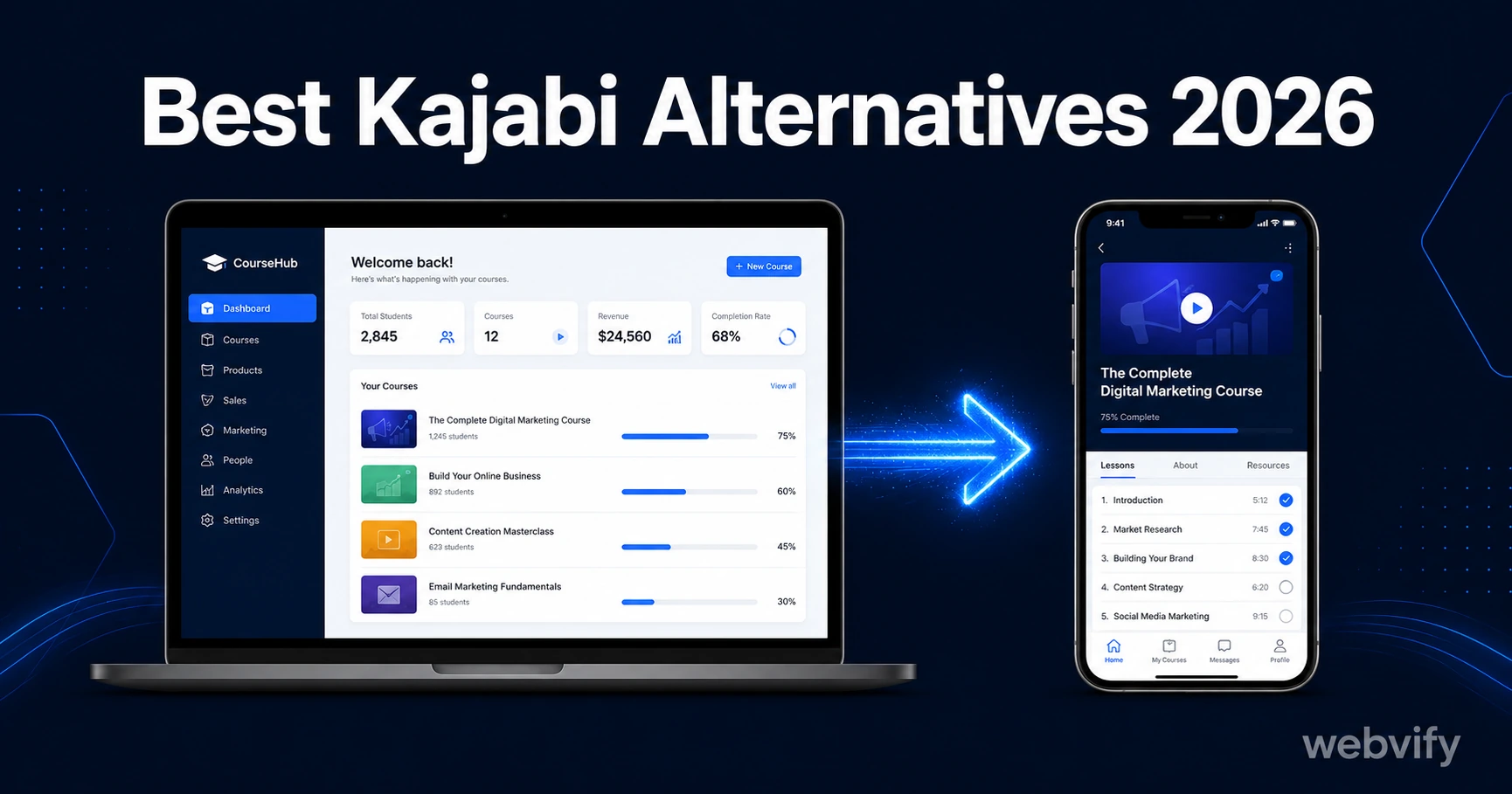
Looking for kajabi alternatives in 2026? Compare platforms by price, App Store support, and whether they rebuild or wrap your existing site.
Inside this article
Kajabi starts at $199 per month. When that subscription lapses, the app built inside it goes with it — your courses, your community, your mobile presence, all of it.
That's the core tension that sends course creators searching for kajabi alternatives 2026: not just finding something cheaper, but finding something where you actually own the output.
Why Kajabi Users Start Looking for Alternatives
Kajabi is an all-in-one platform for selling online courses, memberships, and digital products. That breadth is both its strength and its limitation.
The appeal is obvious: one subscription covers course hosting, email marketing, a website, and a checkout. But the trade-off is that you're building inside Kajabi's system. Your content lives in their proprietary editor. Your brand is wrapped in their infrastructure. And your mobile app, if you want one, means your students download the generic Kajabi app from the App Store — not an app with your name on it.
For creators who already have a website built on WordPress, Webflow, or another platform, Kajabi effectively asks you to maintain two systems: the website you already have and the Kajabi setup you're building from scratch.
The Two Categories of Kajabi Alternatives
This is the split that most comparison articles miss. Kajabi alternatives fall into two completely different categories, and picking the wrong one makes the switch feel worse than staying.
Category 1: Other all-in-one course platforms
Tools like Teachable, Thinkific, and Podia sit in this category. They're cheaper than Kajabi in most cases, and they offer similar functionality: course hosting, payment processing, email sequences. But they share Kajabi's core limitation — you're still building inside someone else's platform. Your content isn't on your website; it's in their system. The dual-maintenance problem doesn't go away.
Category 2: Tools that work with your existing website
This is where the decision becomes more interesting for creators who already have a site. Instead of migrating content into a new platform, these tools wrap what you already have and extend it. Your website becomes the course platform. You keep your existing SEO, your existing brand, and your existing audience.
For course creators running on WordPress with LearnDash or LifterLMS, or on Webflow with Memberstack, this category is usually the more practical path.
Kajabi Alternatives That Work With Your Existing Website
If you already have a website with course content on it, the smartest alternatives don't ask you to start over.
WordPress + LearnDash or LifterLMS
This combination gives you full ownership. Your courses live on your domain, your email list stays with your email provider of choice, and you're not dependent on any platform's continued operation. The trade-off is setup time — you're assembling tools rather than buying a pre-built system.
For creators who want a branded mobile app alongside this, a WebView wrapper approach works well here. Your existing WordPress course site becomes the content layer, and a native app wraps it for App Store and Google Play distribution. The key compliance point is Apple Guideline 3.1.1: any paid enrollment flows need to route through an external browser, not process inside the app, or you'll face App Store rejection. The LearnDash to mobile app guide covers this in detail.
Webflow + Memberstack or Outseta
Webflow gives you design control that most course platforms don't match, and pairing it with a membership layer delivers the gating and payment functionality. Again, this is a more involved setup than Kajabi, but it's one you own end-to-end.
Standalone LMS tools (Teachable, Thinkific)
These are the most direct kajabi alternatives for course creators who want lower entry costs without rebuilding their entire site. Teachable's pricing starts at $39/month on the basic plan. Thinkific has a free tier. Neither includes a branded mobile app with your own App Store listing — they use shared creator apps — but for creators who don't need App Store presence, the cost savings are significant.
The Mobile App Question: Where Kajabi Alternatives Fall Short
Here's a gap that most kajabi alternatives don't solve: a branded mobile app under your own name in the App Store and Google Play.
Kajabi's own app is called "Kajabi" — your students download Kajabi's app, not yours. Most alternatives in the platform category (Teachable, Thinkific, Podia) follow the same pattern. They offer access through a shared app rather than giving you your own App Store listing.
For creators who want a mobile app with their own branding and their own App Store listing, the path is different. Services like Webvify convert your existing website or course platform into a fully branded app and handle the end-to-end submission to Apple and Google — including the App Store review, which typically takes 24–48 hours. You don't need a mobile developer, and the app stays live under your developer accounts, not theirs.
The enrollment flow caveat applies here regardless of which platform you're on: any digital subscriptions or course purchases processed inside an iOS app require Apple's In-App Purchase system, which takes a 30% cut. The standard workaround — used by Udemy, Coursera, and most major e-learning platforms — is to disable in-app purchasing and direct new students to your website's checkout. This keeps the app compliant and keeps your margins intact. The e-learning mobile app guide covers this pattern across all major platforms.
What to Check Before You Switch Platforms
Before committing to any Kajabi alternative, three questions narrow the field:
Does your content need to migrate? If you're switching to another all-in-one platform (Teachable, Thinkific), plan for content migration time. Your videos, quizzes, and drip sequences don't move automatically. If you're wrapping your existing website instead, migration is minimal — you're adding a layer, not starting over.
Who owns your students' data? In Kajabi and most all-in-one platforms, student email lists and purchase history live inside the platform. If you cancel, exporting that data cleanly requires advance planning. WordPress-based setups typically give you full database access from the start.
Do you need App Store presence? If branded mobile app distribution matters for your audience — especially for mobile-heavy niches like fitness, cooking, or language learning — factor that in as a separate capability, because most platforms don't include it.
FAQ: Kajabi Alternatives 2026
What is the cheapest Kajabi alternative for course creators?
Thinkific's free plan allows up to one published course with no transaction fees, making it the lowest-cost entry point among major kajabi alternatives. Teachable's starter plan at $39/month is another common starting point. Both use a shared mobile app rather than giving you a branded App Store listing.
Can I get a branded mobile app with a Kajabi alternative?
Most all-in-one course platforms, including Teachable and Thinkific, offer access through a shared creator app rather than your own App Store listing. To get a branded mobile app with your name in the App Store, the practical path is to use a web-to-app service that wraps your existing course site and handles App Store submission on your behalf.
Do I need to rebuild my content when switching from Kajabi?
If you switch to another all-in-one platform like Teachable or Thinkific, you'll need to manually recreate your course content inside their system. If you move to a WordPress-based setup or another approach that works with your existing website, the migration is significantly lighter — you're adding tools to your existing content rather than duplicating it.
Ready to get a branded mobile app for your course platform without rebuilding from scratch? Webvify converts your existing website into a native app and handles the entire App Store submission process end-to-end.