

The Hidden Cost of Relying Solely on Mobile Browsers
Relying only on a mobile website quietly costs conversions, retention, and trust. Here’s why home screen presence matters in 2026.
Inside this article
- The Hidden Cost of Relying Solely on Mobile Browsers
- The Friction of Mobile Browsers
- The Power of One-Tap Access
- The Home Screen Icon: Your Digital Billboard
- The Credibility Gap of Not Being in the App Store
- Browser vs App: The Experience Gap
- Why Businesses Are Converting Websites into Apps
- Turn Your Website Into a Mobile App with Webvify
The Hidden Cost of Relying Solely on Mobile Browsers
In 2026, nearly every business has a mobile-friendly website. Responsive design solved the layout problem years ago.
But a responsive website does not solve the retention problem.
Many brands assume that if their site works well on mobile, they are already delivering a strong mobile experience. In reality, relying solely on the mobile browser introduces constant friction that quietly reduces conversions, engagement, and repeat purchases.
The difference between "visiting a website" and "having a permanent place on the customer's home screen" is far bigger than most businesses realize.
The Friction of Mobile Browsers
Mobile browsers were never designed to create lasting relationships between brands and users. They were designed for discovery and navigation.
Every time a customer wants to return to your website, they must go through several steps:
- Open the browser
- Search for your brand or remember the URL
- Navigate through tabs or bookmarks
- Wait for the page to load
- Possibly log in again
Each step introduces friction.
And friction kills conversions.
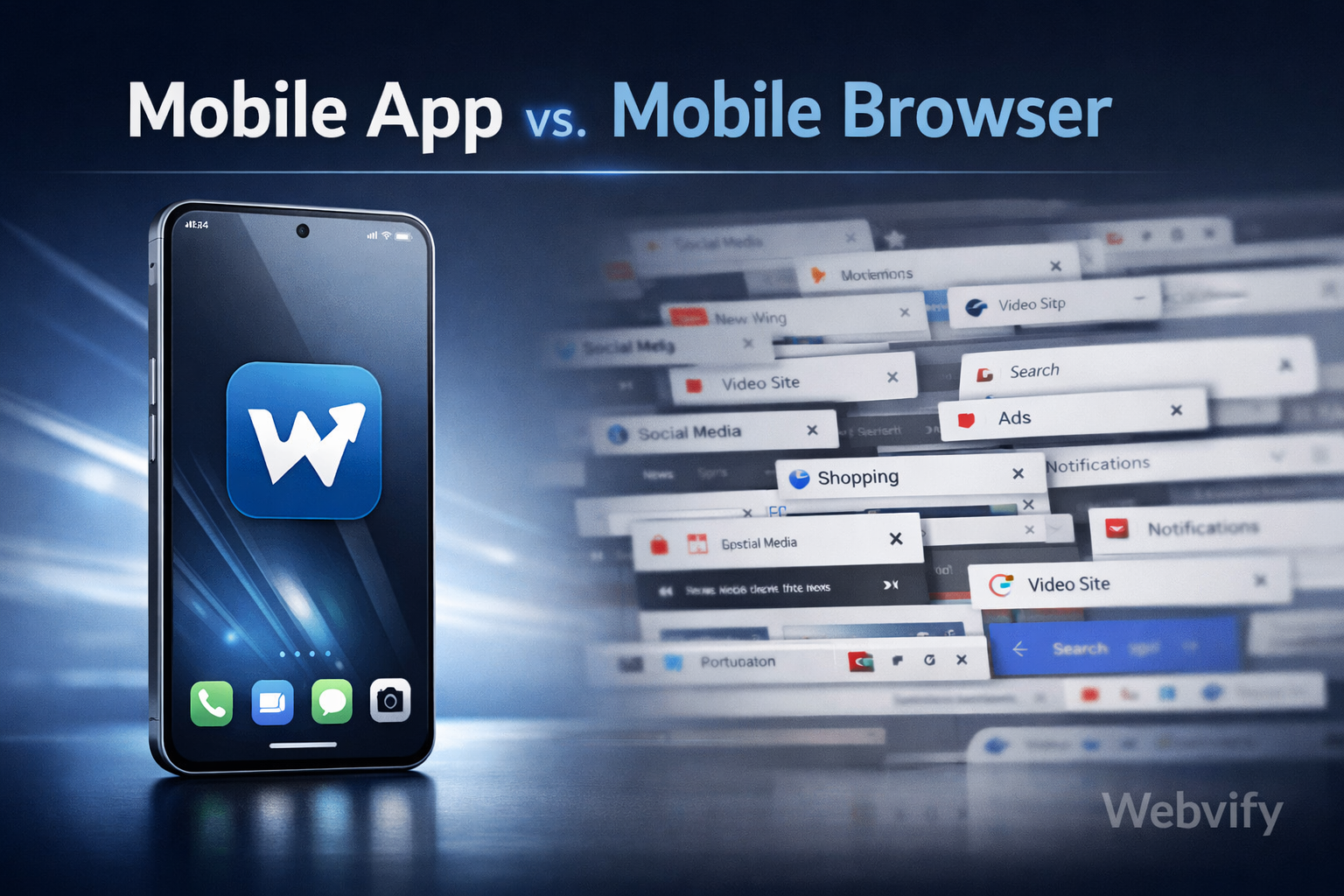
At the same time, the browser environment is full of distractions:
- Dozens of open tabs
- Notifications from other apps
- Competing search results
- Ads from competitors
Your brand becomes one temporary destination among many, instead of a permanent part of the user's digital life.
The Power of One-Tap Access
A mobile app removes these barriers entirely.
Instead of navigating through a browser, customers simply tap your app icon.
One tap.
That small difference changes the entire relationship between the user and your brand.
With a mobile app, users get:
- Instant access without searching
- Faster load times
- Persistent login sessions
- A focused environment without browser distractions
This frictionless experience dramatically improves:
- repeat visits
- session duration
- purchase frequency
- customer loyalty
The Home Screen Icon: Your Digital Billboard
The most underrated marketing channel in mobile is the home screen icon.
When your app lives on a customer's home screen, your brand becomes a constant visual reminder.
Every time they unlock their phone, they see your brand.
Think of it as a permanent digital billboard inside their pocket.
Unlike ads, email campaigns, or social media posts, this visibility doesn't disappear after a few seconds.
It is always there.
Over time, that presence builds familiarity, trust, and habit.
Habit is what drives retention.
And retention is what drives long-term revenue.
The Credibility Gap of Not Being in the App Store
In today's mobile-first world, customers subconsciously associate strong brands with having an app.
When users search for your brand in the App Store or Google Play and find nothing, it creates a subtle credibility gap.
Questions start to form:
- Is this business established enough?
- Do they take mobile seriously?
- Are other brands offering a better experience?
Being present in the app stores signals:
- legitimacy
- professionalism
- long-term commitment to customers
It acts as a trust badge for your brand.
Browser vs App: The Experience Gap
| Experience Factor | Mobile Browser | Mobile App |
|---|---|---|
| Access Speed | Multiple steps | One tap |
| Login Experience | Frequent re-login | Persistent sessions |
| User Distractions | High (tabs, search results, ads) | Minimal |
| Brand Visibility | Temporary visit | Constant home screen presence |
| Customer Retention | Weak | Strong |
| Trust Signal | Standard website | App Store credibility |
The difference isn't just technical.
It's psychological.
An app transforms your brand from a place users visit into a tool they keep.
Why Businesses Are Converting Websites into Apps
Forward-thinking brands are realizing that the mobile web alone is not enough to compete in 2026.
They want:
- stronger customer retention
- direct communication through push notifications
- higher repeat purchase rates
- deeper brand loyalty
The challenge used to be the complexity and cost of building an app.
Today, that barrier is gone.
Turn Your Website Into a Mobile App with Webvify
Webvify makes it possible to convert your existing website into a fully functional mobile app quickly and efficiently.
Instead of rebuilding everything from scratch, Webvify transforms your current web experience into a native mobile app that customers can install directly on their home screens.
That means you can:
- gain permanent home screen visibility
- remove browser friction
- improve retention and repeat purchases
- strengthen brand credibility
—all without the traditional complexity of mobile development.
If your business relies on a mobile website today, the next growth step is simple.
👉 Learn more about turning your website into a mobile app:
https://webvify.app