

Why Dealer Portals Work Better as Mobile Apps for Manufacturers in 2026
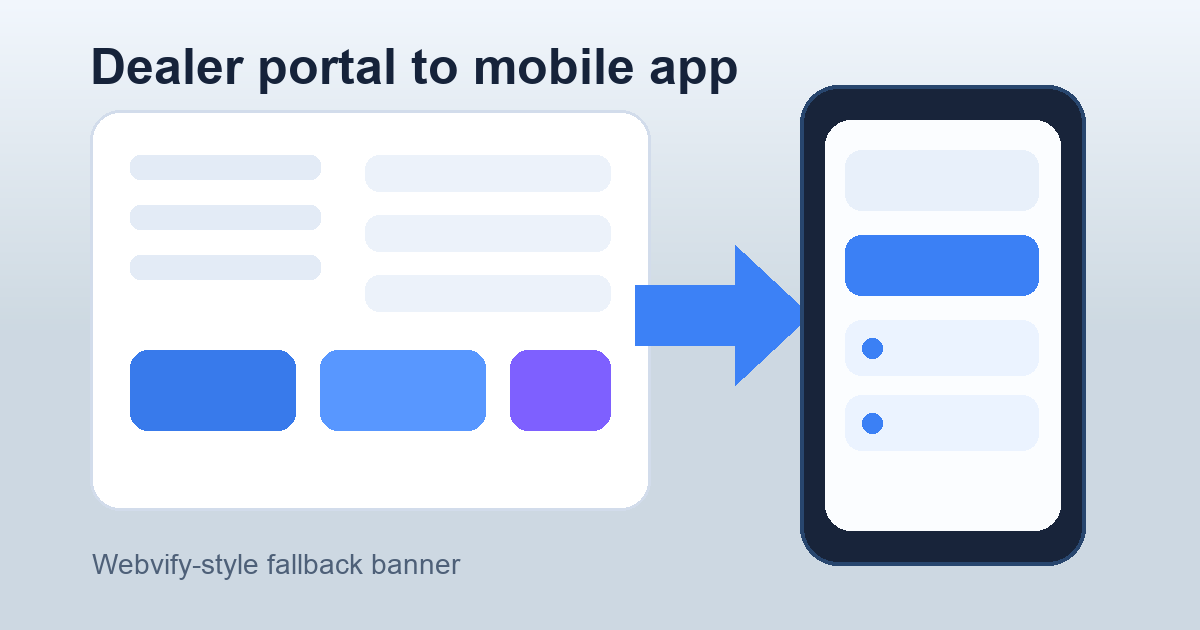
See why manufacturers and distributors are turning dealer portals into mobile apps to increase reorders, improve partner engagement, and reduce manual sales friction.
Inside this article
- The short answer
- Why traditional dealer portals create friction
- What changes when the dealer portal becomes a mobile app
- Mobile app vs browser-based dealer portal
- Where manufacturers see the biggest gains
- Which companies benefit most
- Do you need to build everything from scratch?
- What to improve before launch
- Questions decision-makers often ask
- The practical takeaway
- CTA
The short answer
Dealer portals work better as mobile apps when your partners need fast access, repeat actions, and reliable communication without depending on email threads or desktop logins.
For manufacturers and distributors, the portal is not just an information page.
It is often where real business happens.
That includes:
- placing repeat orders
- checking stock
- viewing prices
- downloading documents
- tracking deliveries
- submitting support requests
- reviewing campaigns or incentives
When those actions are easier on mobile, partner activity usually becomes more frequent and more consistent.
Why traditional dealer portals create friction
A lot of dealer portals were built around desktop logic.
That made sense years ago.
But in 2026, many sales and operations decisions happen away from the desk.
Dealers, resellers, branch managers, and field teams often need answers while they are:
- in a store
- visiting a customer
- checking warehouse stock
- traveling between locations
- reviewing urgent requests
If the portal is hard to use on mobile, action slows down.
And once action slows down, communication moves somewhere else.
Usually to:
- phone calls
- scattered emails
- manual back-and-forth with sales reps
That increases operational load and weakens the buying experience.
What changes when the dealer portal becomes a mobile app
A mobile app does not need to replace your existing portal infrastructure.
In many cases, it simply gives your partners a faster, more practical way to use the system you already have.
Access becomes immediate
Instead of opening a browser, searching for the portal, signing in again, and navigating multiple screens, the dealer opens the app from the home screen and gets to work.
That matters because partner usage is often driven by speed, not curiosity.
The easier the first step, the more likely the next action happens.
Reorders become more natural
For many manufacturers, repeat ordering is one of the most valuable behaviors inside the portal.
A mobile app can make it easier to:
- reorder from previous purchases
- view account-specific pricing
- check product availability
- repeat saved baskets
- contact the right rep when needed
That reduces hesitation and helps dealers act sooner.
Push notifications create timely engagement
This is where a mobile app can do something a normal browser portal cannot do as well.
Useful examples include:
- stock back in place
- order shipped
- new campaign available
- account reminder
- quote response ready
- payment or document notice
These are not generic marketing messages.
They are operational signals that help partners move faster.
Your brand stays present
Dealer relationships depend on reliability.
An app on the home screen keeps your company visible in a way a browser portal usually cannot.
That stronger presence can improve:
- recall
- portal usage frequency
- response speed
- partner confidence in your systems
Mobile app vs browser-based dealer portal
| Area | Browser Portal | Mobile App |
|---|---|---|
| Access | Link and login dependent | One tap from home screen |
| Repeat orders | Easier to delay | Easier to complete |
| Notifications | Mostly email-based | Direct push alerts |
| Daily visibility | Low | Strong |
| Partner engagement | Passive | More active |
| Sales support load | Higher | Can be reduced |
Where manufacturers see the biggest gains
The biggest gains usually show up in repeated workflows.
1. Reorder frequency
If dealers can reorder faster, they are less likely to delay routine purchases.
2. Partner responsiveness
When updates, stock changes, and account actions reach partners directly, response time improves.
3. Lower manual coordination
A stronger app flow can reduce the need for sales teams to chase simple operational steps manually.
4. Better channel retention
When your portal becomes easier to use, your partner relationship becomes harder to replace.
Which companies benefit most
This model is especially useful for:
- manufacturers with dealer networks
- regional distributors
- wholesalers with repeat-order accounts
- brands with franchise or reseller systems
- companies with B2B partner dashboards
If your partners already log in regularly, there is a strong case for giving them a better mobile layer.
Do you need to build everything from scratch?
Usually, no.
If your dealer portal already exists, the opportunity is often not a full rebuild.
It is improving how partners access and use it on mobile.
That is why many teams choose a web-to-app path.
It helps them move faster while keeping the core portal logic, account structure, and internal workflows in place.
What to improve before launch
1. Focus on repeat actions first
The most important mobile screens are not everything.
They are the few things partners do again and again.
2. Make pricing and ordering easy to reach
If the main commercial actions are buried, adoption drops.
3. Keep navigation simple
Partners should reach stock, orders, pricing, and support quickly.
4. Use notifications carefully
In B2B, useful beats frequent.
Good alerts feel like support, not noise.
Questions decision-makers often ask
Will dealers actually use the app?
If they already use the portal for real business tasks, many of them will use an app that makes those tasks faster.
Is this only for large enterprises?
No.
Mid-sized manufacturers and distributors often benefit quickly because even small improvements in repeat ordering can matter.
Does an app replace the relationship with the sales rep?
No.
It supports the relationship by reducing friction around routine actions.
The practical takeaway
If your manufacturer or distributor business already runs through a dealer portal, a mobile app may be the fastest way to make that system more useful, more visible, and more valuable.
The goal is not to impress partners with complexity.
The goal is to help them order faster, respond faster, and stay engaged more often.
That usually improves both partner experience and revenue flow.
CTA
If you already have a dealer portal and want to turn it into a practical mobile app, Webvify can help you launch faster with a web-to-app approach built for real business workflows: https://webvify.app