

Best Mobile App Reseller Programs in 2026: A Comparison for Agencies
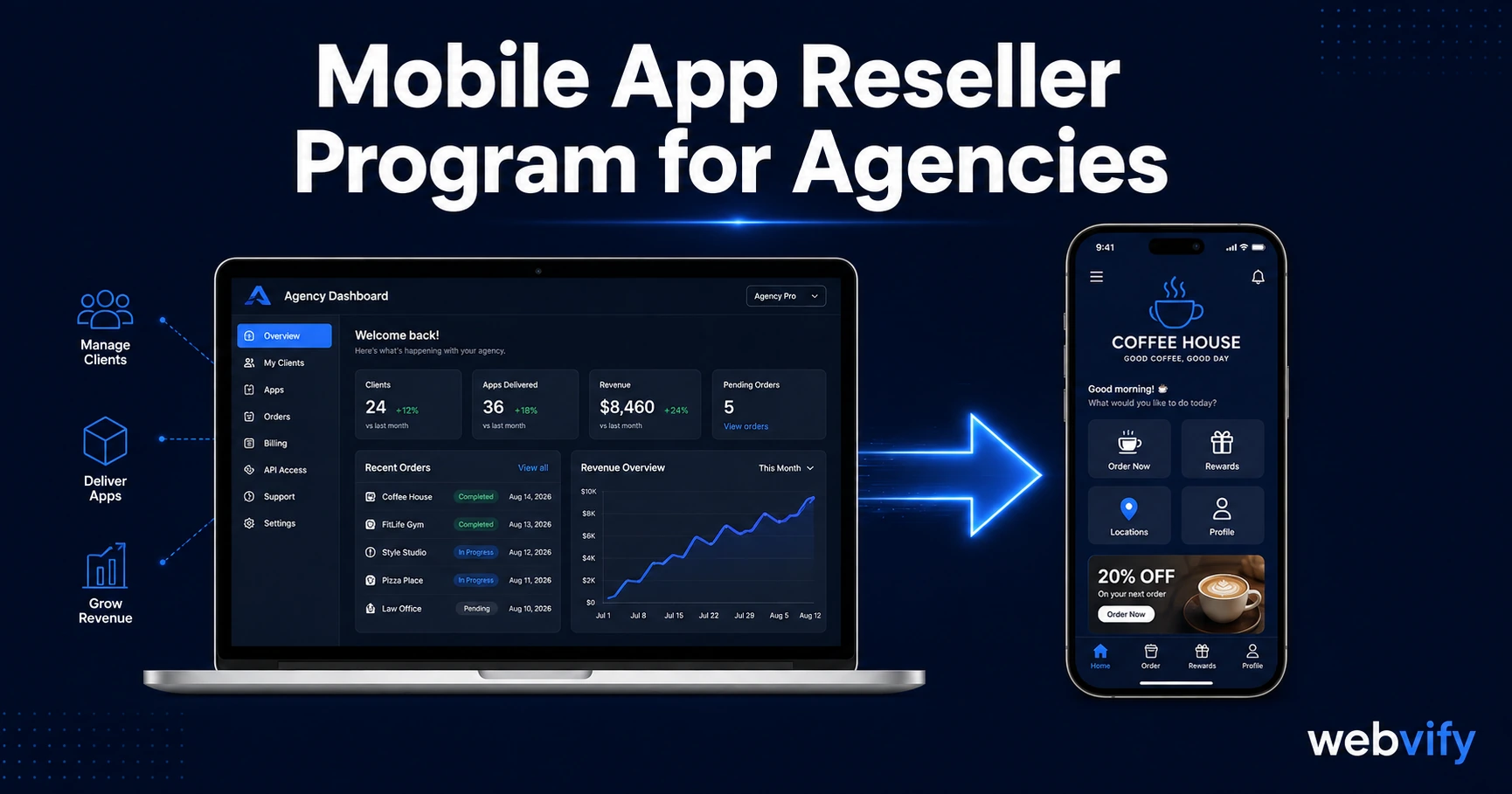
Not all mobile app reseller programs work for agencies. Here's what separates the ones worth offering — and which handle App Store submission so you don't have to.
Inside this article
Best Mobile App Reseller Programs in 2026: A Comparison for Agencies
A web agency charging $3,000 for a website and $0 for the mobile app is leaving the most profitable upsell in its category on the table. Mobile app reseller programs exist to close that gap — but not all of them are built for agencies.
Here's what separates the programs worth offering from the ones worth skipping.
What a Mobile App Reseller Program Actually Gives You
A mobile app reseller program lets your agency offer branded mobile apps to clients without building a mobile development capability. The platform builds, submits, and maintains the app. You sell it, brand it, and keep the margin.
The key variables that separate programs:
- What goes in the package: Some programs deliver a finished app file for your client to submit themselves. Others handle full App Store and Google Play submission, developer account setup, and post-launch management.
- White-label depth: Can you remove the platform's branding entirely? Is the app submitted under your client's developer account or the platform's?
- Ongoing economics: Is pricing per-app or subscription-based? Does the agency earn a fixed margin or work on a wholesale model?
- Technical baseline: Does the app wrap the client's existing website, or does the client need to rebuild content inside a new platform?
The distinction between "build tool" and "managed service" is the one that affects your workload most. If the platform provides a file and leaves the rest to you, you have added mobile complexity to your plate — without the recurring revenue to justify it.
What to Look for in a Mobile App Reseller Program
Before comparing specific programs, these are the criteria that matter for agencies:
1. App Store submission ownership. The agency model breaks if you are responsible for navigating Apple's developer portal for every client. Managed submission services handle this. Self-service tools do not.
2. White-label options. Clients paying $2,000–$3,000 for a mobile app expect it to appear under their brand, not yours or the platform's. Confirm the app can be submitted under the client's own Apple and Google Play developer accounts.
3. Existing website compatibility. If the client has a WordPress site, Shopify store, or any existing web presence, the program should wrap that directly — not require rebuilding content in a new editor. Duplicate content maintenance ruins client relationships.
4. Margin structure. Understand whether you are paying wholesale and charging retail, earning a percentage, or accessing volume pricing. The per-app wholesale model gives agencies the most control over pricing.
5. Post-launch support. App submissions need occasional maintenance: iOS SDK updates, App Store Connect changes, annual developer account renewals. Know who handles these before a client calls six months after launch.
Programs Worth Evaluating in 2026
Webvify
Webvify is an end-to-end managed service: your agency provides the website URL, and Webvify builds the WebView wrapper, handles App Store and Google Play submission under the client's own developer accounts, and delivers a live app in both stores.
For agencies, the reseller model means you buy at wholesale pricing, set your own client rate, and white-label the output. Webvify handles the technical complexity — no mobile development skills required on your team.
What works for agencies: the client relationship stays clean. The app appears under the client's name in the App Store. You are not the technical operator — you are the service provider who made it happen.
Services like Webvify handle everything agencies cannot absorb in-house: developer account setup, binary compilation, screenshot production, and submission compliance. For a detailed breakdown of the agency revenue model, this ROI guide covers the exact numbers.
MobiLoud
MobiLoud offers a white-label reseller path for agencies, primarily targeting WordPress and content sites. The platform produces apps with React Native components layered over a WebView core.
The tradeoff: pricing starts higher than comparable services, and App Store submission handling is tiered separately. For high-volume agencies moving multiple apps per month, the economics can work. For agencies with occasional mobile app requests, the overhead may not.
GoNative (Median)
GoNative (now Median) provides a platform for converting websites to mobile apps with developer-level control. The reseller program skews technical: agencies using GoNative typically manage the submission process themselves, including developer accounts and binary handling.
For agencies with internal mobile dev resources, GoNative provides flexibility and control. For agencies without that capability, the self-service requirement adds friction that does not belong in a client-facing offering.
AppInstitute
AppInstitute offers a white-label reseller program specifically designed for agencies. Apps are built inside their own content editor, which means clients' existing websites are not automatically converted — content needs to be re-entered into the platform.
The implication for client work: the agency creates and maintains a second content system alongside the website. That ongoing overhead is worth factoring in when positioning this to clients.
What the Right Program Looks Like for Your Agency
The right reseller program depends on what your agency wants to own.
If you want to deliver mobile apps as a service without building mobile expertise, a fully managed program where submission, maintenance, and compliance are handled externally is the right fit. Your role stays at client relationship and margin.
If your agency has technical capacity and wants more control over the output, a developer-oriented platform gives flexibility but requires owning the submission process.
For most web agencies adding mobile apps as an upsell — not as a new core practice — the managed service model is the one that scales without adding headcount. Here's how agencies have structured the full reseller offering.
FAQ
How much can an agency charge for a mobile app reseller service?
Pricing for agency-delivered mobile apps typically ranges from $1,500 to $5,000 for initial delivery, with optional monthly retainers of $99–$299 for updates and maintenance. The actual margin depends on your wholesale rate. Agencies using managed services at the lower end of wholesale pricing commonly run 50–70% margins on delivery.
Does the client need their own Apple Developer account?
For any app submitted under the client's name in the App Store, yes — a client-owned Apple Developer account ($99/year) is required. Some platforms submit under a shared account, but the app appears with the platform's name, not the client's. For professional client work, client-owned accounts are the standard. Managed services like Webvify handle the account setup process as part of the service.
What happens if the app gets rejected during App Store review?
With a self-service platform, you handle the rejection response yourself — which requires understanding Apple's review guidelines and modifying the submission. With a fully managed service, the provider handles rejections as part of the engagement. For agencies without mobile development experience, this is one of the most practical reasons to choose a managed program over a build-it-yourself tool.
Ready to add mobile apps to your agency's service lineup? Webvify's agency reseller program covers build, submission, and maintenance — so you focus on the client relationship, not the App Store.