

The Abandoned Tab Syndrome: Why Mobile Web Visitors Don’t Come Back (And How an App Fixes It)
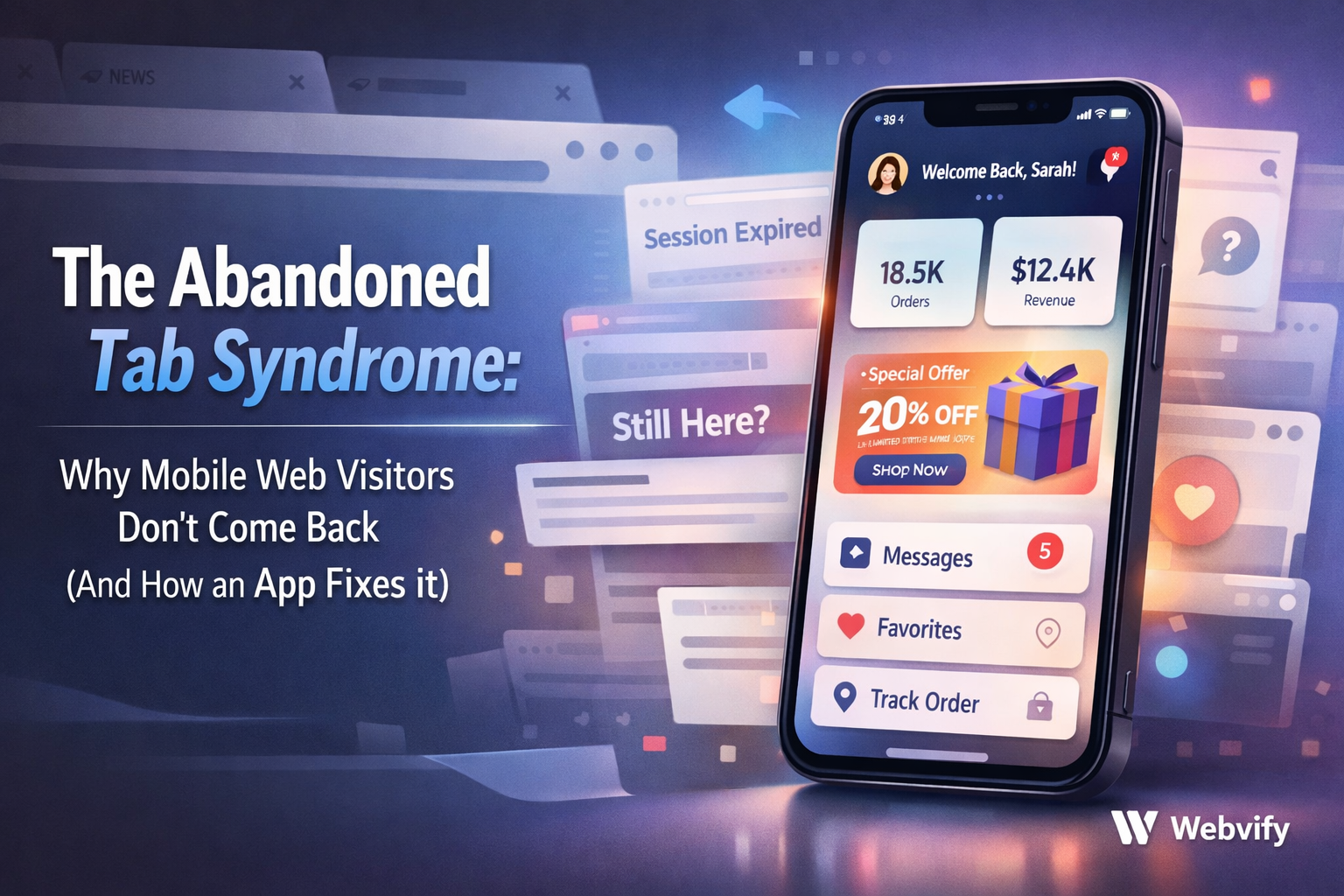
Mobile web users get distracted fast. Learn why visitors disappear after one session and how a branded app brings them back with one tap.
Inside this article
- The problem: your customers didn’t reject you — they just forgot you
- Why mobile web visitors don’t return (even when they liked your brand)
- The psychology difference: a browser tab vs. a home screen icon
- What a branded app changes (without rebuilding your whole business)
- Mobile Web vs. Branded App: what improves in real life
- A practical framework: the 5 retention triggers you can activate
- Quick checklist: do you have an Abandoned Tab problem?
- FAQ
- Final thought
The problem: your customers didn’t reject you — they just forgot you
If you run an e-commerce store, a local service business, or a membership site, you’ve seen this pattern:
- You pay for traffic.
- People visit on mobile.
- They browse.
- Then… they disappear.
It’s tempting to blame the offer, the pricing, or the product.
But often the real enemy is simpler:
Mobile browsers are not built for coming back.
People don’t “leave” your brand. They just get pulled into another tab, another app, another notification.
That’s what I call the Abandoned Tab Syndrome.
Why mobile web visitors don’t return (even when they liked your brand)
On mobile, attention is fragile. A typical visitor is juggling:
- 10+ open tabs
- chats and notifications
- social feeds
- real-life interruptions
A browser session is a temporary state. When it ends, your brand goes back to being… a URL.
The hidden cost of “I’ll come back later”
“I’ll come back later” almost never becomes a second visit.
Not because the customer is lying.
Because the browser gives them no reason to remember.
The psychology difference: a browser tab vs. a home screen icon
A browser tab is disposable.
A home screen icon is a daily visual cue.
That cue matters more than most teams realize.
When your brand becomes an icon:
- You turn “search and re-find” into one tap
- You create passive brand recall (they see you even when they don’t shop)
- You’re no longer competing inside a noisy browser session
This is the same reason customers “default” to Amazon, Uber, or their favorite food apps.
It’s not magic.
It’s placement + low friction.
What a branded app changes (without rebuilding your whole business)
A branded app does not have to mean a complex, expensive rebuild.
If your website already works, your goal is simple:
Keep what works — but package it in an experience that makes return visits effortless.
That’s where a webview-based app is powerful.
Mobile Web vs. Branded App: what improves in real life
| What matters | Mobile Web | Branded App |
|---|---|---|
| Return visits | Low (out of sight) | High (home screen presence) |
| Speed to re-open | URL + re-load | One tap |
| Trust & legitimacy | “just a site” feeling | App Store credibility |
| Re-engagement | Limited | Push notifications (optional) |
| Habit building | Hard | Easier (icon + reminders) |
A practical framework: the 5 retention triggers you can activate
You don’t need 20 features. You need a few triggers that bring people back.
1) Home screen presence
Your brand becomes a shortcut, not a memory test.
2) Faster “second session”
The second visit is where conversion often happens.
3) Light re-engagement (push notifications)
Not spam. Just useful reminders:
- abandoned checkout follow-up
- back-in-stock
- limited-time drops
- loyalty / reward progress
4) A cleaner, focused experience
Apps feel more “intent-based” than browsers.
5) Better repeat behavior
Repeat behavior comes from “easy access”, not bigger discounts.
Quick checklist: do you have an Abandoned Tab problem?
If you say “yes” to 3+ items below, you’re losing money to tab fatigue:
- Most traffic is mobile
- Bounce rate is high on mobile
- Returning visitors are low
- Cart abandon rate is high
- You rely heavily on paid ads
- You don’t have a reliable re-engagement channel
FAQ
Do I need to rebuild my website to have an app?
No. Many brands convert an existing site into a branded app experience (webview-based), then iterate from there.
Will users actually install my app?
Yes—if there’s a clear benefit (faster access, easier checkout, loyalty, order tracking, member content, exclusive drops).
Are push notifications required?
No. Even without push, the home screen icon is already a major advantage.
How fast can a brand launch?
If you already have a working mobile site, you can often launch quickly.
Final thought
If your mobile website is your only “home”, you’re building growth on top of a place people don’t revisit.
If you want to turn one-time mobile visits into repeat customers, a branded app is one of the simplest leverage points.
If you want to ship a branded mobile app from your existing website (fast), explore Webvify.